
By Bernard Hickey
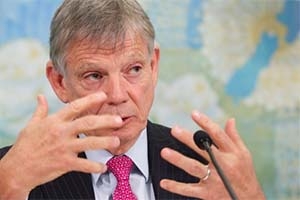
Reserve Bank Governor Graeme Wheeler has confronted critics who argue he should cut the Official Cash Rate more aggressively to ensure headline inflation rises back into the bank’s 1-3% target range.
Wheeler used his first speech of the year to criticize those calling for immediate OCR cuts, saying he planned to use the flexibility built into his Policy Targets Agreement (PTA) with Finance Minister Bill English and would not “mechanistically” make cuts to increase the inflation rate. He used half of his annual speech to the Canterbury Chamber of Commerce to defend his actions within the PTA.
He said he was surprised by the wide range of interpretations of his current 2012 agreement and pointed to some commentators who advocated immediate interest rate cuts.
“A mechanistic approach can lead to an inappropriate fixation on headline inflation,” Wheeler said.
“It would cut across the flexibility deliberately built into the PTA framework, and risk creating serious distortions in the financial system, housing market, and broader economy,” he said.
Annual CPI inflation was 0.1% in the December quarter and it has been below the 1% bottom of the range for more than a year. It has been below the 2% mid-point of the target for four years. ASB, Westpac, HSBC and First NZ have all called on the Reserve Bank to cut the OCR by as much as a further 50 basis points to 2.0% this year.
Wheeler’s speech underlined the sections of the PTA that referred to the target being for 1-3% “on average over the medium term” and with a focus on keeping “future average inflation near the 2% target mid point.” He also underlined the PTA’s requirement the bank “monitor asset prices, have regard to the efficiency and soundness of the financial system and seek to avoid unnecessary instability in output, interest rates and the exchange rate.” He said a flexible approach was needed to take account of the various factors in the PTA.
“All of these factors have bands of uncertainty attached to them. There are also uncertainties as to which transmission channels monetary policy will operate through and the lags involved in achieving desired outcomes,” he said. Wheeler said the very low CPI inflation rate was due to deflation in the tradables sector and a slump in the oil price.
“Low oil prices are recognised in the PTA as a factor that can legitimately cause inflation to be outside the target band. It would be inappropriate to attempt to offset the low oil price effect through the OCR, which tends to influence inflation outcomes over an 18 month to 2 year horizon,” Wheeler said. The bank’s goal was to anchor inflation expectations close to the mid-point of the price stability target range.
“Looking ahead, monetary policy will continue to be accommodative. With the ongoing weakness in commodity prices, and particularly oil, it will take longer for headline inflation to reach the target range,” he said. Wheeler said annual core inflation at 1.6% was well within the target range and the bank’s combined measure of annual inflation expectations was at 2%. This was “more encouraging in terms of consistency with the PTA.”
“However, we would not wish to see inflation expectations become unstable and decline significantly,” he said.
Easing bias retained
Wheeler’s specific comments about the outlook for the OCR were little changed from the bank’s January 29 statement.
“If concerns deepen around the prospects for the global economy and its impact on New Zealand, some further policy easing may be needed over the coming year to ensure future average inflation settles near the middle of the target range,” he said.
“We will continue to monitor closely the emerging economic and financial data.”
Economists said the speech reinforced Wheeler's stance as a 'reluctant cutter'. The New Zealand dollar rose around half a cent to 65.2 USc after the speech and jobs figures showing a big surprise drop in unemployment, slightly stronger than expected jobs growth and weaker than expected wage inflation.
Auckland still a risk
Wheeler said the bank believed that imbalances in Auckland’s property market posed a financial stability risk.
“Record low interest rates, along with record net migration inflows, strong bank lending, heightened investor activity, and insufficient housing supply have led to strong house price inflation in Auckland and an average house price to income ratio over 9.5 that is 70 percent higher than in the rest of the country,” he said.
“In addition, house price inflation has been accelerating in Waikato/Bay of Plenty, Northland and in Central Otago,” he said.
“Recent indicators suggest that housing activity in Auckland may be beginning to slow as a result of the Government’s measures introduced on 1 October 2015 and the macro-prudential policy measures applying to investor-related lending. We will have a better feel for this when we see the February and March 2016 housing data.”
Economist reaction
ASB Chief Economist Nick Tuffley, who has called for rate cuts in June and August, said he was somewhat bemused by a comment put into the news release that some commentators had immediately advocated rate cuts.
"This may be a message to someone! Certainly, we are among a handful of banks calling for further rate cuts," Tuffley said.
"But we would point out this is because we have much weaker inflation forecasts than the RBNZ and have had so for some time," he said.
"The RBNZ is relying on a number of assumptions for inflation to return close to the mid-point of the target band and we simply don’t believe these assumptions will transpire in an environment of spare global capacity and sluggish per-capita domestic growth."
Tuffley queried Wheeler's use of the highest and least variable of a range of measures of core inflation and ASB was wary that the Reserve Bank may be under-estimating the risks of continuing to undershoot its inflation targets.
"Looking back over the past few years, inflation has time and time again surprised all and sundry with how weak it has been – even putting aside the impact of falling oil prices," Tuffley said.
"Given how persistently low inflation has been in recent years, we see increasingly less scope for the RBNZ to accommodate any future negative surprises," he said.
ANZ Senior Economist Philip Borkin described the speech as a shot across the bow of those calling for rate cuts in a note titled: "Take that!"
Borkin said an easing bias had been maintained, but Wheeler had clearly indicated he was not ready to easy policy yet. ANZ remained in the no change camp for the rest of 2016.
BNZ Head of Research Stephen Toplis, who is also in the no change camp, said Wheeler had fired a shot across the bows of those wanting rate cuts.
"There is a very clear insinuation in all this that Governor Wheeler does not want to lower rates again unless he is dragged kicking and screaming to do so," Toplis said, noting the dairy slump was pulling the bank in one direction while better jobs figures were pulling it in the other direction.
"Notwithstanding his lack of desire to move, Wheeler did re-emphasise the downside risks to activity and inflation and was quite open in stating that if global growth slumps or inflation expectations collapse he will have no option but to move," he said.
Former Reserve Bank economist Michael Reddell, who comments on his own blog, said Wheeler had not seriously engaged with the arguments of those calling for rate cuts.
"Instead, he basically makes up an inflation story that simply isn’t supported by the numbers, and attacks straw men. The defensiveness is disheartening," Reddell wrote.
Reddell criticised Wheeler for ignoring tradable inflation when the target is expressed in terms of CPI inflation and tradables inflation makes up around half of CPI inflation. He also criticised Wheeler's citing of lower oil prices and lower government charges for the inflation undershoot when CPI inflation ex petrol was 0.5% last year and the measure of CPI inflation excluding Government charges and alcohol and tobacco
"The Governor also invokes the cut in ACC motor vehicles levies in his defence – which would be fine, except that he completely ignores the offsetting government decisions to increase tobacco excise tax yet again," Reddell wrote.
"Administered government taxes and charges do not explain low headline inflation, and neither (to a great extent) does low petrol prices. To argue otherwise – without much more supporting analysis – just isn’t supported by the data," he said.
Political reaction
Labour Finance Spokesman Grant Robertson said the Reserve Bank was stretching the credibility of its Policy Targets Agreement, which needed a revamp.
"Clearly Graeme has been feeling the pressure that people are putting on in terms of the PTA and (saying) what's the point of it," Labour Finance Spokesman Grant Robertson said.
"I find it a little difficult to believe that the medium term is now such a flexible criteria that it doesn't cover a couple of years or even longer, looking at his speech today," he said.
"I find that's stretching the credibility of this. It does indicate that we need to relook at the Policy Targets Agreement. I think it stretches the credibiity to redefine the medium term out to that level."
(Adds reaction from economists and politicians)
39 Comments
How's the dividend payment to the Government looking Graeme?
The Governor would be better rewarded for his efforts if he named and shamed the critics, especially if they happened to be conflicted politicians/bureaucrats in pursuit of their private landlord endeavours.
It looks like QE has failed in the western world, so where does that leave us? Some financial catastrophic black hole that just sucks us in and returns us as paupers?
WE built our empire of debt because we believed in growth, destroy that belief and what replaces it?
The Fed never had a prayer of forestalling crisis even if it had actually realized that its “rate cuts” and “stimulus” were nothing to anything. It’s a relevant lesson that should have been learned eight years ago, but it barely rated notice. Read more
So we get back to bank assets, all those overvalued farms and houses that need growth in consumption, that is simply not happening.
So the asset looks a bit dodgy but it's the security against a loan, that is the backing or creation of the deposit, someone else's promise to pay, which doesn't look possible any longer, now becomes the weakest link.
Well QE has meant we did not go into a Second Great Depression in 2009, so I am not so sure I'd class it as a failure, in fact I do not. What QE did do was buy us time to do things like fix the banks, but there was no real fixing at all IMHO. So we frittered away that time and in fact if anything allowed the bankers to double and even treble down with other ppls money making things worse and the mess bigger.
You cannot grow forever on a finite planet sooner or later you reach the limits and it just happens to be lucky us.
WE built our empire of debt because we believed in growth, destroy that belief and what replaces it?
Reality?
Which looks like?
Spiraling deflation of most asset classes eg bonds, real estate, stocks.
Money printing will eventually kick in, and hyper inflation with it. So the M2 money supply will increase/inflate, but most wealth/value is stored in the first lot of asset classes above, not the M2 money supply.
We will have overall deflation/wealth destruction, with the subcategory of cash/money begin inflated at the same time.
Huge amounts of wealth will evaporate, and in fact are evaporating right now. But this is only just getting started.
So food and essentials will go up in price, while shares, houses etc will fall in price. Thats what reality catching up will look like.
wouldn't a lot of the equity correction be in response to QE being halted?
http://finviz.com/futures_charts.ashx?t=YM&p=m1
http://finviz.com/futures_charts.ashx?t=DY&p=m1
Inflating cash would bring high interest rates, further depressing asset values.
Was it really wealth in the first place of just a bubble?
http://finviz.com/futures_charts.ashx?t=HG&p=m1
Indeed a lot of equity correction would/will be in response to QE being halted.
Yep, I follow futures markets closely, and got screwed by (ECB chair) Draghi's jawboning about promises of more QE which blew the stops on my short positions as the DAX & oil etc took off the other week.
Agreed, most asset classes are in massive bubbles. It is only wealth if someone will give you money for it in the future.
So, what asset has no counterparty risk? (hint its yellow and shiny)
Edit: dont worry Andrew, your farm is a productive asset. Even when its value crashes, you will still have one of the most useful assets around. Hope you dont have much owing on it though, cause deflation only amplifies debt.
Cashed in a few years back, sold out to a dairy farmer and kept 250 acres. Thought I would have got back in by now but situation without hope.
Now who was it on these comment threads a few days ago that was adamant a 2% OCR would occur in the next month or so
I do not recall anyone saying in the next month or 2, and such a drop would be extremely un-usual and generated by a large catastrophic event which has not occured. I certainly do think we should be at 2% this year. The Q is the human factor ie the RB refusing to drop to get inflation back to the ideal band for an extended time and seems hell bent on continuing.
A justification speech for trying to defend the RBNZ continuous failure to reach its target inflation. Worse an attempt to shift its original inflation target because the RBNZ can't reach it.
I can't recall the All Blacks asking to make the goal posts wider to have a better chance of scoring.
There is no demand or demand is falling, hard to kickstart inflation without demand. To lower interest rates would shift the goal posts away from a return on investment to risk management.
No one will like it when the people with 117 billion of bank deposits, start thinking about risk and return of capital Vs return on investment.
Thats when the bank rings up and asks you to cash up your asset, because the debt was created before the deposit, a dairy farmers loan became my deposit, if the value and earning from the loan fall into arrears it's hard to keep the depositor happy, or with OBR , should I call them investors
Updated with reaction from Grant Robertson and economists.
Keeping to the PTA mechanically seemed to be the imperative when inflation was climbing anywhere near above 2%. But now we discover the target was only a generally good idea.
Oh well, deflation will be arriving faster in NZ.
It is a large financial and systemic risk when a country has a central bank Governor who does not seem able too rationally argue why he does not operate in line with parliaments requirements for extended periods of time. Makes wild claims about "mechanistic" monetary policy when no one is advocating it, and justifies his mistakes in unconvincing ways. He has to go.
it's hard to get wage inflation when you have a surplus of workers. Hard to get good money for your milk when there are thousands of tonnes stored.
We should have had a correction which pushed people out of those industries over producing. Instead Central Banks intervened and lowered interest rates, now we have even more production, even worse structural imbalance and face more pain.
Structural imbalances like the 38 million case wine surplus forecast for California next year, look the global Dairy trade, sheep meat prices, beef numbers in the USA and how big commodity and Ag exporters like Brazil are coping.
This deflation is not being cured by low interest rates
Maybe the PTA was really a cap. No overshooting allowed. But undershooting is fine.
PTA's ( s9 RBA 1989) are to support the banks primary function (s8) which is "achieving and maintaining stability in the general level of prices"- They are not an end in themselves. s11 requires the Governor to ensure the bank acts consistently with s9; that's all, no mention of INFLATION as a desired outcome. Generally prices are stable (except for Auckland houses).
Spot on Andrew
Low interest rates cause misallocation of capital. The natural result of Keynesian economics playing out. Higher interest rates discourage misallocation of capital, and act as a speed limit to the boom/bust cycle.
The problem with the system is far deeper than most realize. It goes back to the creation of the US federal reserve back in 1913. Since then, money has been created as debt. At any given time, there is not enough USD in existance to pay off all the USD denominated debt. The system requires an ever increasing supply of new USD coming online, in order to pay the interest and principal on the existing debt. Once money/debt creation slows down/ stops, the system implodes. Its a giant Ponzi scheme, that's been running for 103 years now, and its about reached its limits.
Unfortunately, much of the world has now reached debt saturation. Even at low/ZIRP, companies/governments are treading water or going backwards as far as servicing debt goes.
NIRP only destroys money quicker, Japan is looking terrible.
But why do we care in NZ? Well, the USD is the reserve currency of the world, and what happens to the USD flows on to every other country in the world. Yes, NZ is slightly different, but ultimately, our fate is tied to the major world economies.
It is indeed a deep and complex rabbit hole we have been led down. The amount of interest bearing debt compounds relentlessly unless some is destroyed at regular intervals. This is because interest received is largely reinvested not spent. Untaxed interest payments come to replace taxable profit. It is a giant and multilayered scam built up over generations. Unfortunately the politicians are too thick to see it and the bureaucrats are too over educated to see it as they only see the world as they have been taught to see it.
banks create the debt and we get to work, create and produce real goods to pay the interest.
I wonder what powers parliament has to remove a Governor who does not keep to the PTA over a series of years and seems unable to raise a convincing rationale that rebuts his critics and explains his capricious decisions. He has become a systemic and financial risk. We can have no confidence that the central bank is acting in the interests of financial stability.
So if his job is financial security he needs to enforce very strict lending requirements, like when I was young and you needed %40 as a deposit.
Low interest rates let the businesses which should fail, keep producing and in turn endanger other businesses which could have survived.
thats what he should do all loans on housing 20% deposit and LtoI ratio of 6, same for farms
for investors deposit should be 30% first house 40% second and so on
then he could drop the interest rate to zero
my farm value is 40x earnings and that is in a good year.
Cannot have zero interest rates, money has to have a time value or it's not worth anything.
Nikkei is loving it
AJ:
All true
You should go further and reveal to the many here who will be unaware
Who set those rules at 30% and 40% deposit and how those rules got changed, and who changed them, when they changed, and why
Worried about the men in white coats.
Try this
The Secret Financial Network Behind "Wizard" George Soroshttp://www.freerepublic.com/focus/f-bloggers/2626002/posts
No I think the issue is inflation. He is required to keep inflation within bounds that encourage financial security. The ratios for loans to equity can be adjusted independently. the problem with deflation is that it increases indebtedness and leads to increased risk of systemic collapse. A little inflation is much to be preferred.
So how does he kick of inflation?
"off"?
the government could create inflation tomorrow if that is needed, the truth is their benefactors want as much cheap labour as they can get hence the doors jammed open.
without wage inflation prices don't need to rise
in my mind the RBNZ realise the agenda so they are looking far down the road and are worried about financial stability so are steering a course to try not to see banks collapse
As has been pretty much proven however cheap labour in an over-capacity market isnt going to do diddly for profits of anything else if the workers are too poor to buy.
Could it be that within 12 to 18 months many countries, like Japan, will have negative interest rates, therefore deposits in the bank will erode capital so incentive is to spend, which in turn stimulates production. With zero or close to zero interest rates companies could then start to pay off debt rather than interest and finally clean up some of this mess.
Unfortunate consequence would be that elderly/retired will have to live off their capital rather than interest - this really does appear to be a possible scenario over the next decade. Clearly QE has failed - something else innovative must be attempted.
not going to happen, with negative interest rates the money will pile into assets not spending as people look for a return and or safety, you are correct on the elderly though,
that's why QE has failed as the money has not gone towards production or consumer spending but property, share buy backs and increased dividends.
it is time to put risk back into the markets
We welcome your comments below. If you are not already registered, please register to comment
Remember we welcome robust, respectful and insightful debate. We don't welcome abusive or defamatory comments and will de-register those repeatedly making such comments. Our current comment policy is here.