

By Gareth Vaughan
A sea change in thinking and behaviour is required from both central banks and the banks they regulate if the world's to overcome the dual problems of too much debt and too little economic growth, says Andreas Dombret, a member of the executive board of the Deutsche Bundesbank.
In a speech to a Harvard Law School Symposium in New York, Dombret noted the world economy is stricken by two illnesses simultaneously.
"The first is the result of the excessive lifestyle it led before the (global financial) crisis. I’m referring to the overblown financial system and the extreme leveraging, which created a lasting liability in the shape of mountains of debt. It was this excessive leveraging which paved the way to the financial crisis. During the crisis itself, it was plain to see that leverage levels needed to be lowered, especially in the financial sector. But precious little headway has been made in this regard, leaving us with an unstable financial system," Dombret said.
"The second ailment is that global economic growth has been stubbornly stagnant over the past seven years. Most policy responses to the crisis have sought to put output levels and growth back on track. Yet growth has been stuck in the doldrums in most advanced countries."

He pointed out that finance-led growth emerged as the dominant political strategy in the 1980s, meaning financial deregulation was high on the agenda to foster financial development with monetary policy used to counter financial turmoil. Ultimately, however, the period from the 1980s to 2007 saw monetary expansion push up liquidity levels facilitating balance sheet expansion and excessive risk taking, said Dombret.
"Given this experience, a doctor treating a patient with these symptoms would stop prescribing painkillers. But as it turned out, the monetary 'medication' actually started to be expanded in 2008. First via ultra-low interest rates, then through quantitative easing, followed, more recently, by even more monetary measures aimed at kick-starting inflation and the economy."
"The liquidity provided stabilised the financial system, but it also inflated asset prices. The aftermath of the expansionary monetary policymaking before the crisis should serve as a reminder not to make the same mistake twice. Providing an endless flow of liquidity as a kind of painkiller does nothing to tackle the root cause of the economic challenges we are facing," Dombret added.
"The second painkiller frequently administered to support financial development in the pre-crisis era was deregulation and a 'light touch' in regulation and supervision. The idea behind this approach was that lenience would fuel increased investment. Unfortunately, it inflated the credit bubble."
Dombret argues "solid regulation and responsible supervision" are the keys to limiting future bubbles.
'Financial intermediation can do more harm than good'
"Yes, we’ve already achieved a great deal since the crisis - Basel III and TLAC (total loss absorbing capacity) at the global level; Dodd-Frank in the US; the banking union in the euro area. And some are saying we’ve already gone too far. The evidence, however, tells a different story: it is higher standards that strengthen credit intermediation and economic development. That’s something worth remembering in the face of what are, intuitively, compelling claims about capital costs. These claims have been discredited by the experience gained during the crisis and by empirical evidence," said Dombret.
"In sum, these policies did not constitute a sustainable lifestyle, nor did they deliver a systematic cure. Rather, they turned out to be painkillers. So the big question I’m asking myself is this: should we carry on treating the symptoms by taking more and more painkillers - or should we look for a fundamental change of lifestyle that might cure the underlying problems?"
Although financial intermediation is important, if it's not regulated, or is insufficiently regulated, it can do more harm than good, he added. This should be kept in mind in every decision regulators make. Furthermore, banks and investors need to change their behaviour. Banks need to adapt their business models, setting themselves sustainable profit targets that do not undermine ethical behaviour, Dombret said.
"Without a doubt, such financial policies need to be complemented by fundamental economic policy reforms."
Suggesting that over three decades the approach of the more finance the better was pursued, Dombret said: "I won't remind you where all this led. We just need to remember the tremendous costs for banks and for society at large that followed the burst of the last credit bubble."
Things turn pear shaped when private sector debt hits 100% of GDP
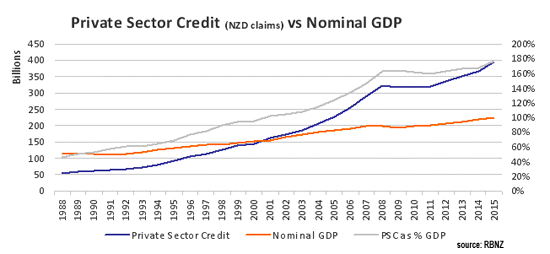
Dombret argues that finance starts having a negative impact on output growth when private sector debt reaches 100% of Gross Domestic Product (GDP). He points out that most advanced economies far exceeded this level before 2008 and continue to do so.
Dombret's speech was circulated by the Bank for International Settlements (BIS), the central banks' bank. A 2012 BIS working paper made similar arguments about private sector debt's impact on productivity growth. The paper actually cited New Zealand as an example saying: "In the first half of the 1990s, (NZ) private credit was below 90% of GDP. Credit then rose steadily, reaching nearly 150% of GDP by the time of the crisis. This increase created a drag of nearly one half of 1 percentage point on trend productivity growth."
The working paper suggested that keeping debt "well below" 90% of GDP provides the room needed to respond in the event of a severe shock.
The chart below shows NZ's private sector credit reaching 177% of GDP.
'More finance not the solution'
Ultimately, Dombret suggests, more finance is not the solution to current problems. Thus sticking to the simple “more finance, more growth” trajectory is not a sustainable solution.
"That would run the risk of focusing on what is currently our most pressing problem - lifting growth expectations - at the expense of our long-term and fundamental goal of achieving a stable financial system. And by doing that, we would also sacrifice sustainable growth."
Put another way, Dombret suggests most doctors would prescribe a sophisticated course of treatment aimed at a patient’s long-term wellbeing rather than a box of painkillers every week.
"But ask them what exactly they would prescribe, and the result will probably be rather like asking several economists for macroeconomic policy advice. You might end up with more treatment plans than you have doctors - or patients for that matter."
"What we need is less, and better finance - finance that serves the real economy and sustainable development. How do we achieve that? There are several angles to that question, but the ones I would like to emphasise are financial regulation and supervision, and monetary policy," said Dombret.
"As I said earlier, providing a flow of liquidity as a monetary painkiller does nothing to tackle the root causes of the economic challenges we are facing. In the absence of economic progress on the structural front, monetary easing is not the key to a sustainable economy. It does, however, affect financial stability, given that it can fuel bubbles. Therefore, we need to look for an exit strategy. It is important for central banks to think hard about how they intend to achieve an exit as soon as economic conditions make it viable to do so."
"From a more general angle, integrating financial stability considerations into monetary policy while maintaining the primacy of the price stability goal will be a key challenge for the future. I welcome the fact that central banks are moving in that direction," said Dombret.
Banks must either manage their risks adequately, or regulators must force them to do so, and where necessary take disciplinary measures,
"As such it is up to a supervisor to increase an individual institution's capital requirements if need be. At the same time, however, we must be careful that risky activities do not move to unregulated areas."
Ultimately, Dombret argues, policies must set their sights on a long-term solution, or a lasting cure rather than an endless supply of painkillers.
"We should not turn a blind eye to the short-term challenges we face, of course. But what we must do is refrain from solutions that encourage excessive indebtedness. Finance will be an important ingredient in the cure for growth, but it will need to be of a better quality, not a greater quantity," Dombret concludes.
*This article first appeared in our email for paying subscribers early on Friday morning. See here for more details and how to subscribe.
We welcome your comments below. If you are not already registered, please register to comment
Remember we welcome robust, respectful and insightful debate. We don't welcome abusive or defamatory comments and will de-register those repeatedly making such comments. Our current comment policy is here.