
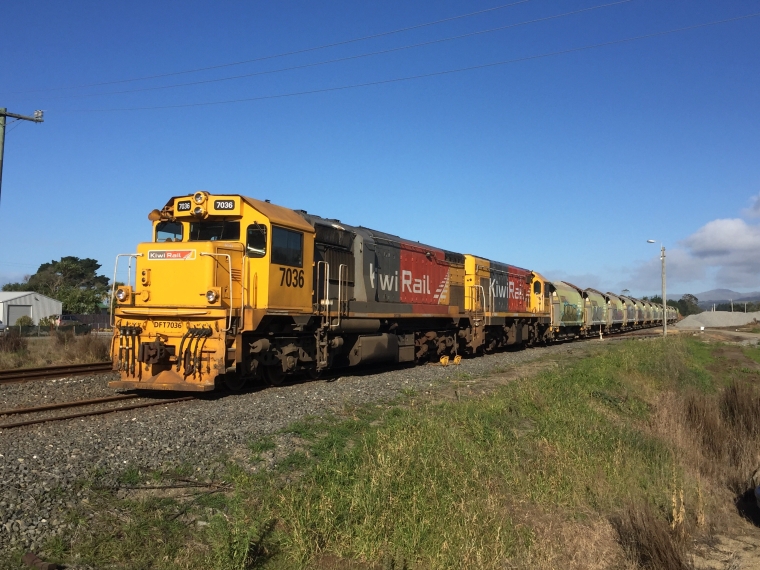
A new report by consultants AECOM New Zealand and Deloitte on the feasibility of upgrading Northland’s rail network makes for interesting reading and highlights some of the potential issues involved in moving the Ports of Auckland north.
The business case was produced for the Ministry of Transport and paid for by the Provincial Growth Fund (PGF) and says upgrading the Northland rail network and building a new rail spur from the main line to Northport would cost $1.3 billion.
Last year the Government established the Upper North Island Supply Chain Strategy working group to look at the development and delivery of a freight and logistics in the country’s Upper North Island. It has also been tasked with investigating the feasibility of relocating the Ports of Auckland to Northport in Whangarei. But before that can happen the rail network north of Auckland would need to be upgraded to handle the massive amounts of freight that would be involved.
The working group released an interim report on its work to date on April 27 and is expected to present its final findings to the Government in September. Associate Transport Minister Shane Jones is hoping the newly released AECOM and Deloitte paper, coupled with the working group’s findings expected later this year, will help him convince his cabinet colleagues of the viability of shifting the Ports of Auckland to Whangarei.
He says connecting Northport to rail and enabling it to service Auckland-bound freight would make a major contribution to the region’s economic development.
“The Northland Rail business case, together with the recently released interim report from the Upper North Island Supply Chain Strategy, present a bold vision for investment in how freight moves around the upper North Island,” Jones says. “The business case shows how Northland could play a role in transforming New Zealand’s golden triangle – Auckland/Hamilton/Tauranga - into a golden diamond if Northland is once again a fully functioning part of the national rail network.”
Jones says the next step in the process will involve the acquisition of land required for the rail corridor to Northport to be completed and the design for the link to the port be developed in detail. He says ministers will also seek more detailed advice from officials and KiwiRail on how investment in rail can be rolled out over a four to six year period to facilitate early access to services and to generate revenue from the investment as soon as possible.
But while the AECOM and Deloitte paper outlines some of the potential benefits to the Northland region, it also raises some flags over who is going to pay for the rail upgrades and what the exact benefits will be. It states:
“There is currently no committed funding identified to deliver the preferred Northland rail project option. There are a number of sources of potential funding, including the Provincial Growth Fund (PGF), which initial conversations have highlighted as a potential source for at least some of the required funding. At this stage of the project funding and financing of the project has not been determined.”
It says the Government has committed to investing $1 billion a year in regional economic development projects through the Provincial Growth Fund over three years (2018–2021). And Northland has been identified as an area for early investment and funding.
However, to develop the funding strategy further there will need to be further discussions with central and local government, as well as with third parties who may benefit from the redevelopment of Northport. While other funding options such as a Public-Private Partnerships (PPP) should also be considered.
Other sources of funding include the National Land Transport Fund (NLTF), which uses revenue collected from fuel excise duties, road user charges and motor vehicle registrations, as well as through the sale of surplus state highway land and Crown allocations. While the Super City is even listed as a potential source of funds, even though it admits securing funding would be a long shot and states:
“Auckland Transport and Auckland Council may see tangible benefits in the form of reduced congestion, improved journey times as well as safety benefits in moving freight from road to rail. These benefits within an Auckland context are unlikely to provide for a compelling funding case for regional authorities.”
The report describes the rail upgrades as “marginal projects” that aren’t being driven by existing demand.
“While they will deliver in part on the Government’s regional development and transport policy objectives the identifiable benefits will be less than the indicative costs of building and operating the rail infrastructure. While the rail investment will measurably mitigate some of the problems associated with road transport to, from and within Northland, the region will still require ongoing upgrades to its road and highway networks to improve access, safety, productivity and regional development.
“However the two potential rail investments, which are inherently linked, do provide considerable future strategic option value for providing significantly improved connectivity for heavy industry and freight volumes between the flat industrial area around Marsden Point and the natural deep-water access at Northport. This proposition has been discussed for almost 20 years, with many significant stakeholders wanting a definitive decision to allow them to develop their own long-term planning within this context.”
It says because there is no existing demand for either the Northland to Auckland rail line upgrade, or the rail spur to Northport, further work is needed to establish who would actually use it.
“Unlike most infrastructure built in New Zealand, this investment is not responding to existing demand. Rather, investment in the NAL and the new link to the port will be lead infrastructure made in advance of, and to stimulate, freight demand. Such an investment can only be made on the attributes of the origin and destination that this rail connection will serve, these being our largest economic centre – Auckland and Marsden Point with its freight handling and industrial potential.”
And Northport’s ability to fund the works could also create problems.
“Installation of the Marsden Link for current trade will have the effect of creating significant cost for Northport, as it integrates the railway into its operations, without additional revenue. The construction of the Marsden Link in advance of additional freight will likewise create significant costs for the port, without revenue."
But despite such issues it does say there would be regional economic development benefits.
“Upgrading the NAL and providing the Marsden Link will provide an option for some cargo owners to move a proportion (up to 5-7%) of the region’s freight. The renewal of the NAL and the construction of the Marsden Point rail link will provide an initial benefit of increased local economic activity, as well as the potential to train younger Northlanders in infrastructure projects. This workforce could then be used in future infrastructure projects across Northland and Auckland.
“With the greater uptake of rail, road-rail terminals will be required at a number of strategic locations such as Otiria/Moerewa, Helensville, Wellsford, Maungaturoto and Dargaville. Hubs are important for freight to access the rail network, usually being transferred to and from road. The development and operation of these road-rail terminals will generate ongoing employment opportunities in those areas. These hubs will also potentially attract future industrial development around them, to make use of the transport connection they provide.”
And the local tourism industry could also see some benefits too, with the rail upgrades allowing tourist operators to attract more visitors to both Auckland and Northland.
We welcome your comments below. If you are not already registered, please register to comment
Remember we welcome robust, respectful and insightful debate. We don't welcome abusive or defamatory comments and will de-register those repeatedly making such comments. Our current comment policy is here.