

This Top 5 COVID-19 Alert Level 3 special comes from interest.co.nz's Gareth Vaughan.
As always, we welcome your additions in the comments below or via email to david.chaston@interest.co.nz. And if you're interested in contributing the occasional Top 5 yourself, contact gareth.vaughan@interest.co.nz.
Following the Prime Minister's announcement on Monday afternoon, this should be the last Top 5 Alert Level 3 special. Certainly in my house the parents are really looking forward to the kids going back to school, and the kids are even looking forward to going back. Hopefully we'll then be free from the type of home schooling special demonstrated below...
1) Pandemics depress the economy, public health interventions do not: Evidence from the 1918 Flu.
This academic paper probes the impact of pandemics and the associated public health responses on the real economy, looking at evidence from the 1918 Flu Pandemic in the United States. The authors find cities that intervened earlier and more aggressively do not perform worse and, if anything, grow faster after
the pandemic is over. The findings therefore suggest non-pharmaceutical interventions not only lower mortality, they might also mitigate the adverse economic consequences of a pandemic.
The paper is obviously interesting against the backdrop of what's going on across much of the world right now, and also in terms of the tough lockdown implemented here in New Zealand. The authors are Sergio Correia from the Board of Governors of the Federal Reserve System, Stephen Luck from the Federal Reserve Bank of New York, and Emil Verner from the Massachusetts Institute of Technology - Sloan School of Management.
Our analysis yields two main insights. First, we find that areas that were more severely affected by the 1918 Flu Pandemic see a sharp and persistent decline in real economic activity. Second, we find that early and extensive NPIs [non-pharmaceutical interventions] have no adverse effect on local economic outcomes. On the contrary, cities that intervened earlier and more aggressively experience a relative increase in real economic activity after the pandemic. Altogether, our findings suggest that pandemics can have substantial economic costs, and NPIs cannot only be means to lower mortality but may also have economic merits by mitigating the adverse impact of the pandemic.
Our two main findings are summarized in Figure 1, which shows the city-level correlation between 1918 Flu mortality and the growth in manufacturing employment from 1914 to 1919 census years.1 As the figure reveals, higher mortality during the 1918 Flu is associated with a relative decline in economic activity. The figure further splits cities into those that were more and less aggressive in their use of NPIs. Cities that implemented stricter NPIs (green dots) tend to be clustered in the upper-left region (low mortality, high growth), while cities with more lenient NPIs (red dots) are clustered in the lower-right region (high mortality, low growth). This suggests that NPIs play a role in attenuating mortality, but without reducing economic activity. If anything, cities with stricter NPIs during the pandemic perform better in the year after the pandemic.
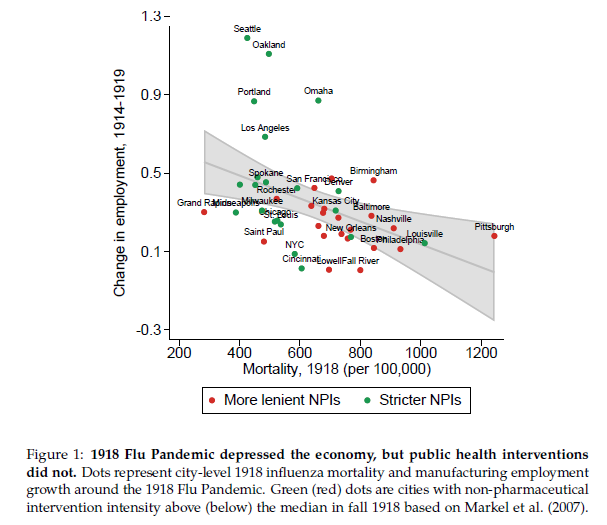
Altogether, our evidence implies that pandemics are highly disruptive for economic activity. However, timely measures that mitigate the severity of the pandemic may also reduce the severity of the persistent economic downturn. That is, NPIs can reduce mortality while at the same time being economically beneficial.
When interpreting our findings, there are several important caveats to keep in mind. First, our analysis is limited to data on 30 states and 43 to 66 cities. Second, data on manufacturing activity is not available in all years, so we cannot carefully examine pre-trends between 1914 and 1919 for the manufacturing activity outcomes. Third, the economic environment toward the end of 1918 was unusual due to the end of WWI. Fourth, our cross-regional analysis does not allow us to capture aggregate general equilibrium effects.
Finally, while there are important economic lessons from the 1918 Flu for today’s COVID-19 pandemic, we stress the limits of external validity. Estimates suggest that 1918 Flu was more deadly than COVID-19, especially for prime-age workers, which also suggests more severe economic impacts of the 1918 Flu. The complex nature of modern global supply chains, the larger role of services, and improvements in communication technology are mechanisms we cannot capture in our analysis, but these are important factors for understanding the macroeconomic effects of COVID-19.
2) The threat of enfeebled great powers.
Writing for Project Syndicate, Arvind Subramanian sees three watershed events coming out of the COVID-19 crisis. These are the end of Europe’s integration project, the end of a united, functional America, and the end of the implicit social compact between the Chinese state and its citizens. This means all three major powers will emerge from the pandemic internally weakened, undermining their ability to provide global leadership.
In an excellent article Subramanian has some tough language for Europe.
The continent’s leaders have faltered and dithered, from European Central Bank President Christine Lagarde’s apparent gaffe in March – when she said that the ECB was “not here to close spreads” between member states’ borrowing costs – to the bickering over debt mutualization and COVID-19 rescue funds and the reluctant, grudging incrementalism of the latest agreement.
And:
Suppose, as seems likely, that the successful economies of the EU core recover from the crisis while those on the bloc’s periphery falter. No political integration project can survive a narrative featuring a permanent underclass of countries that do not share their neighbors’ prosperity in good times and are left to their own devices when calamity strikes.
The US cops it too.
But so far, the world’s richest country has been by far the worst at coping with the pandemic. Although the US has less than 5% of the world’s population, it currently accounts for about 24% of total confirmed COVID-19 deaths and 32% of all cases.
In rapid succession, therefore, America’s credibility and global leadership have been buffeted by imperial overreach (the Iraq war), a rigged economic system (the global financial crisis), political dysfunction (the Trump presidency), and now staggering incompetence in tackling COVID-19. The cumulative blow is devastating, even if it is not yet fatal.
And then there's China. He argues the crisis will probably hurt China’s long-term economic prospects.
First, the Chinese authorities’ terrible initial handling of the pandemic, and in particular their catastrophic suppression of the truth about the COVID-19 outbreak in Wuhan, has called the regime’s legitimacy and competence into question. After all, the social contract looks less attractive if the state cannot guarantee citizens’ basic wellbeing, including life itself. China’s true COVID-19 death toll, which is almost certainly higher than the authorities are admitting, will eventually come to light. So, too, will the stark contrast with the exemplary response to the pandemic by the freer societies of Taiwan and Hong Kong.
Second, the pandemic could lead to an external squeeze on trade, investment, and finance. If the world deglobalizes as a result of COVID-19, other countries will almost certainly look to reduce their reliance on China, thus shrinking the country’s trading opportunities. Similarly, more Chinese companies will be blocked from investing abroad, and not just on security grounds – as India has recently signaled, for example. And China’s Belt and Road Initiative – its laudable effort to boost its soft power by building trade and communications infrastructure from Asia to Europe – is at risk of unraveling as its pandemic-ravaged poorer participants start defaulting on onerous loans.
Subramanian argues by further weakening the internal cohesion of the world’s leading powers, the COVID-19 crisis threatens to leave the world even more rudderless, unstable, and conflict-prone than it was before the virus came along.
The sense of three endings in Europe, America, and China is pregnant with such grim geopolitical possibilities.
There's an interesting take on getting COVID-19 here from virologist Peter Piot. He's director of the London School of Hygiene & Tropical Medicine. He got COVID-19 in mid-March, spent a week in hospital, and has been recovering at home in London since. Piot, 71, was one of the discoverers of the Ebola virus in 1976, headed up the Joint United Nations Programme on HIV/AIDS between 1995 and 2008, and is currently a coronavirus adviser to European Commission President Ursula von der Leyen.
I was concerned I would be put on a ventilator immediately because I had seen publications showing it increases your chance of dying. I was pretty scared, but fortunately, they just gave me an oxygen mask first and that turned out to work. So, I ended up in an isolation room in the antechamber of the intensive care department. You’re tired, so you’re resigned to your fate. You completely surrender to the nursing staff. You live in a routine from syringe to infusion and you hope you make it. I am usually quite proactive in the way I operate, but here I was 100% patient.
I shared a room with a homeless person, a Colombian cleaner, and a man from Bangladesh—all three diabetics, incidentally, which is consistent with the known picture of the disease. The days and nights were lonely because no one had the energy to talk. I could only whisper for weeks; even now, my voice loses power in the evening. But I always had that question going around in my head: How will I be when I get out of this?
And he talks about the long-term health issues some COVID-19 survivors will face.
Many people think COVID-19 kills 1% of patients, and the rest get away with some flulike symptoms. But the story gets more complicated. Many people will be left with chronic kidney and heart problems. Even their neural system is disrupted. There will be hundreds of thousands of people worldwide, possibly more, who will need treatments such as renal dialysis for the rest of their lives. The more we learn about the coronavirus, the more questions arise. We are learning while we are sailing. That’s why I get so annoyed by the many commentators on the sidelines who, without much insight, criticize the scientists and policymakers trying hard to get the epidemic under control. That’s very unfair.
NHK conducted an experiment to see how germs spread at a cruise buffet.
— Spoon & Tamago (@Johnny_suputama) May 8, 2020
They applied fluorescent paint to the hands of 1 person and then had a group of 10 people dine.
In 30 min the paint had transferred to every individual and was on the faces of 3.
pic.twitter.com/1Ieb9ffehp
4) Printing and devaluing money the easiest way out of a debt crisis.
Ray Dalio, founder of investment management firm Bridgewater Associates, has published an appendix to chapter two of his upcoming book The Changing World Order. In it Dalio looks at four levers policy makers can pull to bring debt and debt-service levels down relative to the income and cash-flow levels required to service debts. In a COVID-19 ravaged world, governments, corporates and households will be looking to do this.
The four levers Dalio cites are austerity, or spending less, debt defaults and restructurings, transfers of money and credit from those who have more than they need to those who have less than they need (e.g. raising taxes), and printing money and devaluing it.
In comparison to the other options, he argues printing money is the most expedient, least well-understood, and most common big way of restructuring debts.
In fact it seems good rather than bad to most people because it helps to relieve debt squeezes, it’s tough to identify any harmed parties that the wealth was taken away from to provide this financial wealth (though they are the holders of money and debt assets), and in most cases it causes assets to go up in the depreciating currency that people use to measure their wealth in so that it appears that people are getting richer.
You are seeing these things happen now in response to the announcements of the sending out of large amounts of money and credit by central governments and central banks.
Note that you don’t hear anyone complaining about the money and credit creation; in fact you hear cries for a lot more with accusations that the government would be cheap and cruel if it didn’t provide more. There isn’t any acknowledging that the government doesn’t have this money that it is giving out, that the government is just us collectively rather than some rich entity, and that someone has to pay for this. Now imagine what it would have been like if government officials cut expenses to balance their budgets and asked people to do the same, allowing lots of defaults and debt restructurings, and/or they sought to redistribute wealth from those who have more of it to those who have less of it through taxing and redistributing the money. This money and credit producing path is much more acceptable. It’s like playing Monopoly in a way where the banker can make more money and redistribute it to everyone when too many of the players are going broke and getting angry. You can understand why in the Old Testament they called the year that it’s done “the year of Jubilee.”
In the article Dalio also writes extensively about currencies.
Bloomberg has the story of Toronto day trader Syed Shah who, having started April 20 with $77,000 in his account, ended up owing his broker $9 million at the end of the day after trading oil on the day the price sank below zero for the first time ever.
What he didn’t know was oil’s first trip into negative pricing had broken Interactive Brokers Group Inc. Its software couldn’t cope with that pesky minus sign, even though it was always technically possible -- though this was an outlandish idea before the pandemic -- for the crude market to go upside down. Crude was actually around negative $3.70 a barrel when Shah’s screen had it at 1 cent. Interactive Brokers never displayed a subzero price to him as oil kept diving to end the day at minus $37.63 a barrel.
At midnight, Shah got the devastating news: he owed Interactive Brokers $9 million. He’d started the day with $77,000 in his account.
“I was in shock,” the 30-year-old said in a phone interview. “I felt like everything was going to be taken from me, all my assets.”
Thomas Peterffy, chairman and founder of Interactive Brokers, told Bloomberg the dramatic fall in the price of oil futures exposed bugs in his company’s software. Peterffy described this as "a $113 million mistake on our part”.
Customers will be made whole, Peterffy said. “We will rebate from our own funds to our customers who were locked in with a long position during the time the price was negative any losses they suffered below zero.”
That could help Shah. The day trader in Mississauga, Canada, bought his first five contracts for $3.30 each at 1:19 p.m. that historic Monday. Over the next 40 minutes or so he bought 21 more, the last for 50 cents. He tried to put an order in for a negative price, but the Interactive Brokers system rejected it, so he became more convinced that it wasn’t possible for oil to go below zero. At 2:11 p.m., he placed that dream-turned-nightmare trade at a penny.
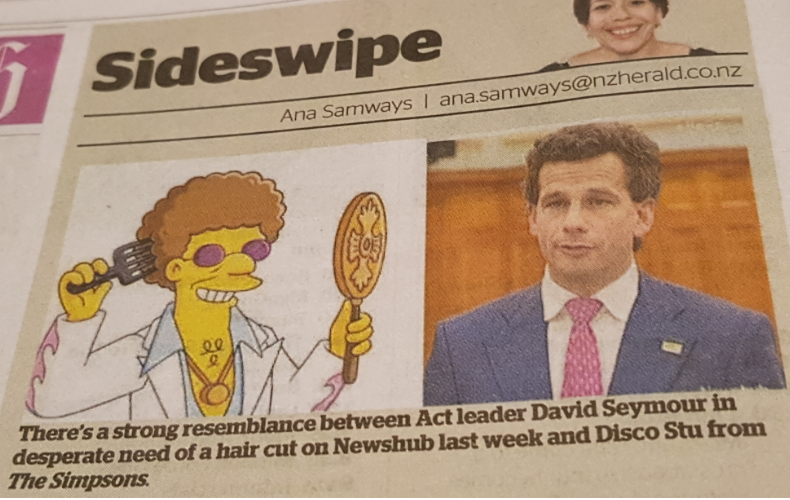
Hairdressers and barber shops will be in hot demand once they reopen from Thursday. Epsom MP David Seymour might be among their customers...
We welcome your comments below. If you are not already registered, please register to comment
Remember we welcome robust, respectful and insightful debate. We don't welcome abusive or defamatory comments and will de-register those repeatedly making such comments. Our current comment policy is here.