

ANZ economists are raising the prospect that the country might see a 'double-dip' recession from the end of this year and into next year.
"Uncertainty is extreme. And while not our forecast, we think there is a material risk that the economy enters a double-dip recession from Q4 2020," ANZ senior economist Miles Workman says.
In an ANZ Insight publication, Workman says the bank's economists had warned recently that the recession is just beginning, and this view hasn’t changed.
"However, the time it will take for economic fundamentals to be revealed in the dataflow has always been very uncertain. Economies can be slow ships to turn, but data volatility can mask that."
Workman says "it may take a bit longer for the extent of the blow to become evident".
He notes that a number of timely economic indicators have bounced very sharply out of lockdown.
"That’s not a surprise, given the abrupt halt the economy experienced. We always knew the data was going to be volatile. That said, we’ve been pleasantly surprised at the pace at which these indicators have recovered and the fact that it has been reasonably broad based.
"But we are also very cautious about taking too much signal from the bounce about where the economy is headed from here, as the impact of the closed border and wider recessionary dynamics are yet to be fully felt (not to mention global headwinds).
"The lockdown and the closed border are completely separate economic shocks. One is done; one is set to be with us for a while."
Workman said it was "difficult to quantify", but pent-up demand will be playing a role in the post-lockdown rebound.
"New Zealanders knocked a billion dollars off their credit cards during lockdown, and have been having a very happy time putting it back on. Delayed spending on non-essential items will still be working through, with involuntary savings during the lockdown burning a hole in some pockets."
He cited recent spending data from ANZ customers:
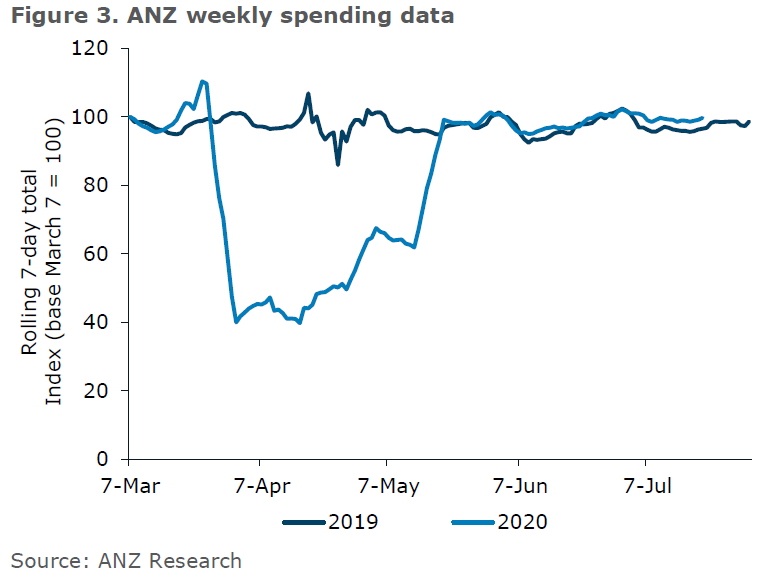
"What is telling in the consumer spending data is that while daily spending has returned to 2019 levels, there has been no significant overshoot . People have not made up for their lost shopping time in lockdown.
"We think the very recent data have been supported by the closed border during the school holiday period. As this unwinds and pent-up demand is exhausted, transactions could slip below year-ago levels once again. We’ll be keeping a close eye on weekly transactions data over the coming weeks to get a gauge on the underlying spending impulse."
Workman goes into a lot of detail on the border closure and the impacts on tourism. He notes the seasonality of tourism and the fact winter is the off-season, with fewer international visitor arrivals and more kiwis going on holiday abroad to escape the cold - normally. Because of this, net visitor arrivals (foreign visitors to NZ less NZ resident departures) have a tendency to dip into negative territory between May and September, but then become strongly positive between October and April.
However, due to the closed border that's been different this year, with Kiwis not able to leave during the winter months and to some extent filling the hole in tourism that normally exists in New Zealand during those winter months.
"But from October through to April, we will miss out on significantly more tourism income if the border remains closed – with more than 5.5 times as many net visitors lost than what’s been gained during winter. November, when net visitor arrivals typically lift sharply into surplus, is when tourism-related businesses are likely to really notice the cashflow impacts of a closed border," Workman says.
He thinks the "unusual profile" for net visitor arrivals in 2020 could have a meaningful impact on the seasonally adjusted GDP figures via net services exports, boosting quarterly GDP on the off season - the second quarter of the year and into the third - but weighing on it over the summer.
"The impact isn’t trivial. We estimate seasonally adjusted GDP could be around 1% higher than otherwise over Q2 and Q3. But the boost will be temporary, unwinding in Q4 and Q1.
"So come summer, GDP could be hit from both the absolute impact of a closed border (which we estimate is leaving around a 5% hole in the economy) plus the additional volatility from these seasonal impacts (perhaps detracting an additional 1%).
"In reality, it will be very difficult to disentangle these different impacts, but it does reinforce our view that the recovery won’t be a straight line. In particular, the strong seasonality of tourism will push some of the weakness into Q4 and Q1 GDP. We already expect a small moderation in Q4, but if this extends into Q1 it would mark a double dip recession."
Workman says the ANZ economist believe underlying economic momentum is travelling well below pre-crisis levels.
"We expect to enter 2021 with GDP around 5% lower than end-2019 levels, regardless of how volatile the next few quarters are. Fiscal and monetary stimulus is working hard, but can’t provide a full offset."
We welcome your comments below. If you are not already registered, please register to comment
Remember we welcome robust, respectful and insightful debate. We don't welcome abusive or defamatory comments and will de-register those repeatedly making such comments. Our current comment policy is here.