
By Chris Trotter*
What has happened to Labour? Since claiming 50.01% of the Party Vote and a clear parliamentary majority, the party is undergoing a strange and alarming metamorphosis. From the party of Helen Clark: which at least attempted to preserve the historical ties (however tenuous) to Labour’s original political mission; to a collection of politicians who are happy to exploit the Labour brand, but have set their faces against anything resembling traditional Labour policies. The extremely unusual phenomenon of a party in full, headlong retreat from an unprecedented electoral victory merits some form of explanation.
At the heart of Labour’s perplexing defeatism (what other word can one apply to its wholesale adoption of conservative economic and social nostrums?) is its repeated experience of defeat. For three elections in a row, following the fall of the Clark Government in 2008, Labour failed to crest 40% of the Party Vote. (Indeed, Clark herself only managed to secure a Party Vote above 40% mark twice in her whole 15 years at the top of the Labour Party i.e. 2002 and 2005).
The Labour caucus’s ingrained defeatism was reinforced mightily by the catastrophic defeats of 2011 and 2014 when first Phil Goff and then David Cunliffe dragged their party well below 30%. While the shot in the arm provided by Jacinda Ardern’s 36.89% in 2017 was, unquestionably, a powerful stimulant (she had lifted Labour’s Party Vote by a very creditable 11.76 percentage points) it still left Labour trailing National by 7.56 percentage points. Even on a good day, it seemed, New Zealanders’ preferences lay elsewhere.
Now, there will be plenty who object that Labour is being too hard on itself. Supporters of “The Left” (whatever that means in 2020!) will argue that when the votes flowing to Labour, the Alliance and the Greens are added together the strength of progressivism in New Zealand is much more accurately presented. They will point out, for example, that tallying the votes of the progressive parties in 1999 produces a figure, 51.64%, not too far short of the 59.04% progressive triumph of 2020.
Unfortunately for “The Left”, that is not how Labour reads these numbers. As any honest representative of either the Alliance or the Greens will attest, Labour does not look upon unashamedly radical MPs as comrades in the struggle for a democratic-socialist/eco-
The Labour caucus’s scorn for the radical Left extends well beyond the Greens (and, before, them, the NewLabour Party and the Alliance) to include whatever remnant of left-wing activism might still exist within Labour’s own ranks. In the aftermath of Helen Clark’s departure in 2008, it became clear to many not-very-left-wing Labour MPs that this remnant was disconcertingly large. Large enough, certainly, to impose a surprisingly progressive election manifesto on Phil Goff in 2011. Large enough, by 2013, to impose David Cunliffe upon a parliamentary caucus who hated his guts. Still large enough, even after Cunliffe’s disastrous showing in 2014, to deny (by a whisker!) the party leadership to Grant Robertson.
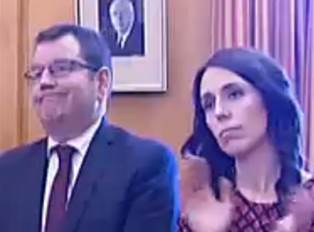
The picture of the crestfallen pair, Robertson and Ardern, as the news of Andrew Little’s narrow victory was announced, is worth several thousand words.
Even more telling, however, was the naked fury on display at the Labour Party’s annual conference held in Ellerslie in November 2012. This was the conference where it first became clear to the dominant, Robertson-led, faction of the Caucus that the party membership was slipping from its control, and that its purblind adherence to Helen Clark’s and Michael Cullen’s lacklustre variant of Tony Blair’s “Third Way-ism” was not what the party wanted.
Having successfully persuaded Andrew Little to step aside (with a lot of help from Labour’s Maori MPs) putting forward Jacinda Ardern as his replacement was the Robertson faction’s last roll of the dice. Indeed, it was probably Labour’s last roll of the dice. With internal polling indicating that if something dramatic wasn’t done to arrest the Little slide, then Labour could easily slip into the teens and cease to be a viable Opposition party. To say that “Jacinda” saved Labour’s bacon is to understate her achievement quite considerably.
The rest, as they say, is history. But the history before the history remains crucial to understanding why the government elected on 17 October is so committed to serving-up the thin gruel of warmed-over Blairism. At the very centre of that commitment is the Ardern-Robertson duumvirate’s unshakeable belief that the Labour Party’s traditional leftism has, for at least three decades, been unsaleable to a majority of the New Zealand electorate. Hence their abiding fear that even the slightest suggestion that traditional Labour leftism has become the driving force behind government policy will see its support tumble back into the 30s – or worse.
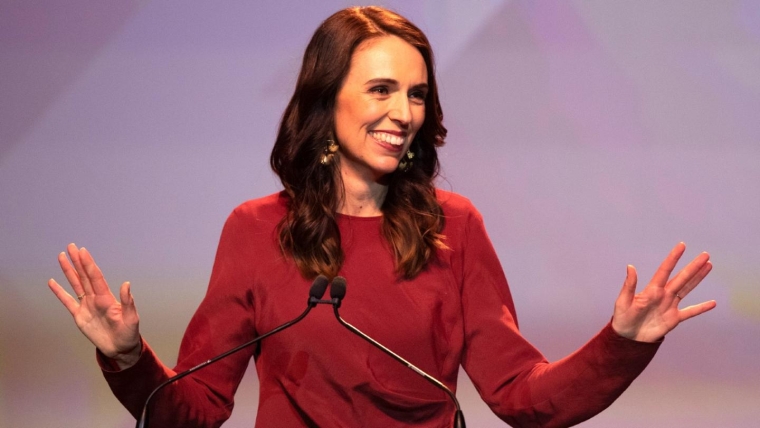
The admiration and deep affection in which the Prime Minister is held by so many New Zealanders has its roots in her conduct during crises. Be it the Mosque Shootings, or the rapid onset of the Covid-19 Pandemic, Ardern’s responses were instinctive, almost impulsive. In both situations there were no rulebooks to consult, no standard remedies to apply. She dug deep into the person that she is and found all that was necessary to meet the challenges that rose before her.
But, crises – by definition – are not permanent. Eventually, the rulebook returns – along with the standard remedies. In these circumstances, the instinctive, impulsive “Jacinda” is reabsorbed into the cautious and conventional politician she has always been. For a time, Ardern’s superb communication skills will help to deflect the voters’ attention from her rock-solid adherence to the social and economic status-quo – but not forever.
The proposition upon which the Ardern-Robertson duumvirate is betting the whole Labour house is disarmingly simple: that the eventual exposure of this government as a bunch of fiscal and political conservatives will not harm its chances of re-election. They know that it is much less damaging for Labour to bleed out a few angry left-wing voters to the Greens and the Maori Party, than to precipitate the mass desertion of the tens-of-thousands of former National Party voters who lifted Labour’s share of the Party Vote from 37% to 50%.
Thirty years of beating-back, shutting-down, and ignoring the raised voices of the Left has hardened Labour’s leaders to the heartfelt appeals of unions, NGOs, and other assorted do-gooders dedicated to serving the poor and disadvantaged. For Ardern and Robertson – and, it should be noted, the newly appointed General Secretary of the Labour Party, Rob Salmond – the question to be resolved is not whether the case advanced by “The Left” is right or wrong, but how many votes will it cost/benefit Labour at the next election.
When Helen Clark became Prime Minister in 1999, the transformational periods of “Rogernomics” and “Ruthanasia” were barely a decade old. Moreover, traditional Labour leftism, as manifested in the Alliance; and the Greens eco-socialism; were crucial to her ability to govern. Meaning? There was only so much revisionism she could get away with! In 2020, however, the neoliberal revolution is 30 years in the past, and those who remember fondly the New Zealand that preceded it grow fewer with every passing winter. Labour is no longer a tradition, it has become a brand – and Jacinda Ardern and Grant Robertson are changing it.
*Chris Trotter has been writing and commenting professionally about New Zealand politics for more than 30 years. He writes a weekly column for interest.co.nz. His work may also be found at http://bowalleyroad.blogspot.com.
We welcome your comments below. If you are not already registered, please register to comment
Remember we welcome robust, respectful and insightful debate. We don't welcome abusive or defamatory comments and will de-register those repeatedly making such comments. Our current comment policy is here.