

Nothing seems more certain than rising home loan interest rates in 2014, especially floating rates.
That is because the RBNZ has given clear 'forward guidance' that it has started the process of normalising interest rates away from the stimulus settings needed to combat the GFC and the Christchurch earthquake.
Our economy is doing well at present and it is time to revert to a more realistic cost of money.
Cheap money causes people to make distorted decisions.
Home owners with a mortgage now face new choices and options.
Many are choosing to switch away from floating rate loans, locking in the certainty of fixed rates "before they rise even further", following market signals that the OCR could be as much as 1% higher by the end of 2014, and possibly another 1% higher by the end of 2015. Nothing about the future can be said for certain, however.
But is switching from floating (or short term fixed) to long term fixed the right move?
I can't tell you; that is a decision you will have to make based on your own personal financial situation and your tolerance for risk. You should seriously consider getting the advice of a professional adviser if you are unclear about any aspect of a decision. Over a long period, financial variances can add up to a lot.
For some people, staying with a variable rate will make sense, however.
And this will be the case, even if the interest rate for variable rates is higher than floating rates.
It's not all about the rate.
It's actually about the rate you pay your loan off. Most people overlook this crucial fact, but the maths are clear.
For many people who can maintain sensible financial discipline over a long period of time, floating rate arrangements will result in paying less interest over the lifetime of the mortgage and consequently less total payments. You end up getting your house for thousands less.
And that is because floating rate mortgages allow you to make extra pay-downs in a way that fixed rate ones don't.
For most people, the best way to achieve this is by using a revolving credit account.
Revolving credit is more like a giant overdraft arrangement than a standard mortgage loan.
In a standard table mortgage loan, you make equal payments regularly that pay off the loan in a fixed period of time (25 years, say). Yes, you can fiddle with it by making extra drawdowns and banks will love you for doing that. Or you can make the occasional extra payment when you have additional funds - when the loan allows it.
But a Revolving Credit loan is smarter than that. It allows you to get these advantages from the weekly irregularities of your bank account.
This is how it works:
The bank converts your mortgage to an Revolving Credit account. In fact, this is your current account with an overdraft level equal to what you owe them on the home loan.
Into this current account (it used to be called a chequing account) you credit your pay, and pay out your expenses.
The overdraft limit reduces by the same amount as your previous mortgage payment - so the amount of overdraft steadily decreases over time.
But here's the big benefit: any and every balance below that limit saves you interest. Interest is only charged by the bank on what your account balance is, not what the Revolving Credit limit is.
So when you have your wages or salaries (or bonuses, or proceeds from your Trade Me sales, or inheritances from a great aunt, or whatever) paid into your current account, that reduces the interest you pay. Sure you will buy groceries, petrol, pay insurance etc out of that account and these transactions add to our overdraft. But unless you are running insolvent - buying more than you earn - you will get the long-run benefit of the gap between your actual bank account and the Revolving Credit limit.
This chart shows you the principle.
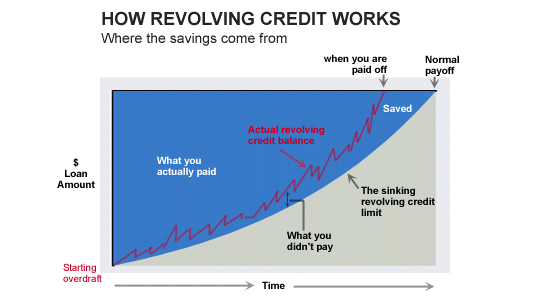
Another advantage is that these small benefits are calculated on a daily basis, so every day you are below your limit is an interest-rate saving benefit to you. Keep that up and you will pay off the home loan faster than just staying on the table mortgage treadmill for 25 years.
And it can be much faster.
The numbers can be astounding. A trusted professional mortgage adviser can work them out for you, or you can use our handy mortgage calculator to get a sense of what they may be. It's a little fiddly to do on your own, but if you are good with spreadsheets, its worth a try.
The savings are real. If you don't make them, they just get paid to the bank.
However, there is a catch. To get these benefits involves 'work'.
You need to be focused and disciplined over a long period to 'earn' the $10,000s that will be involved for most people.
If you don't work at it, you could get into a financial hard place. That difference between the balance in your revolving credit account and the account limit can be drawn on at any time. There is a high temptation sitting there - and the bank wants you to spend it. They earn their best interest off you if you run a revolving credit account to its maximum. The holiday in Fiji, the new car, the new TV or gadget will be whispering in your ear "you can afford it" - and as the separating builds up it will look like you can 'afford' bigger and bigger things - often things like remodeling projects.
A revolving credit account can act just like an ATM. And that is the trap. (In fact, credit cards and revolving credit operating together can be double trouble for the weak.)
If you can avoid the temptation however, you win big; over 25 years, really big. Your home loan could be paid off many years faster and the savings are enormous.
And a few extra basis points interest you will pay on the arrangement will be chicken-feed, almost irrelevant compared with the benefits.
Do you have what it takes? Only you know that, but an experienced professional mortgage adviser you trust will be able to quantify what you stand to gain.
| Plan |
Monthly $ Fee |
Current % rate |
|
 |
Flexible | 12.50 | 6.10% |
 |
Orbit | 12.00 | 6.00% |
 |
Mortgage One | 20.00 | 6.60% |
| Rapid Repay | 3.50 | 6.19% | |
| Kiwibank | Revolving | 0.00 | 5.90% |
 |
Choices Everyday | 9.95 | 6.00% |
| Co-op Bank | Revolving | 7.50 | 5.95% |
 |
Home Equity | 0.00 | 6.60% |
 |
Flexi | 0.00 | 5.90% |
| TSB | Liberty | 10.00 | 6.04% |
--------------------------------------------------------------
Mortgage choices involve making a significant financial decision so it often pays to get professional advice. A Roost mortgage broker can be contacted by following this link »
--------------------------------------------------------------
We welcome your comments below. If you are not already registered, please register to comment
Remember we welcome robust, respectful and insightful debate. We don't welcome abusive or defamatory comments and will de-register those repeatedly making such comments. Our current comment policy is here.