

This is the fifth chapter of Oliver Hartwich essay "Why Europe Failed", an analysis of an ageing Europe, burdened by the size of its welfare state. He draws cautionary lessons for New Zealand's policy makers. You can read the full version here.
This fifth section is titled "Panen et Circenses: The rise of the European welfare state". Part I is here. Part II is here. Part III is here. Part IV is here.
By Oliver Hartwich*
 The anti-democratic political structures of European integration should have made the European project unpopular. Similarly, the declining relative importance of Europe should have been a concern for Europe’s citizens. And if none of that bothered the Europeans, then maybe the slowing economic dynamism should have.
Yet despite such shortcomings, there have not been uprisings against (Western) Europe’s status quo since World War II. European citizens witnessed falling average growth rates decade after decade. They saw mass unemployment become a persistent feature of their society. They also realised how their economies lost entire industries to newly developing countries. Despite this, there has been remarkable political stability for decades across the EU.
This is of course not to say that there have never been any changes of government, which sometimes even brought about some policy changes. However, the basic direction has remained the same. At least Western Europe countries were typically governed by parties that subscribed to a mixed economy model and continued with European integration through the EU and its predecessors. Whether governments were led by centre-left or centre-right parties or coalitions became a matter of aesthetic preference. It rarely ever mattered much beyond that.
Government spending as a percentage of GDP increased dramatically across Europe all through the 20th century (Table 1).
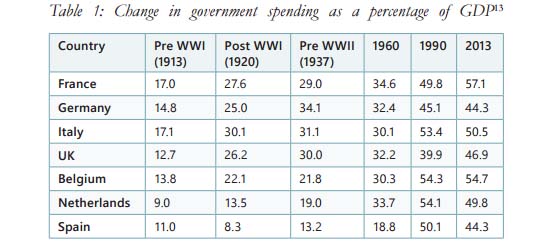
The pattern of government growth is also similar across Europe. Both world wars increased government spending (except in Spain, which remained neutral in World War I and thus did not have to increase its expenditure). Since the immediate post-World War II and reconstruction era, government spending has increased to unprecedented levels. The most extreme case is France where the state now accounts for well over half of the economy.
These spending rises have not been driven by the core areas of government spending of law and order, defence and certain public goods. Instead, all the increases in government spending have been in education, health and welfare.
In a 2014 paper for the Centre for Policy Studies, economist Brian Sturgess analysed data for 19 European OECD countries for 15 years from 1996 to 2011. He found that on average, European governments now direct only 19% of their total spending to core responsibilities, while 10% is spent on subsidies and infrastructure, 12% on education, 15% on health, and 38% on social security.14
On average, these European countries spent almost 30% of GDP on welfare alone, which is more than the total of government spending before World War II.
There are many possible explanations for this growth of government. American economist Robert Higgs describes a ratchet effect in his book Crisis and Leviathan. In times of real or imagined national emergencies, mainly wars and recessions, government takes over previously private rights and activities. When the crisis passes, government retreats somewhat, but never to the same level as before.15 This ratchet effect could indeed explain why European governments increased in size during the two world wars. However, it is less well suited to explain the additional (and substantial) government growth since 1945.
Another explanation is the rise of Keynesian economics after World War II. Keynesian demand-side management had given governments a licence to increase spending to ‘stimulate’ the economy. This probably contributed somewhat to the growth of government. However, not every European country subscribed to Keynesian policies. Germany, for example, only briefly flirted with Keynesianism in the late 1960s and 1970s, and yet its spending record was similar to that of countries where Keynesianism was stronger.
The theory of public choice explains this growth in government spending as a consequence of lobby activities and rent seeking. Public choice undoubtedly has strong explanatory power – but it still does not explain why European governments grew much faster than their counterparts in other developed economies such as the US, Australia or New Zealand.
Perhaps the burgeoning size of government in Europe has something to do with the specific political structure of the EU. Though this argument might be hard to prove empirically, there is some value to it. In building the unpopular political superstructure of the EU, the European elites had to ensure the electorate would not desert them. They achieved this by establishing a welfare state that went far beyond a mere safety net. Instead, European welfare states became an all-encompassing insurance and entertainment scheme.
Seen this way, the European welfare state was a means of buying the public’s silence and acquiescence. It was the same method of securing power Juvenal described in his Satires two millennia ago:
Already long ago, from when we sold our vote to no man, the People have abdicated our duties; for the People who once upon a time handed out military command, high civil office, legions — everything, now restrains itself and anxiously hopes for just two things: bread and circuses.
Bread and circuses – or panem et circenses in the Latin original – were the means of bribing the masses in ancient Rome. Modern Europe is witnessing a similar phenomenon. To their subservient citizens, the European elites provide free or heavily subsidised education, health care, TV and radio programmes, roads, income support and pensions, public transport, libraries, opera houses, and theatres.
Unfortunately, it is often overlooked that government can only bribe the people with their own money. In the words of the great French economist Frédéric Bastiat: “Government is the great fiction through which everybody endeavours to live at the expense of everybody else.”
As a result, the very people benefiting from the welfare state are also footing the bill – at an astonishing cost. Last year, the German Federation of Taxpayers calculated the difference between gross wages and net take-home pay based on OECD data. To do this, they also included the effect of value added taxes, which are often hidden from view.16
For a single income earner on the national average income, Belgium topped the list of predatory governments with a tax burden of 59.1%, followed by Hungary (54%) and Germany (53.1%). In most large European economies, the burden was well above 40%.
The respective tax burdens for families with two income earners and two children are somewhat lower, but tax burdens in Europe still range from 47% in Greece to 29.4% in the UK. By comparison, the figures for Australia and New Zealand 23.2% and 15.5%, respectively.
Buying European citizens’ loyalty for their mixed economy welfare states has effectively enslaved them. Is that the price of peace the EU claims it has brought to the continent? Has Europe lost its economic liberty as the price of national safety?
The welfare state (broadly defined as all government spending outside the state’s core functions) was the means by which Europe bought itself political stability. Little wonder, then, that the moment governments could no longer afford to pay for it, the previous political consensus started falling apart. This also explains the rise of radical parties such as SYRIZA in Greece, the National Front in France, and Podemos in Spain.
The rise of the European welfare state, the reduction of economic dynamism, and the increasingly questionable legitimacy of the European project go hand in hand. Panem et circenses could have been the motto of Europe’s post-World War II mixed economy model. It remains to be seen whether the EU will also share the Roman Empire’s fate.
13. Vito Tanzi, “The Economic Role of the State in the 21st Century,” Cato Journal 25:3 (Fall 2005), pp. 617–638. 2013 data sourced from http://www.tradingeconomics.com/germany/government-spending-to-gdp.
14. Brian Sturgess, Not Paved With Gold: Government ‘Investment’ Does Not Equal Growth (London: Centre for Policy Studies, 2014).
15. Robert Higgs, Crisis and Leviathan: Critical Episodes in the Growth of American Government (New York: Oxford University Press, 1987).
16. Volker Stern, Rundschreiben 8/2014: Zum Steuerzahlergedenktag 2013 und 2014 (Berlin: Deutsches Steuerzahlerinstitut des Bundes der Steuerzahler, 2014), http://www.steuerzahler.de/files/61647/RS_08-2014_-_Stern_-_Zum_Steuerzahlergedenktag_2013_und_2014.pdf.
Oliver Hartwich is the Executive Director of The New Zealand Initiative. Before joining the Initiative he was a Research Fellow at the Centre for Independent Studies in Sydney, the Chief Economist at Policy Exchange in London, and an advisor in the UK House of Lords. Oliver holds a Master’s degree in Economics and Business Administration and a Ph.D. in Law from Bochum University in Germany.
This is part V of a serialisation of his essay "Why Europe Failed". Part I is here. Part II is here. Part III is here. Part IV is here. Part VI tomorrow is titled: "Europe's demographic time bomb". You can read the full version here.
We welcome your comments below. If you are not already registered, please register to comment
Remember we welcome robust, respectful and insightful debate. We don't welcome abusive or defamatory comments and will de-register those repeatedly making such comments. Our current comment policy is here.