
By Christina Leung and Kirdan Lees*


But the economic environment is changing. No longer does the Reserve Bank need to lift rates to reduce demand.
Today the Reserve Bank needs to deal with supply shocks that rapidly change how New Zealand firms organise activity.
Increasingly that makes inflation targeting no longer fit-for-purpose. Instead, targeting income growth – the sum of inflation and economic growth – looks the best bet to deal with new economic conditions.
Inflation targeting has worked but the economic environment is changing
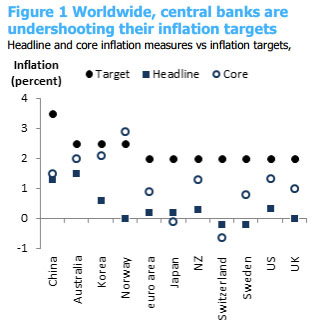
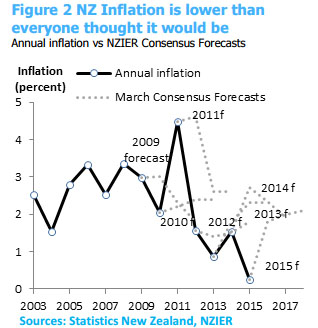
But the global economic environment is changing. The Reserve Bank used to have to raise rates when demand for goods was sufficiently strong that it threatened to bring about higher inflation. Today, the battle is not so much demand, but negotiating a myriad of shocks to the way firms supply goods. These shocks include improvements in logistics that make it easier and faster to deliver goods to consumers, new technologies like fracking which make extracting oil cheaper, and new devices that place product information at consumers’ fingertips. Globalisation and the internet have greatly increased competitive pressures across the globe. New Zealand is no exception.
Targeting income growth deals with the new economic environment better than inflation targeting
High time to reassess the monetary policy framework
We could tweak the existing system…
Before leaping in to wholesale framework changes it is worth considering tweaks to the status quo that might improve how the economy deals with supply shocks while preserving inflation targeting. We see two possible tweaks that would help:
♦ Taxing and contracting in real not nominal terms – Many of the costs associated with inflation come from taxing nominal rather than real incomes. If feasible, taxing real incomes would help mitigate some of the costs and uncertainty from indexing taxation to nominal incomes. Likewise, contracting over real wages that take into account changes in inflation, rather than nominal wages that don’t would reduce the costs of inflation.
♦ Broadening the Policy Targets Agreement – Rewriting the Policy Targets Agreement to place more weight on asset prices and output rather than inflation could help on the margin, allowing the Reserve Bank to focus more on output rather than inflation. But the Policy Targets Agreement has been tweaked pretty hard. Pushing further risks disconnecting with the nominal anchor, that is, the variable a central bank uses to set household and firm expectations about how where interest rates need to be.
…but benefits are likely to come from more fundamental changes.
If supply shocks that lower inflation but don’t affect growth keep hitting the economy there are alternatives. Rather than targeting inflation, targeting growth in nominal incomes produces good outcomes by allowing a central bank to respond more rapidly to supply shocks. Nominal GDP targeting requires raising interest rates when nominal GDP is above trend and lowering rates when nominal GDP is weak.
Many economists test how nominal inflation targeting performs relative to inflation targeting in stylised economic models. These models suggest less volatile inflation, output and interest that make people about 22 percent better off.5 This relates to the responsiveness of monetary policy and Sumner (2014) argues that had the Federal Reserve followed a nominal GDP target, monetary policy would have responded more rapidly, mitigating the extent of the recession after the GFC.6 Models that include asset prices are likely to exacerbate these differences.
A good monetary policy regime needs to do two things:
♦ Define a nominal anchor – that is, a target variable the central bank uses to align expectations of households and firms on the future path of interest rates
♦ Help stabilise the economy against shocks that buffet the economy.
A monetary policy regime also needs to be feasible for a central bank to implement. A central bank cannot simultaneously fix the exchange rate and move the interest rate to achieve an inflation target since capital flows will look to take advantage of interest rates differentials and shift the demand for Kiwi dollars and the exchange rate.
The Reserve Bank of New Zealand has tried basically two monetary policy regimes – fixing the exchange rate which was tried until the Kiwi was floated on 4 March, 1985 and then inflation targeting from the early 1990s. Each regime tries to minimise the impact of shocks on the economy. In the case of a fixed exchange rate, mitigating volatility by fixing export and import prices or under inflation targeting, moving interest rates in response to shocks. Similar to inflation targeting, under nominal income targeting a central bank responds to economic shocks by moving interest rates up or down.
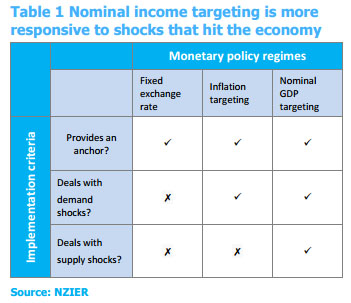
And nominal income targeting would deal with demand shocks equally as well as inflation targeting, for example, by reducing rates quickly during the GFC. Since demand and supply shocks are the key shocks that hit the economy, it is critical any regime can deal with these shocks. Table 1 assesses nominal income targeting inflation targeting against current and previous monetary policy regimes using our key criteria.7
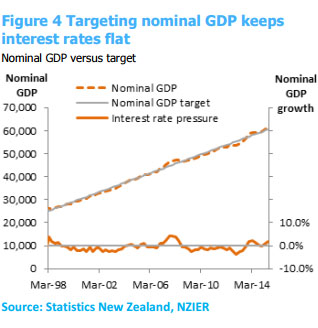
Right now the gap between inflation and nominal income growth is pretty big and growing, yielding materially different interest rates settings depending on the underlying framework.
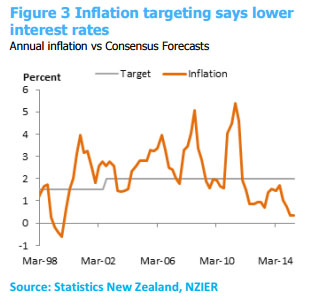
Our current inflation targeting framework says lower interest rates are required to hit a two percent target while a nominal GDP target would suggest interest rates are about right.
If the current low inflation environment persists for much longer it is difficult to justify the extended period of inflation away from target as temporary factors. Either rates need to be lower or the inflation target is undermined.
In contrast, nominal GDP targeting seems like an increasingly sensible framework for setting monetary policy delivering a better mix of inflation and GDP growth.
At the very least, there are appealing options should inflation targeting run out of steam.
Notes:
1. Ehrman (2015) describes the current period as “targeting inflation from below”.
2. Japan has recently set a target for nominal GDP.
3. Sometimes nominal income growth targeting is criticized as being difficult to implement because GDP is subject to revisions. But nominal income growth targeting requires setting interest rates so future income growth is close to target. Interest rates would not be buffeted by revisions to GDP. Revisions to GDP also affect the output gap, a crucial driver of inflation in most Reserve Bank models. These models apply under both frameworks so from a modelling perspective revisions are equally problematic.
4. For some countries with a large amount of debt after the Global Financial Crisis, targeting nominal GDP is appealing since it allows for some inflation and nominal GDP growth that help inflate debt away, keeping nominal debt at levels that the economy can manage. Tight monetary policy that aims to keep a lid on inflation works against repaying debt. This rationale doesn’t apply to New Zealand with government debt at relatively low levels.
5. See Jensen (2002) while McCallum and Nelson (1998) find nominal income targeting dominates inflation targeting in a stylised open economy model.
6. McCallum and Nelson (1999) and Jensen (2002) provide model-based insights and see Sumner (2014) for an overview of recent US debates.
7. Mann and Hooper (1993) provide several examples of evaluating monetary policy regimes based on the response to demand and supply shocks.
References
Ehrmann, Michael (2015), “Targeting Inflation from Below - How Do Inflation Expectations Behave?,” International Journal of Central Banking, Vol. 11 No. S1, September.
Frankel, Jeffrey (2014), “Nominal GDP Targeting for Middle Income Countries”, Working Paper Series rwp14-033, Harvard University, John F. Kennedy School of Government.
Jensen, Henrik (2002), “Targeting Nominal Income Growth or Inflation?,” American Economic Review, American Economic Association, vol. 92(4), pages 928-956, September.
Mann and Hooper (1993), Evaluating Policy Regimes: New Research in Empirical Macroeconomics, Brookings Institute, Brookings Institution Press,
McCallum, Bennett T. and Edward Nelson (1999), “Nominal income targeting in an open-economy optimizing model,” Journal of Monetary Economics, Elsevier, vol. 43(3), pages 553-578, June.
Sumner, Scott B. (2014), “Nominal GDP Targeting: A Simple Rule to Improve Fed Performance”, Cato Journal, Vol. 34, No. 2 Spring/Summer.
Christina Leung is a senior economist and Kirdan Lees is a principal economist at the NZIER. The original version of this article is here.
We welcome your comments below. If you are not already registered, please register to comment
Remember we welcome robust, respectful and insightful debate. We don't welcome abusive or defamatory comments and will de-register those repeatedly making such comments. Our current comment policy is here.