

By Bernard Doyle*

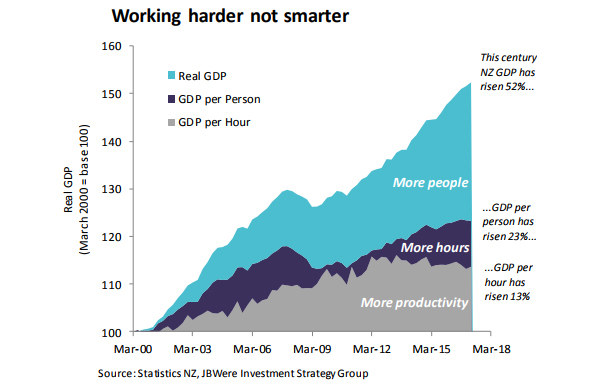
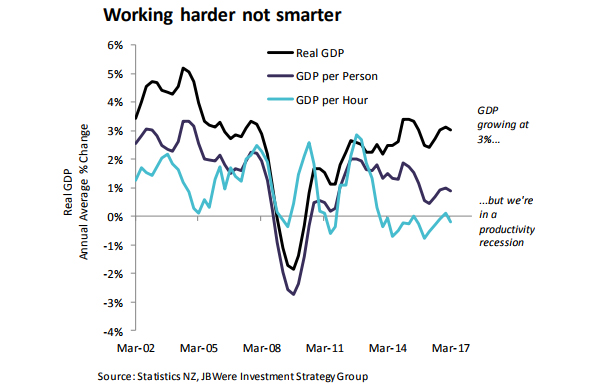
New Zealand has been in a productivity recession since 2012. Not that you’d notice from headline GDP numbers, which continue to print impressively. However GDP per hour worked has flat-lined for five years. Our per capita GDP growth is similar to Japan.
In the absence of productivity gains, our economy has relied on more people, working more hours. Net migration provides a conveyor belt of fresh labour, but it comes with attendant bottlenecks in housing and infrastructure. The profitability windfall for these sectors has not arrived, with earnings warnings from all the major listed construction companies this year.
An economic growth model that is reliant on pushing the capacity envelope can be prone to mishap. Against that, our key sources of demand: agricultural commodities, tourism and net migration, are volatile and have a habit of evaporating at short notice. Moreover asset prices have become a vulnerability: both housing and equity markets in New Zealand are priced for perfection.
It is election season in New Zealand but from an asset allocation perspective we are voting with our feet ahead of the big day. Irrespective of election outcome, we are recommending clients reduce their exposure to the NZ equity market by about a quarter.
A Capacity Hungry Growth Model…
GDP per hour is in recession...
The New Zealand economy appears locked in a volume game. Since the turn of the century, the economy has grown in size by around 50%. However most of the growth has come from more workers, working harder (population growth and hours worked, previous page, left). The holy grail of prosperity, GDP per hour worked, has grown at a far less impressive 13%. In other words, only about a quarter of our growth has come from working smarter. More worryingly, GDP per hour stalled in 2012. So, for the past five years, all of our economic growth has relied on more people, working more hours.1
…growth is reliant on population expansion
Of course, productivity growth has proven elusive in many advanced economies – it is not to suggest New Zealand is failing. However equally, it would be disingenuous to suggest our top quartile OECD growth rate is a mark of success. It really reflects a choice to utilise population to drive growth in a way most of our trading partners are not prepared to. Japan for example, which has similar per capita GDP growth to New Zealand, could conceivably achieve similar headline GDP growth if it chose to loosen its immigration policy.
So is our population-dependent growth model working well? We observe that there is a dearth of analysis on the question of the optimal rate of population growth for this country. 2 Immigration is by far our most important source of population growth. Unfortunately the policy debate in New Zealand has deteriorated to trench warfare: immigration is either “good” or “bad”. While we sit on the “good” side of no-mans land, we wonder how much thought has gone into establishing an appropriate rate of inflow to shoot for.
Tight capacity can lead to mishaps
We have a peculiar lens of looking at New Zealand: as investors, who can choose to deploy capital here, or in other markets. In that respect, the balance and sustainability of our economic growth is important to us. Growth that pushes the capacity envelope has a limited shelf life. It is also prone to mishap: housing bubbles, resource misallocation, interest rate volatility and other dangers. We won’t judge whether playing a volume game in this economy is the right thing to do, but as investors, we have some concerns:
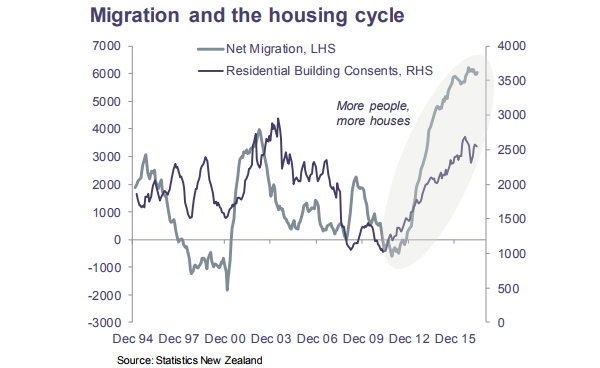
• Net migration drives housing demand, but it has a boom-bust history (above left). Unfortunately, our two other important cyclical drivers, tourism and dairy, can also evaporate at short notice.
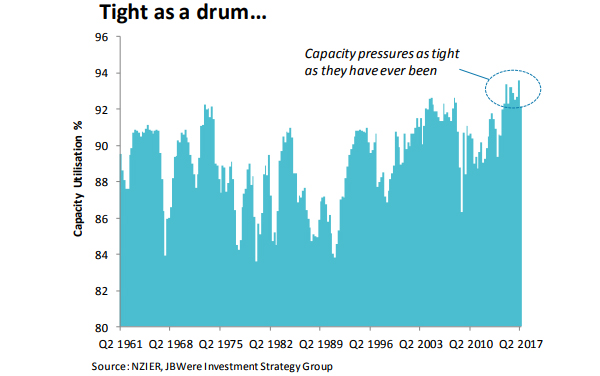
• New Zealand’s capacity pressures are unprecedented (above right). This is not surprising given the economy that has been in a productivity recession since 2012.
• High immigration is touted as a solution to alleviating capacity pressures, but it becomes a game of bop-a-mole. Shortages of labour in specific sectors (agriculture, tourism) may be relieved, but exacerbated in others (housing, infrastructure, education). Why? Migrants, like locals, need accommodation, transport, schools, hospitals and other necessities of life.
• Wage increases to attract talent into successful businesses can be undermined if the solution to input shortages is invariably tapping into the vast global labour pool. Relative prices play a critical role in winnowing the wheat from the chaff in the productive sectors. If a business cannot afford to attract staff from another area of the economy, it can be a signal to adapt. Dampening this will ultimately hamstring productivity growth.
The construction sector epitomises the dilemma we face as investors. After three years of record migrant inflows, which according to some would leave us awash with fresh skilled labour, a senior executive of Fletcher Building described the construction sector thus:
"We must acknowledge the New Zealand industry is absolutely at capacity and you're seeing that reflected in sub-contractor rates and the availability of resources for jobs, etc….It's an unprecedented level of activity, it's ramped up very quickly and if you don't manage it carefully, we can attest it hurts you certainly." Philip King, July 2017
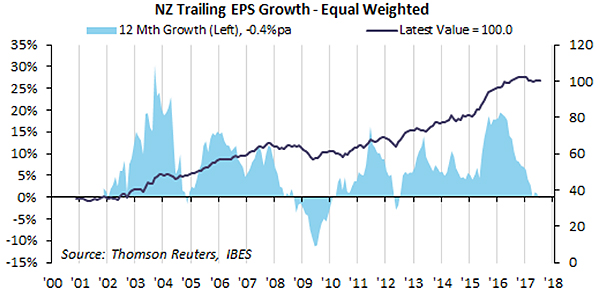
Earnings growth has faded…
So, in the midst of a building boom, construction has been a tough sector to own, with profit warnings in all of the major listed companies. This underlines the trade-off of an economy that has the needle in the red. Volume growth is impressive, but profitability actually becomes harder to find. Indeed looking at our broad market measures, profit growth has been losing momentum for more than a year (below).
…Prone to Asset Price Distortions
…but asset prices are distorted
All of the above would be no more than a bugbear if we could pay the right price for assets in the economy. Unfortunately, this is not the case - we see clear evidence of asset price distortions that either present tail risks to the economy or simply diminish future return potential. The two that concern us are:
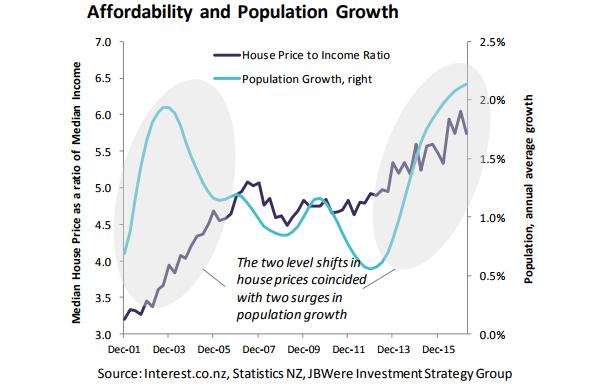
Housing. The popular narrative on the housing shortage in Auckland and other hotspots is all about easing supply-side constraints such as regulation and land use. Of course these are valid debates, but not enough attention is paid to demand. The two level shifts in house price:income coincided with two immigration-led surges in population growth in 2002-04 and 2014-now (below left).
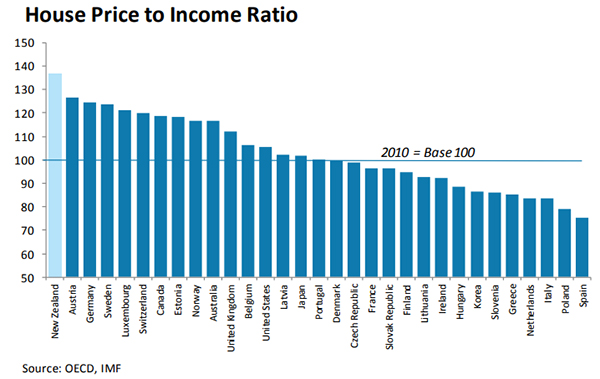
The run-up in our house price ratios since 2010 has left the rest of the OECD in the dust (below). A half glass full interpretation could be that this is yet another indicator of our success. However on that interpretation Ireland and Spain looked world-beaters in 2007, before gravity kicked in. We aren’t directly exposed to house prices in our equity portfolios, but a correction would be a headache as the collateral damage to the rest of the economy is significant. So while we aren’t forecasting a housing crash, elevated price:income ratios are just another source of risk to medium term investors in the New Zealand theme.
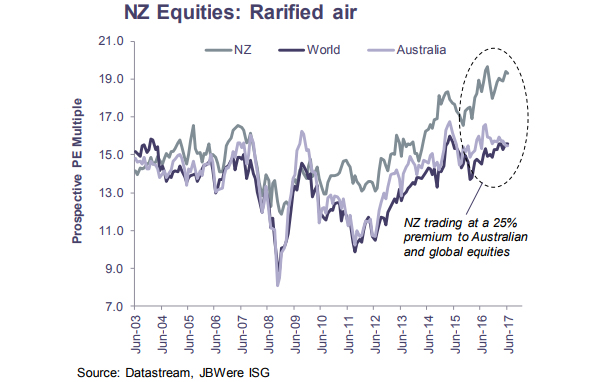
Equities. Valuations in the equity market continue to concern us. At around 20x earnings, New Zealand is one of the most expensive share markets in the world (see chart above). To be clear, we don’t believe NZ equities are a speculative bubble. That said, there has been a clear one-off valuation lift from falling global interest rates. Unless we believe bond yields can again hit the all-time lows of mid-last year, that valuation tailwind has ended. On the contrary we see a better than even chance that yields trend higher as the emergency policies of central banks around the world are progressively wound back.
A low return outlook, with risk to the downside
Our judgement is that the risk to New Zealand equities is not a sudden correction, although as we saw in September last year, that can certainly happen. Our concern is that current equity valuations have baked in about all the good news it is possible to see, and then some. Consequently a long period of low returns (0% to +5%) is a plausible scenario. Moreover, if some of the sustainability issues we are seeing in our economy came back to bite us, low returns could become “no returns”, or negative returns.
From Macro to Money: An Easy Asset Allocation Decision = an easy asset allocation decision
Complaining about productivity growth is almost a hobby for the economics profession. The test for us is whether we walk the talk. In the spirit of the election season, from an asset allocation perspective we are voting with our feet ahead of the big day. Irrespective of political outcome, we recommend clients reduce their exposure to the NZ equity market by about a quarter.
Our asset allocation recommendations and their rationale are outlined in our July Investment News here. The link between the economy to the equity market is summarised below:
• Our poor productivity performance is indicative of an economy that is living close to the edge of spare capacity, and reliant on population expansion to grow.
• Our key sources of demand: agricultural commodities, tourism and net migration, are volatile and have a habit of evaporating at short notice.
• Asset prices are either adding risk to financial stability (house prices) or eroding future return prospects (equities).
• Listed companies don’t appear to be thriving in the productivity recession, and marketwide earnings growth has tailed off.
Looking from the macro backdrop, to valuations, to earnings, the decision to reduce our NZ equity holdings is not a difficult one.
*Bernard Doyle is a strategist at JBWere. This is a re-post of a JBWere report. It is used here with permission.
We welcome your comments below. If you are not already registered, please register to comment
Remember we welcome robust, respectful and insightful debate. We don't welcome abusive or defamatory comments and will de-register those repeatedly making such comments. Our current comment policy is here.