

The strong savings patterns of Kiwis seen during the early days of the pandemic are being quickly reversed, while the value of household assets is falling, according to new data out from Statistics New Zealand.
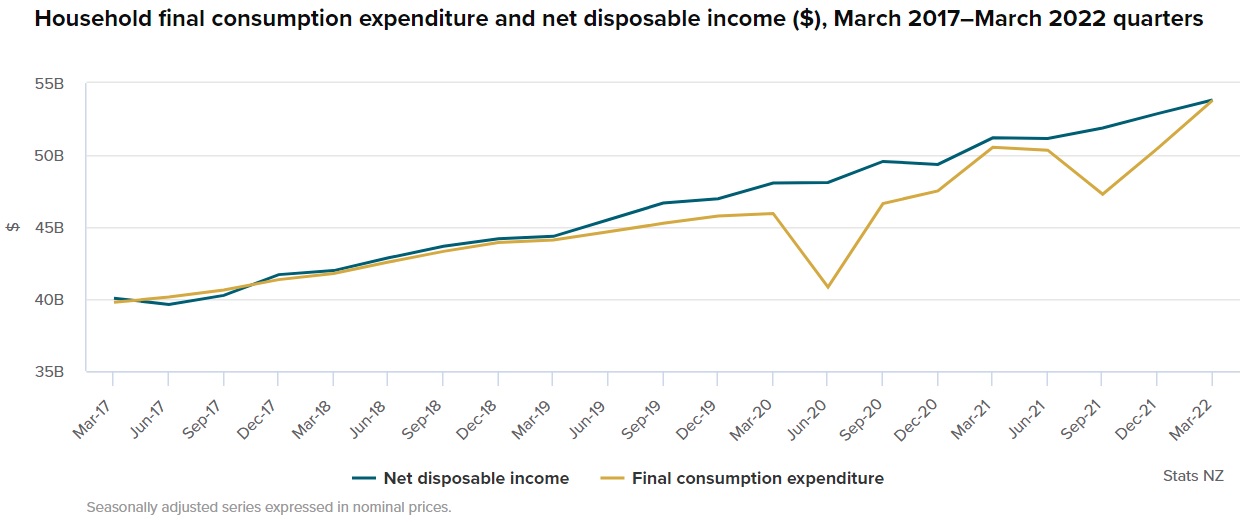
Stats NZ says in the March quarter this year Kiwis spent nearly every dollar of their income "as the ratio of saving to disposable income approached zero".
Also, household net worth fell in the March 2022 quarter by $42.3 billion, or 1.7%.
This is the first quarterly decrease in household net worth since a fall of 0.3% in the June 2019 quarter.
In terms of the household spending, Stats NZ said in the March quarter a rise in disposable income was "outpaced" by continued growth in household spending. This resulted in a return to the level of saving seen before the pandemic.
The March 2022 quarter saw household disposable income increased by 1.8% to $53.8 billion - but at the same time consumption spending increased by $3.3 billion (6.6%) to $53.8 billion.
Stats NZ's national accounts institutional sector senior manager Paul Pascoe said in the earlier stages of the pandemic, household saving was relatively high.
"Limited access to shops and services decreased household spending. At the same time, government subsidies supported household incomes.
"Saving decreased in the March 2022 quarter as household spending surged,” he said.
In terms of household net worth, Stats NZ measures this as the value of all assets owned by households less the value of all their liabilities, or what they owe.
Household net worth fell in the March 2022 quarter by $42.3 billion, or 1.7%. The impact of falling house prices can be seen.
The value of total household assets fell $38.2 billion while liabilities rose $4.1 billion, both contributing to the overall decrease in net worth.
Stats NZ says households have both financial and non-financial assets. For the household sector, non-financial assets are mostly a mix of residential buildings and land, making up around 45% of total assets.
Combined 'non-financial assets' (IE largely property) fell $30.6 billion in the March 2022 quarter following an increase of $76.1 billion in the December 2021 quarter.
"The fall in the value of non-financial assets represents a decrease of 2.3% this quarter after a sustained period of strong growth. These property valuations include owner-occupied properties only," Stats NZ said.
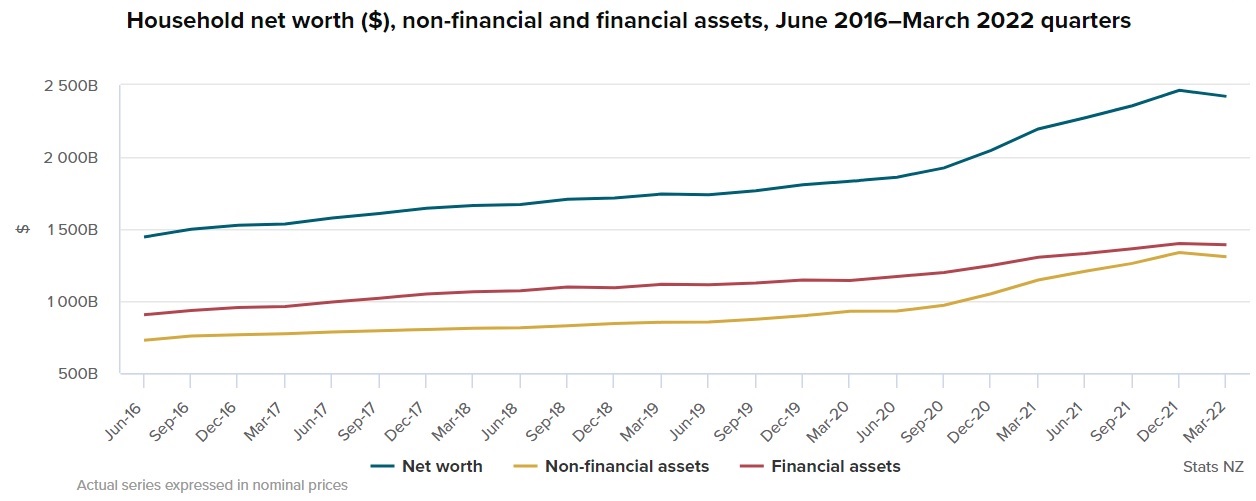
Household financial assets also fell during the quarter, down $7.7 billion. Equity and investment fund shares led the fall, down $6.8 billion. This asset class includes shares held in listed companies, investment fund shares, and equity in unincorporated New Zealand businesses. The latter includes the ownership of rental properties as equity, that is, the value of the properties less the mortgages held.
Households also experienced a $3.5 billion fall in the value of their insurance and pension assets in the March 2022 quarter. Partly offsetting falls in household financial assets was an increase in currency and deposits (such as term deposits), up $2.6 billion. This is the only financial asset class to record an increase from the previous quarter.
Household financial liabilities like housing loans, consumer loans (credit card debt), and student loans grew 1.5%, continuing a relatively steady increase in recent quarters.
We welcome your comments below. If you are not already registered, please register to comment
Remember we welcome robust, respectful and insightful debate. We don't welcome abusive or defamatory comments and will de-register those repeatedly making such comments. Our current comment policy is here.