

The Financial Markets Authority (FMA) is reporting a big spike in the amount of money withdrawn by the over-65s from KiwiSaver accounts in the past year.
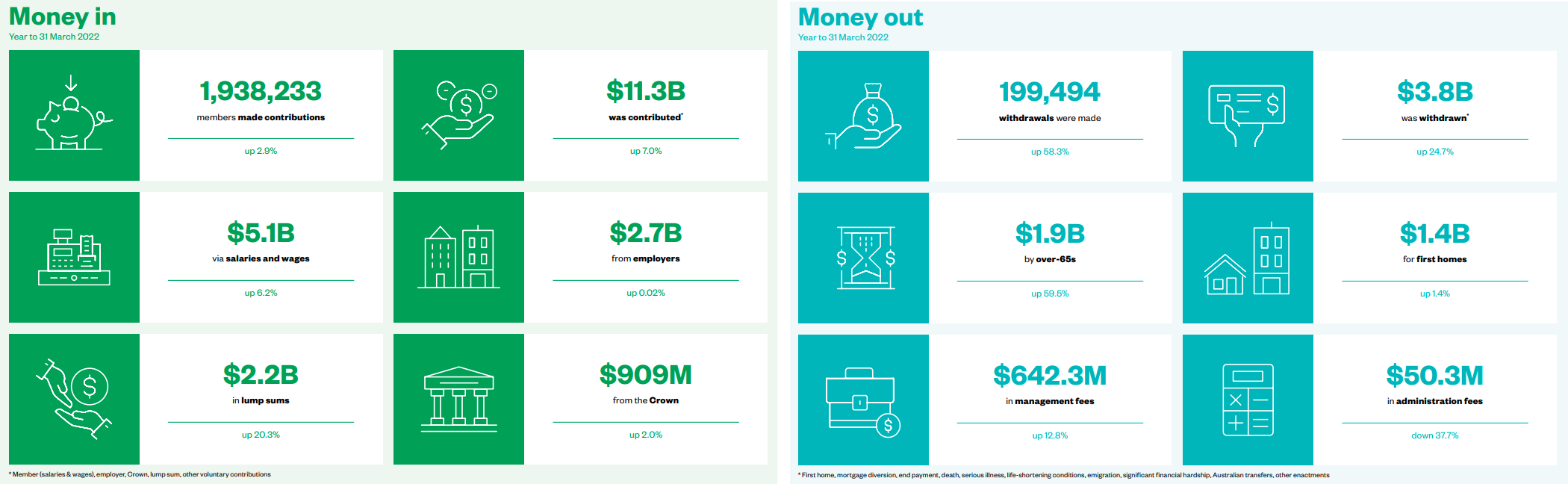
The FMA's KiwiSaver Annual Report for 2022 says that in the year to March 2022 the over-65s withdrew $1.95 billion – which was up a whopping 59.5% on last year’s $1.22 billion, and almost double the amount this age grouping withdrew just three years ago.
"This means retirees are again the biggest withdrawers, after a dip last year that saw them exceeded by first home buyers for the first time," the report says.
More retirees chose to fully exit KiwiSaver this year too – up 10.0% to 21,466.
The number of over-65 members kept growing, however, by 14.0% to 168,028 – on top of last year’s 15.0% increase.
The FMA said this trend is in part due to KiwiSaver being more popular with ‘younger’ people over the past 15 years, i.e. more signing up in their fifties, who are now reaching retirement age.
Asked about the big spike in withdrawals in the past year, an FMA spokesperson pointed to the move as "a sign of KiwiSaver’s maturity and that is working as designed", meeting its original purpose of providing income in retirement.
"We expect the amount withdrawn by over-65s will continue to increase in years to come."
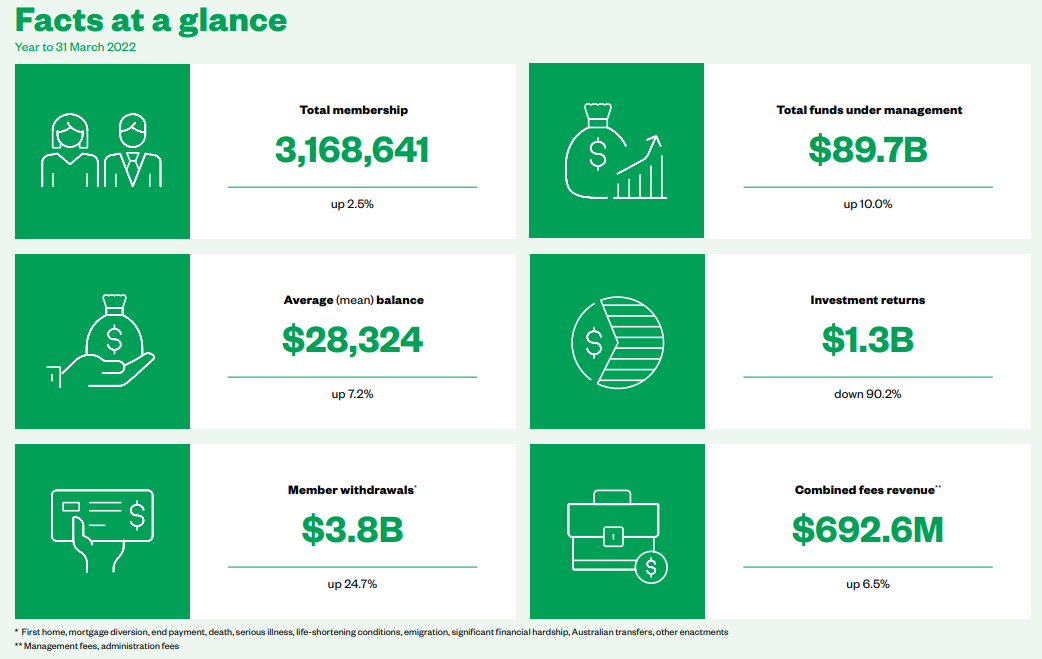
First home withdrawals stayed relatively static after rising a lot last year, up just 1.4% to $1.44 billion.
However, this is still double the amount withdrawn in the year to March 2018, which the FMA said can be attributed to the corresponding rise in house prices, and heightened public awareness of KiwiSaver home withdrawals.
With unemployment down during the year, so too were significant financial hardship withdrawals, decreasing 33.4% to $106 million, back to the levels seen before a jump last year.
In terms of the big picture over the past year, KiwiSaver investment returns were $1.3 billion, a sharp fall on 2021’s extraordinary $13.2 billion gain, yet up on 2020’s Covid-induced $820 million loss, and in line with the more ‘normal’ year to March 2019, which gained $3.8 billion, the FMA said.
KiwiSaver funds under management have shown net growth of 10% to $89.7 billion for the year ended 31 March 2022, despite another turbulent period for global markets.
The 10% net growth in funds under management was largely driven by $11.3 billion in contributions from 1,938,233 members. This included a significant 20.3% increase in lump sum contributions, totalling $2.2 billion.
"After its 15th year, KiwiSaver’s size is now equivalent to around 25% of national GDP (up from 15% of GDP in 2017)," the FMA said.
FMA's director of investment management Paul Gregory said the data in this year’s report shows the strength of KiwiSaver as a long-term savings vehicle, with resilience to volatility a necessary feature of its design.
"While we celebrate World Investor Week, the report reinforces our messages about taking a long-term view for investing."
The total amount invested in growth and balanced funds surged 17.7% and 20.8%, respectively, while assets in conservative funds fell 14.4% in part due to bonds suffering significant price declines but also as around 300,000 default members were moved from conservative funds to balanced funds under the Government’s new default provider settings in place from December 1, 2021.
The FMA said the shift in the amounts invested across the different fund types is consistent with a longer-term trend where the numbers of investors in conservative funds (excluding previous default members) has shrunk 3.6% from 2017 to 2022 while growth fund membership has ballooned 54.8% in the same period, now accounting for nearly half of overall membership.
The average annual fee paid by active members rose by just 2.1% to $245, while the average annual fee paid by default members fell 11.1% to $64.
"New Zealanders have become increasingly aware of the role KiwiSaver can play in their financial well-being and preparedness for retirement, particularly when the likelihood of owning a home becomes less certain," Gregory said.
We welcome your comments below. If you are not already registered, please register to comment
Remember we welcome robust, respectful and insightful debate. We don't welcome abusive or defamatory comments and will de-register those repeatedly making such comments. Our current comment policy is here.