

Household mortgage interest costs rose by some 39% in the year to September, according to new figures from Stats NZ.
These rising mortgage costs, along with high food prices, helped to push the annual inflation for households up to 7.7% in the year to September, as measured by Stats NZ's household living-costs price indexes (HLPIs).
That's actually higher than the inflation figures that came out last week, as measured by the Consumers Price Index (CPI).
A major difference between the HLPIs and the Consumers Price Index (CPI), which showed annual inflation of 7.2%, is that the CPI includes the cost of building a new house (which rose 17% in the year to September), while the HLPIs include mortgage interest payments - which shot up by the aforementioned 39%.
"These two measures of inflation are typically used for different purposes. A key use of the CPI is monetary policy, while the focus of the HLPIs is to provide insight into the cost of living for different household groups," Stats NZ said.
It said all household groups faced their highest or equal-highest annual cost-of-living increase since the HLPIs series began in 2008. The 7.7% annual figure is actually an increase from 7.4% as of the June quarter.
This is the breakdown by groups of Inflation experienced from the September 2021 quarter to the September 2022 quarter, according to Stats NZ:
- all households was 7.7%
- beneficiary was 6.5%
- Māori was 7.7%
- superannuitant was 6.8%
- highest-spending households was 8.8%
- lowest-spending households was 6.5%.
"Higher prices for housing and food were the main contributors to the increase across all the household groups," Stats NZ's consumer prices manager Katrina Dewbery said.
Stats NZ says the quarterly household living-costs price indexes (HLPIs) measure how inflation affects 13 different household groups, plus an all-households group. The consumers price index (CPI) measures how inflation affects New Zealand as a whole.
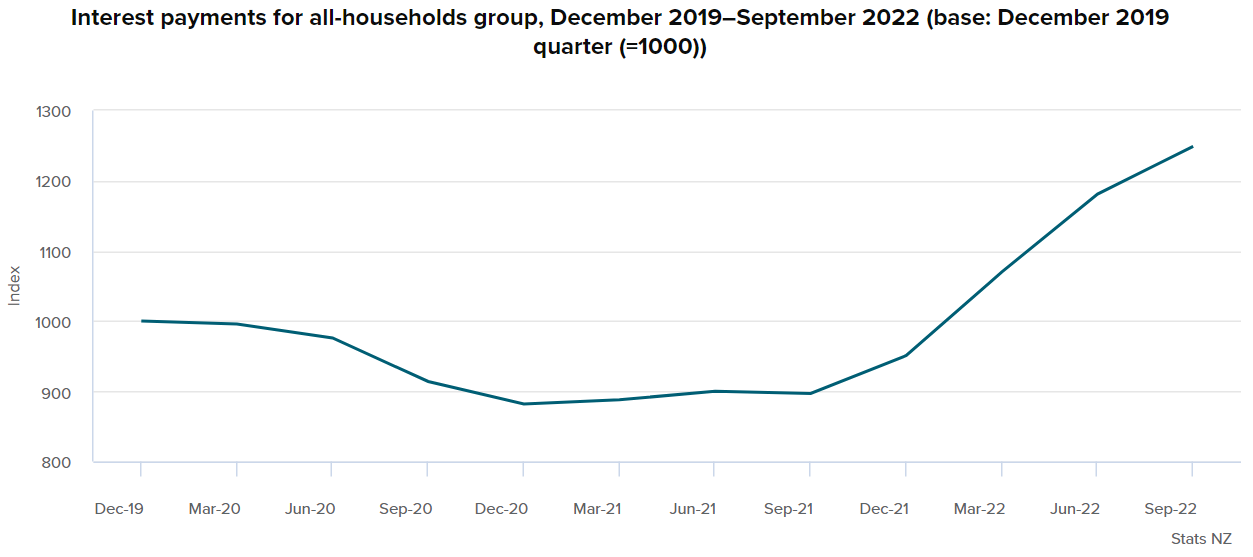
Stats NZ says about 7.4% of expenditure for higher spending households is on interest payments. This compares with 4.7% for the average household and 2.0% for the lowest-spending households group. This means highest-spending households experience the higher interest rates more than other household groups.
Petrol prices were another contributor to the rise for most household groups, increasing by 19% for the average household when compared with the same quarter last year.
Quarterly living costs rose for all household groups in the September 2022 quarter compared with the June 2022 quarter. The cost of living for the average household rose 2.1% when compared with the June 2022 quarter. It was 1.5% for beneficiary households, 1.9% for lowest spending households, and 2.4% for highest-spending households.
Stats NZ said rising food prices were the biggest contributor to quarterly inflation for all household groups. For the average household, food prices rose 4.1%.
Fruit and vegetable prices were the biggest contributor to the price rise for all household groups, followed by grocery food. Within fruit and vegetables, tomatoes, lettuce, and broccoli were the main contributors to the rise.
Higher prices for property rates and related services, airfares, rent, and interest payments were also major contributors to quarterly inflation for most household groups.
We welcome your comments below. If you are not already registered, please register to comment
Remember we welcome robust, respectful and insightful debate. We don't welcome abusive or defamatory comments and will de-register those repeatedly making such comments. Our current comment policy is here.