
This is the second part of our half-year look at 2024. The first part can be read here.
So, what's 2024 to be? A game of two halves? Or just one rather soggy (w)hole?
Well, while it would be nice to think 'the best is yet to come' for this year, it looks like it would be wishful thinking. Very wishful thinking.
As I write this about halfway through the year, we appear as a country to have descended into something of a funk. The previous mental resilience that we saw in the face of high interest rates seems, all of a sudden, to have crumpled rather quickly. The economy is down. People appear to be down. We are in, well, a soggy hole.
Where do we go from here then? How quickly can we pick back up from this. And when?
In very simplistic terms, we need the following chain reaction:
Inflation comes down, the Reserve Bank cuts the Official Cash Rate, retail interest rates (mortgages etc) come down, people feel wealthier and start spending more money again, businesses start to pick up with the increased spending, more jobs are created. Somewhere in the midst of this the housing market will perk up (this could happen at any stage in the chain reaction; remember this is a country that added 40% to its house prices during a pandemic - there's no bad time for a housing market surge in New Zealand).
As ever, I'm not going to try to specifically predict the timing of any of this as such. I will just outline here what I see as the crucial issues over the remaining six months of this year and what the potential ramifications are. Looking for clues, if you like.
Inflation is the key. The Reserve Bank has set out to smash inflation by hiking the Official Cash Rate (OCR) all the way up from 0.25% to 5.5% in order to take heat out of what was a very overheated economy. Hence, we now have: High mortgage rates, reduced spending, reduced economic activity and now rising unemployment.
At its peak in this 'cycle' annual inflation hit 7.3%. As of the March quarter it was 4.0%. The RBNZ targets inflation between 1% and 3%, and explicitly, wants 2%. Here's an abridged version of the forecasts from the latest Monetary Policy Statement. (The full table is on page 50).
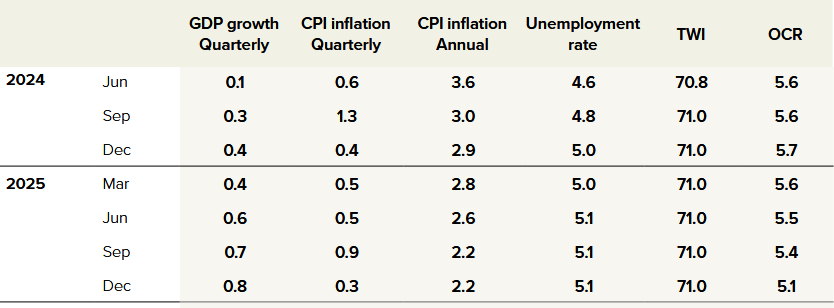
So, note that the RBNZ is now forecasting inflation will get back under 3% in the December 2024 quarter. Believe me, the RBNZ won't contemplate 'leaving us alone' until then.
But it's not just about the so-called 'headline' inflation figure. The RBNZ frets over domestically sourced, or non-tradable inflation. And this is proving tough to get down. Statistics NZ is releasing the June quarter Consumers Price Index (inflation) figures on July 17. This CPI release will be even more significant than usual just because of how finely the economic situation is balanced. I'll have a detailed preview of it closer to the time.
In the meantime, however, I will say that the RBNZ really needs the June quarter CPI figures to demonstrate signs that, particularly the domestic inflation, is coming to heel.
Prior to the March quarter, the RBNZ had forecast that the non-tradable/domestic figure would fall to 5.3% for that quarter, from 5.9% as of December. In the event it fell only to 5.8%.
The RBNZ is trying again. It's forecasting that as of the June quarter annual non-tradable inflation will, this time, hit that 5.3% figure, down from 5.8%. The RBNZ's current forecast is for non-tradable annual inflation to fall to 4.7% by December. And that of course is the point at which the RBNZ believes 'headline' inflation will fall under 3.0% - to 2.9% to be precise.
We've just got to hope for the best that these forecasts are achieved because the RBNZ's going to keep throttling us till it decides inflation is under control.
Okay, we are getting there - but when?
The RBNZ itself IS starting to show more confidence that inflation will be made to behave. RBNZ chief economist Paul Conway, in recently releasing some new RBNZ inflation analysis, said the bank expects spare capacity to start emerging in the economy over 2024, and this will "feed through strongly into lower domestically generated inflation". He didn't say it, but the message I inferred was: 'Trust us, we are getting there'. Okay, but getting there when?
Frustratingly, nobody can absolutely promise when those inflation figures will definitely be in the kind of retreat that will enable the RBNZ to call off the dogs and start reducing that Official Cash Rate.
As can be seen from the above table of forecasts, the RBNZ is not currently forecasting reducing the OCR till the second half of 2025. Personally, I'm not sure what sort of shape our economy would be in if the RBNZ sticks to that sort of timeframe.
I think the economy has in the past three months, and even more so perhaps in the last six weeks, shown signs of really buckling under. Spending has dried up, the signs are the job market is tightening quickly, the economy is as flat as a pancake. Some economists are already forecasting that GDP will have gone backwards again in the June quarter 2024. And, yes, house prices have gone backwards again and economists are quickly slashing forecasts of future price growth.
Phew. Let's be positive. It is possible that the real swoon that now seems to have come over the economy could see the decline in inflation accelerate - and faster than the RBNZ anticipates. Oh, yes, please.
The wholesale interest rate markets, which like to jump ahead on these things, are currently fully pricing in the first cut to the OCR in November of THIS year. And for good measure a follow-up cut is also fully priced in for February 2025.
Is this possible? Well, yes, I think it is - IF inflation really starts to retreat.
However, I guess if we want to be the ultimate in glass-half-empty pessimists we could also ask, yes, okay - but what if inflation DOES in any case stay somewhat stubbornly high?
Well, that would be when we could really start to worry, I think. And that's why the second half of this year is so important, kicking off with those inflation figures on July 17.
We really need inflation to behave itself - sooner rather than later
If, particularly the domestic inflation figures, stay still quite resiliently high then we are in trouble. Have no doubt. Because the RBNZ would feel compelled to hold the OCR high and the economy would - based on what we are seeing now - start to be squeezed beyond pain.
Conversely, if the CPI figures do show signs of dropping off quickly, then that's very good news.
So, in terms of what happens over the rest of this year, the 'happy' scenario would be inflation retreating to the point the RBNZ starts to at least seriously consider cutting the OCR.
The 'unhappy' scenario would be if inflation continued to be 'sticky' and we would then get to the end of the year with no clear sign of when those interest rates might start to come down.
The best case scenario then would likely be a first cut to the OCR in November. I can't really envisage any situation in which the RBNZ could be convinced to go earlier than then. If the OCR was to be cut in November, that would send the country into the Christmas break in a rather better mood, but would of course not be able to 'save' this year as one of economic stagnation.
So, we would be looking beyond this year and into 2025 for recovery and all that entails, with some spending returning in the economy, the labour market beginning to stabilise and, yes, that housing market starting to perk up again. It would probably be only a gradual recovery, gaining strength in 2026. But a recovery is a recovery. We'll take it.
There's no guarantees
How quickly our economy can start to pick up again is therefore going to be totally dependent on the timing of that first OCR cut. The longer we may have to wait for that, the longer it will take the economy to stabilise and then start to go forward again.
The other point to think about is if inflation does somehow manage to stay stuck above 3%, for how long does the RBNZ continue squeezing? Does there come a point at which the economy simply starts to break? If so, would the RBNZ eventually have to back down on the high interest rates anyway?
All we can do in the meantime is push on through a second half of the year that looks as challenging, if not even more challenging, than the first half was.
Beating inflation has become the be-all-and-end-all. We are just going to have to hope it proves to be worth it.
We welcome your comments below. If you are not already registered, please register to comment
Remember we welcome robust, respectful and insightful debate. We don't welcome abusive or defamatory comments and will de-register those repeatedly making such comments. Our current comment policy is here.