

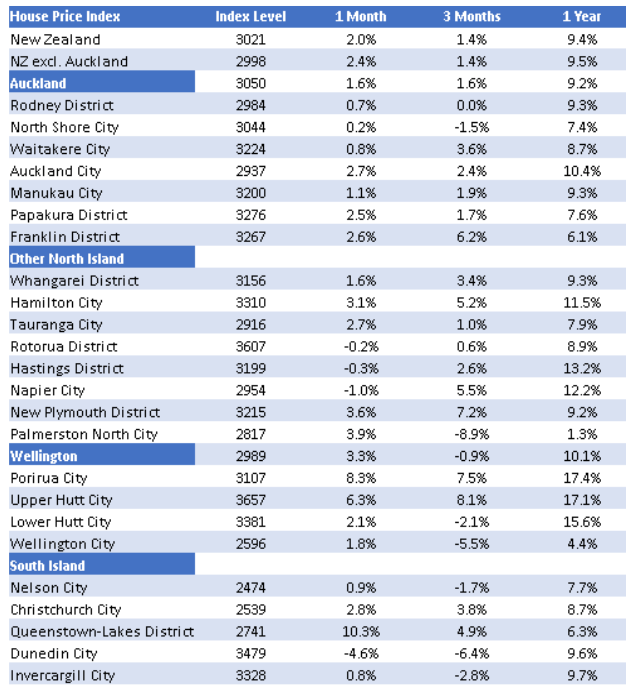
Dunedin was the only place in the country to show any serious price weakness in July, while prices took an unexpectedly large jump in Queenstown-Lakes, according to the Real Estate Institute of NZ's House Price Index (HPI).
The HPI adjusts for changes in the composition of sales each month so is considered a better indicator of overall price movements than either median or average prices.
It shows that nationally, housing prices increased by 2.0% overall in July compared to June, are 1.4% higher than they were in April, and 9.4% higher than they were in July last year.
Price growth was slightly more subdued in the Auckland Region with the HPI up 1.6% in July compared to June, and 9.2% compared to 12 months earlier.
Within the Auckland region price growth was strongest in the central Auckland suburbs and weakest on the North Shore (see table below).
The area with the strongest price growth was Queenstown-Lakes, with the HPI for the district up a whopping 10.3% for the month, putting it ahead by 6.3%% for the year.
That was surprising given the area's reliance on tourism, however prices in the region can be volatile, so monthly figures should be treated with some caution.
Dunedin went against the national trend and recorded a 4.6% decline in the HPI for July compared to June which pushed it down by 6.4% compared to three months earlier, perhaps signalling that the city's recently strong, investor driven price growth may be coming to an end.
There was also a hint of flat or softer prices in the figures for Rotorua, Napier and Hastings.
However the strength of the overall figures caused Westpac's economists to revise their expectations for price movements for the rest of the year. Westpac Senior Economist Michael Gordon warned that the current strength in pricing might not last, but that prices were likely to fall less than had previously been expected.
"The surge in sales in July suggests a degree of pent up demand following the COVID-19 lockdown," he said.
"However it's just as true that there is pent up interest to sell.
"Listings have rebounded even faster than sales in the last two months and consequently the stock of unsold homes has risen since the lockdown ended.
"This is not a recipe for ongoing strength in house prices.
"We expect some renewed softness in prices by the end of the year.
"However it is now looking unlikely that the market will be as weak as our original 7% decline forecasts.
"We will be shifting our forecasts to a 2.5% decline between now and the end of the year," he said.
The comment stream on this story is now closed.
REINZ House Price Index - July 2020
We welcome your comments below. If you are not already registered, please register to comment
Remember we welcome robust, respectful and insightful debate. We don't welcome abusive or defamatory comments and will de-register those repeatedly making such comments. Our current comment policy is here.