

By Greg Ninness
Continuing interest rate falls mean mortgage payments remain affordable for typical first home buyers, even though house prices remain at or near their all time highs, according to interest.co.nz's Home Loan Affordability Reports.
The reports show that the average of the two year fixed mortgage rates charged by the major banks dropped to 2.72% in July after falling for six consecutive months.
Twelve months earlier in July 2019 the average two year fixed rate was 3.81%. And two years ago, in July 2018, it was 4.46%.
That has kept mortgage payments affordable even though the Real Estate Institute of New Zealand's national lower quartile dwelling price has risen from $377,707 in July 2018 to $401,900 in July 2019, and on to $476,000 in July 2020.
So far this year the national lower quartile price peaked at $480,000 in March, dropped back in April and May before climbing back up over June and July to be almost back to its March peak.
Around the country the regional lower quartile prices have more or less followed the same trend and only two regions, Manawatu/Whanganui and Otago, recorded a drop in their lower quartile prices in July compared to June. Three regions, Hawke's Bay, Taranaki and Canterbury, were at record or record equalling highs in their lower quartile prices in July
So overall, prices at the bottom end of the market remain at or near their recent highs, while mortgage interest rates are at record lows.
While there are big regional variations in lower quartile prices, which ranged from $725,000 in Auckland to $265,000 in Southland in July, the historically low interest rates are keeping mortgage payments affordable for typical first home buyers in all regions.
With a 20% deposit and a 30 year mortgage at the average two year fixed interest rate, the mortgage payments on a lower quartile-price home would range from about $544 a week in Auckland to $199 in Southland.
If a couple were both working full time at the median rate of pay for 25-29 year olds in their region, those mortgage payments would take up less than a third (31.3%) of their after-tax pay in Auckland and just 11.8% of their after-tax pay in Southland.
Using the same calculations, mortgage payments would take up less than a quarter of take home pay in all regions outside Auckland.
As a rule of thumb, mortgage payments are only considered unaffordable if they take up more than 40% of take home pay, so by that measure, all mortgage payments on lower quartile-priced homes are well within affordable territory for typical first home buyers in all regions of the country.
However with prices so high, scraping together a deposit will remain a challenge for many.
The 20% deposits at July's lower quartile prices ranged from $53,000 in Southland to $145,000 in Auckland.
Even 10% deposits would likely be stretch for many people in the higher-priced regions such as Auckland ($72,500), Waikato ($49,000), Bay of Plenty ($52,900), Wellington ($55,700) and Nelson/Marlborough ($50,000).
But interest rates are so low currently that mortgage payments would remain affordable even for typical first home buyers with just a 10% deposit.
With a 10% deposit the mortgage payments on a lower quartile-priced home would remain under a third of after tax pay for typical first home buyers in all regions of the country except Auckland.
Even in Auckland, the mortgage payments would only just cross the threshold into unaffordable territory at 40.5% of take home pay, which would mean household budgets would be starting to get tight for typical first home buyers but they would probably still be manageable.
So it's probably little wonder that first home buyers, many of whom have likely been saving for several years to get a deposit together, are continuing to take the plunge into the housing market, even though economic uncertainties abound in these COVID-troubled times.
The tables below show the main measures of affordability for typical first home buyers throughout the country, and the differences with 10% or 20% deposits.
The comment stream on this story is now closed.
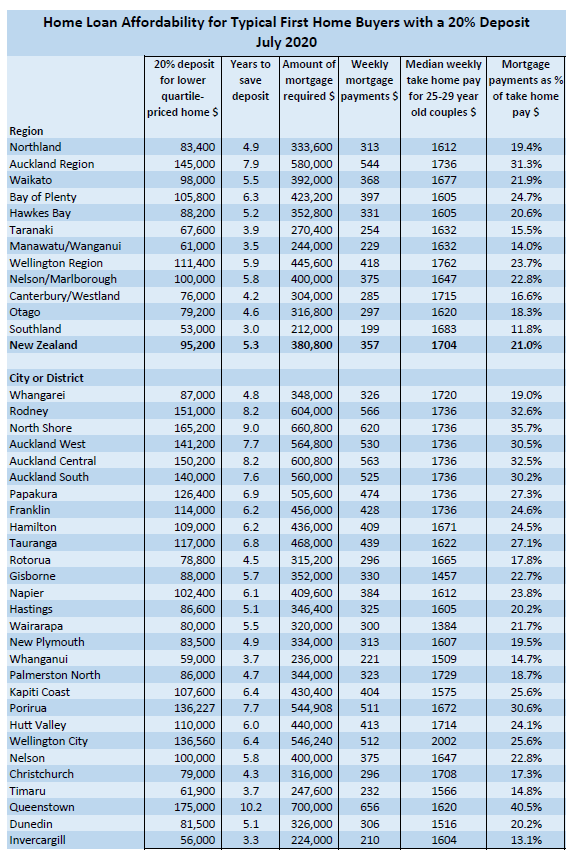
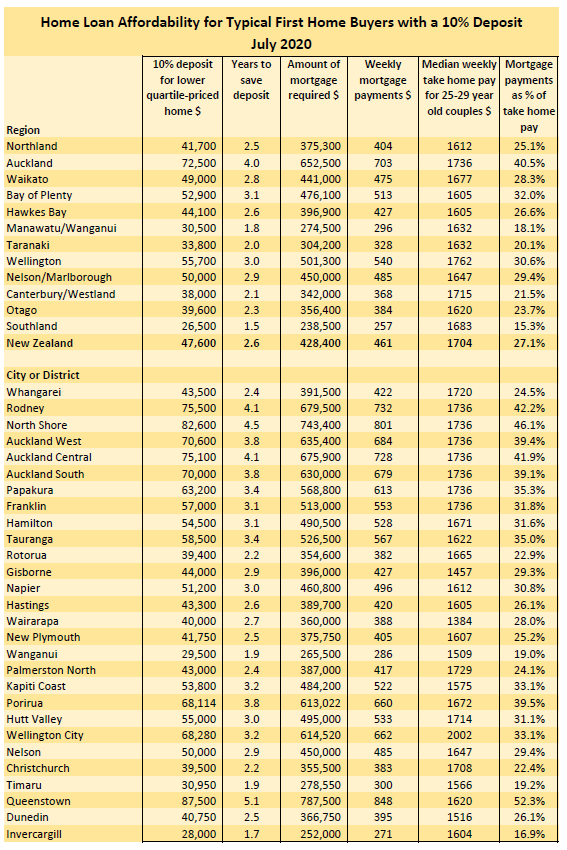
Note: The years to save a deposit figure is based on saving 20% of after-tax pay each week.
*This article was first published in our email for paying subscribers. See here for more details and how to subscribe.
We welcome your comments below. If you are not already registered, please register to comment
Remember we welcome robust, respectful and insightful debate. We don't welcome abusive or defamatory comments and will de-register those repeatedly making such comments. Our current comment policy is here.