
The Government’s push to allow for more housing densification is expected to have differing effects on land prices.
The Government on Tuesday announced plans to tweak the Resource Management Act to enable landowners to build up to three homes of up to three storeys on most residential sites in the country’s main centres without the need for a resource consent (building consent will still be required). Previously, district plans would typically allow for one home of up to two storeys.
The proposed change will affect Auckland, Hamilton, Tauranga, Wellington and Christchurch, and may be rolled out to other cities/towns with acute housing need.
Minister for the Environment David Parker acknowledged the change may cause some land values to rise. But overall, he expected the cost of land per dwelling to fall over time.
Parker gave the example of a large section with a low-value house on it. In this instance, the value of the land may rise, due to there being a lot of development potential. The property might be worth more with three modest houses on it, than with the existing run-down house.
Conversely, Parker said the value of a section in an affluent suburb that has a big fancy house on it, is unlikely to rise in value.
Referencing work done for the Government by consultants at Sense Partners and PWC, Parker also said the policy’s impact on land prices is likely to diminish, the further you move from a city centre.
People who live in cities tend to prefer living close to the city centre. Hence there’s more potential for densification there.
Parker said central government wasn’t going to meet local government’s requests for more funding for infrastructure to support densification. See this story for more on Local Government New Zealand’s position and exactly how much funding central government is providing for infrastructure.
“Councils get increased rate revenue that come from the additional dwelling,” Parker said.
“They have the ability to, and responsibility to, fund some of this infrastructure. It’s not all a central government responsibility.”
Parker also made the case, infrastructure to support densification is cheaper than infrastructure to support urban sprawl. Plus, densification results in lower carbon emissions.
Pushed on whether the blanket policy undermines town planning and well-thought-out urban design for the sake of urgently increasing housing supply, Parker said, “We do have to be a wee bit careful that we don’t allow matters of taste to intrude too far on planning, because they can become a crutch upon which NIMBYism [the ‘not-in-my-backyard’ approach] lies.”
He said the Government isn’t “forcing anyone to do anything”. Rather, it’s “enabling” densification.
As Revenue Minister, Parker is also the architect of the Government’s other major surprise policy, aimed at improving housing affordability - the removal of the ability for residential property investors to deduct interest as an expense when paying tax.
Asked whether the Government was scrambling to cool the housing market, having let it get out of control, Parker said, “Oh, do you think it was us that did that?
“The greatest determinant of the recent increase in house prices has actually been beyond the control of any government. It’s been the rapid drop in interest rates caused by monetary policy [controlled by the Reserve Bank].
He said the Government had a “social responsibility to react”.
“If there’s a change in the property market that moderates house price inflation and enables more people to buy a home that they live in, rather than rent - that’s something I will be shouting proudly, rather than finding that as something I have to defend at the next election,” Parker said.
For more detailed information on the proposed change to the Resource Management Act that will allow for more densification, see this story.
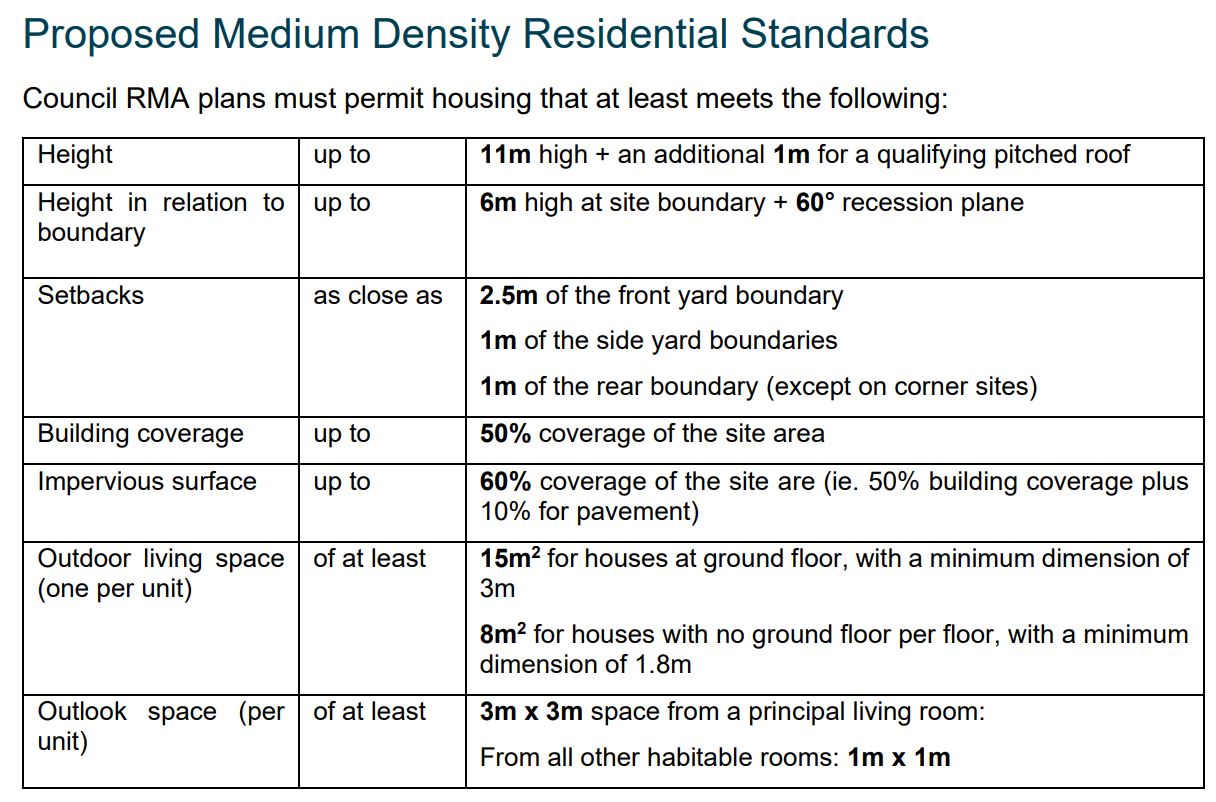
Below are some of the specifications property owners seeking to subdivide without resource consent would need to meet.
We welcome your comments below. If you are not already registered, please register to comment
Remember we welcome robust, respectful and insightful debate. We don't welcome abusive or defamatory comments and will de-register those repeatedly making such comments. Our current comment policy is here.