


The residential property market is showing signs of stabilising as it slogs through the winter months, although it's still far too fragile to call it a recovery.
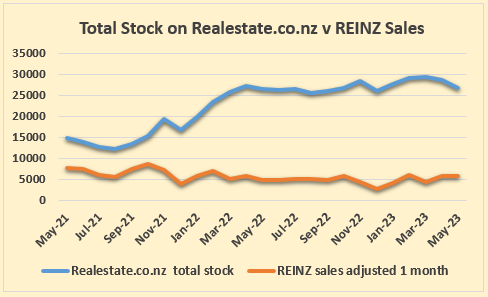
At the end of June property website Realestate.co.nz had a total of 24,676 residential properties available for sale. That number has declined for three consecutive months and is now at its lowest level since February last year. That means the total number of homes on the market is now back up to where it was prior to the outbreak of the Covid-19 pandemic in 2019.
The recent decline in stock on the market has been caused by two things.
Firstly, there has been a slight improvement in sales, with the Real Estate Institute of New Zealand recording 5629 sales in June, up by 719 (+14.6%) compared to June last year.
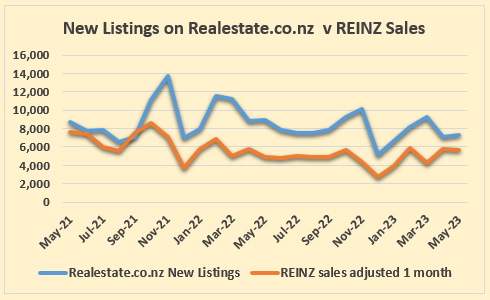
But the biggest impact on stock has come from a reduction in the number of properties being newly listed for sale each month, which has declined form 7893 in June last year to 6218 in June this year. That's a reduction of 1675 properties (-21.2%).
That means the number of sales recorded by the REINZ each month expressed as a percentage of the new listings received by Realestate.co.nz the previous month, has increased from 61% in June last year to 77% in June this year. Meanwhile sales expressed as a percentage of total stock on the market at the end of the previous month has increased from 18% to 21% over the same period.
A clue to what's driving those trends can be found in the comparison of asking prices with selling prices.
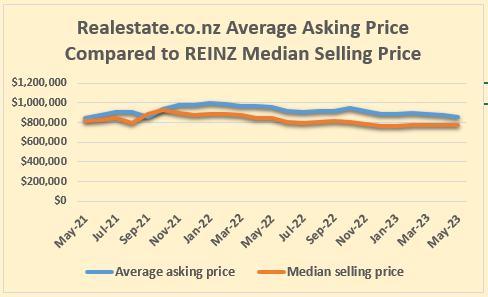
Since the beginning of this year, the REINZ's median selling price has increased by $17,500 (+2.3%), rising from $762,500 in January to $780,000 in June, although it has been flat for the last three months.
Over the same period, the average asking price of properties available for sale on Realestate.co.nz has declined by $40,698 (-4.6%), from $882,386 in January to $841,688 in June.
That suggests a major driver of sales has been a reduction in asking prices.
All of the above figures sit well with the feedback interest.co.nz is currently receiving from the coalface of the residential property market. This is that the main driver of market activity is vendors who are becoming more realistic in their price expectations, whether they have a property that has already been on the market for some time, or are bringing a new listing to the market. And that is stimulating sales.
Those vendors unwilling to accept current pricing are increasingly sitting on the sidelines, hence the decline in new listings.
Another factor to consider when looking ahead to next spring, is that there is a significant amount of latency in the market from both buyers and vendors who have held off from making a sale or purchase.
The degree to which new listings come to market in spring and how well that matches up with demand form buyers will obviously have a big impact on how the market performs.
While mortgage interest rates are usually top of mind when trying to predict market trends, an even more important factor in the current market is how well the economy performs over the next few months.
Given current property prices even after allowing for recent price falls, buyers need have a good measure of confidence in the economy and in their own employment prospects in particular, if they are to commit to the huge amount of debt that they need to take on to make a purchase.
And confidence and certainty are two things that are in short supply at the moment.
The comment stream on this article is now closed.
- You can have articles like this delivered directly to your inbox via our free Property Newsletter. We send it out 3-5 times a week with all of our property-related news, including auction results, interest rate movements and market commentary and analysis. To start receiving them, register here (it's free) and when approved you can select any of our free email newsletters.
We welcome your comments below. If you are not already registered, please register to comment
Remember we welcome robust, respectful and insightful debate. We don't welcome abusive or defamatory comments and will de-register those repeatedly making such comments. Our current comment policy is here.