


Home ownership continued to become slightly less affordable for aspiring first home buyers in July, even though incomes are rising and prices declined at the bottom of the market.
The Real Estate Institute of New Zealand's national lower quartile selling price declined by $3000 last month, to $587,000 from $590,000 in June.
However, around the regions the price movements were mixed. Lower quartile prices declined in Northland, Auckland, Waikato, Hawke's Bay and the Wellington Region, rose in Manawatu/Whanganui, Taranaki, Nelson/Marlborough, Canterbury, Otago and Southland, and were unchanged in the Bay of Plenty.
At the same time incomes are on the rise, with interest.co.nz estimating the after-tax pay for a typical first home buying couple, based on median pay rates for 25-29 year-olds, would have increased by an average $5 a week in July.
The combination of a small increase in take home pay and slightly lower prices overall at the bottom of the market should have been beneficial for first home buyers. But unfortunately rising interest rates spoiled the party.
Although the Reserve Bank has kept the Official Cash Rate on hold for the time being, higher mortgage interest rates are still flowing into the market, with the average of the two year fixed rates offered by the major banks rising to 6.74% in July from 6.50% in June.
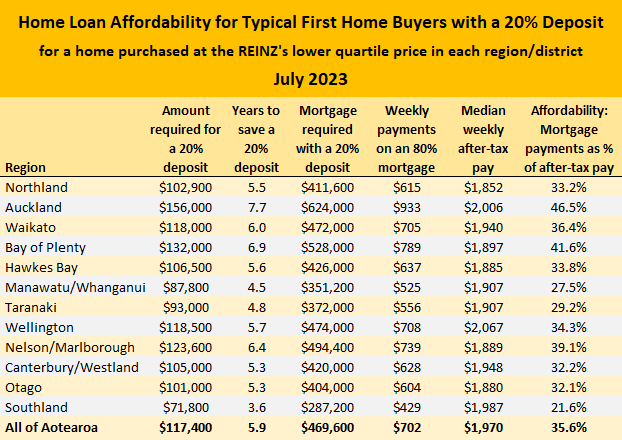
That pushed the mortgage payments on a home purchased at the national lower quartile price with a 20% deposit ($117,400) to a record $702 a week in July, the first time it has ever been above $700 a week.
That's equivalent to 35.6% of the take home pay of a typical first home buying couple, with 40% being the threshold for when mortgage payments are considered unaffordable.
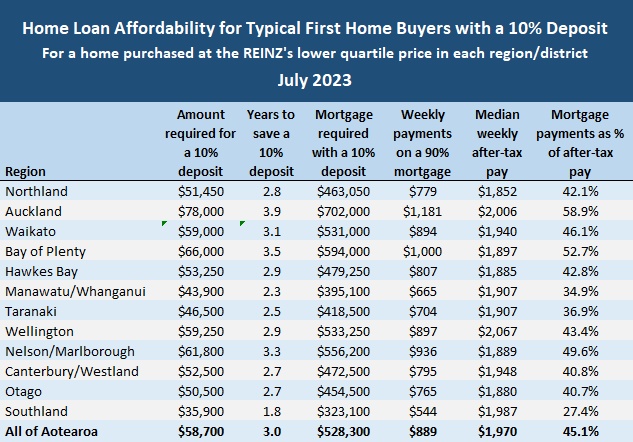
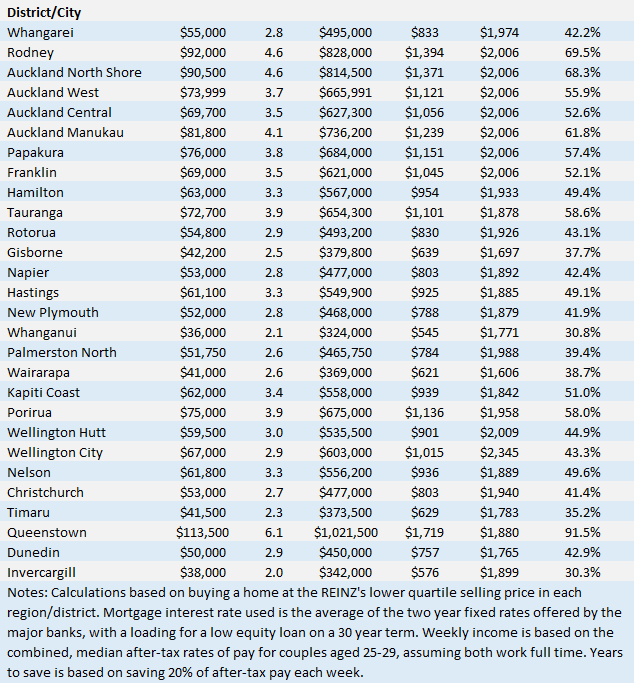
However if the first home buyers only had a 10% deposit ($58,700) for the same home, the mortgage payments would jump to $889 a week, eating up 45.1% of take home pay for typical first home buyers, putting it squarely into unaffordable territory.
So the ability to raise a 20% deposit is probably the single biggest obstacle first home buyers on average incomes face to being able to afford a home of their own.
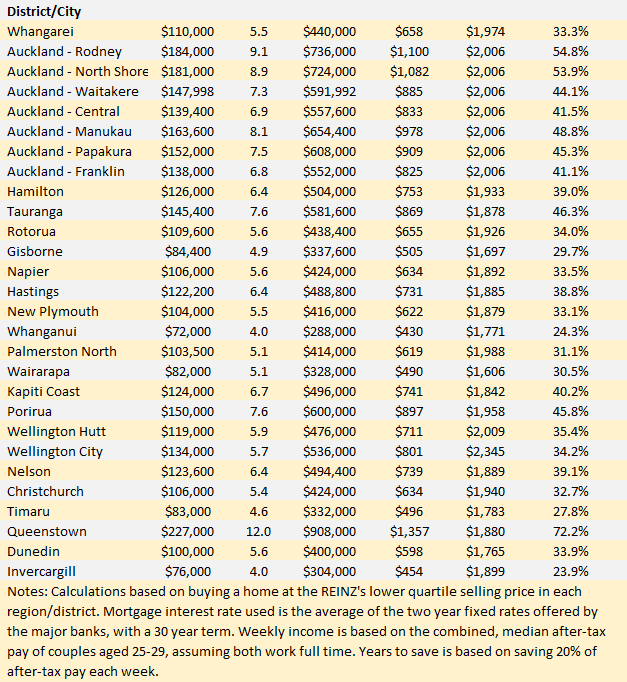
Even with a 20% deposit, first home buyers on average incomes would likely struggle to afford the mortgage payments on a lower quartile-priced home anywhere in the Auckland region or in Tauranga, on the Kapiti Coast or in Porirua because property prices are so high relative to incomes in those areas.
But there's one part of the country that stands out as easily the most unaffordable place to buy a home - Queenstown.
Queenstown's lower quartile selling price was $1,135,000 in July. That means even with a 20% deposit ($227,000) you would need a mortgage of $908,000 to buy a lower quartile-priced home in the town. And the mortgage payments on that would be $1357 a week, equivalent to 72.2% of the median take home pay for typical fist home buyers in the district.
The table below shows the main affordability measures for typical first home buyers with either 10% or 20% deposits in all main urban districts throughout the country in July.
The comment stream on this article is now closed.
We welcome your comments below. If you are not already registered, please register to comment
Remember we welcome robust, respectful and insightful debate. We don't welcome abusive or defamatory comments and will de-register those repeatedly making such comments. Our current comment policy is here.