
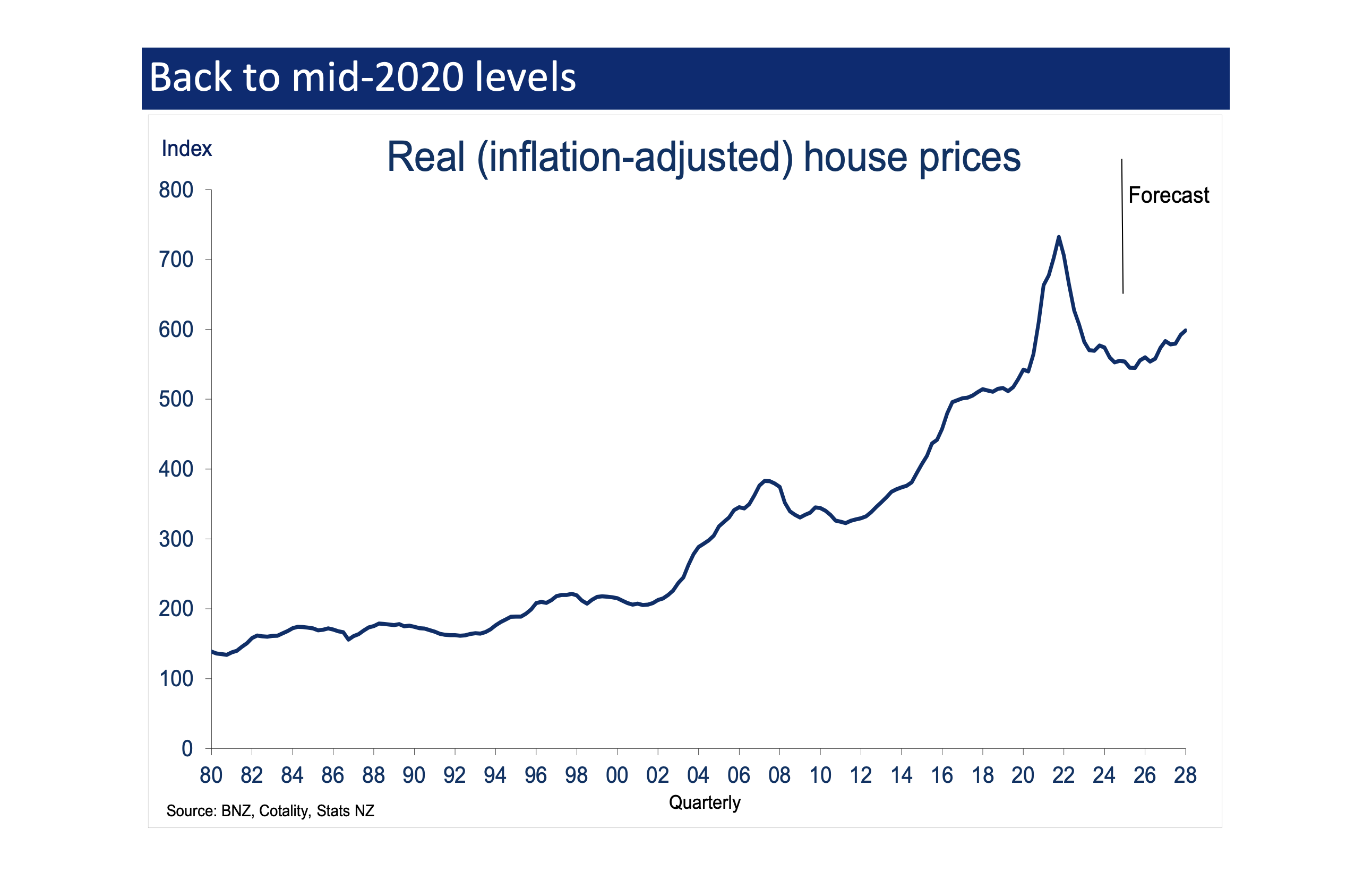
New Zealand’s $1.6 trillion housing market is going nowhere fast. Prices have barely moved since the bubble burst in late 2021.
But is this a symptom of the country’s stuttering economic recovery, or is it the cause?
REINZ’s house price index showed a modest rebound after bottoming out in early 2023, but momentum has faded. The index rose just 0.3% in the year to June, despite a 170 basis point drop in the 2-year swap rate.
Economic activity has also stumbled. GDP rebounded through the December and March quarters after a sharp mid-2024 contraction, but likely contracted again in June. The Reserve Bank’s nowcast estimates a 0.3% fall.
The link between the two trends is a chicken-and-egg problem. Is housing weak because the economy is soft, or is the economy soft because housing is?
Bernard Hickey, an economic commentator and Interest.co.nz alumnus, wrote in his newsletter that New Zealand’s “housing-market-with-bits-tacked-on” economy was struggling because buyers weren’t bidding up prices as they had in past recoveries.
Kiwibank chief economist Jarrod Kerr said in a note that further cuts to the Official Cash Rate were needed to stimulate housing demand if “optimistic” growth forecasts were to be met.
But that kind of thinking frustrates Housing Minister Chris Bishop, who wants to break the link between rising house prices and economic growth.
“Destroying the idea that the economy should be based on house price growth is a fundamental formula this government is trying to embed into the New Zealand psyche and into the arteries of the economy,” he told Interest.co.nz on Tuesday.
Outrageous fortune
Property has an outsized influence on the New Zealand economy because of the sector’s scale. It contributes 15% to annual GDP and accounts for more than half of all household assets.
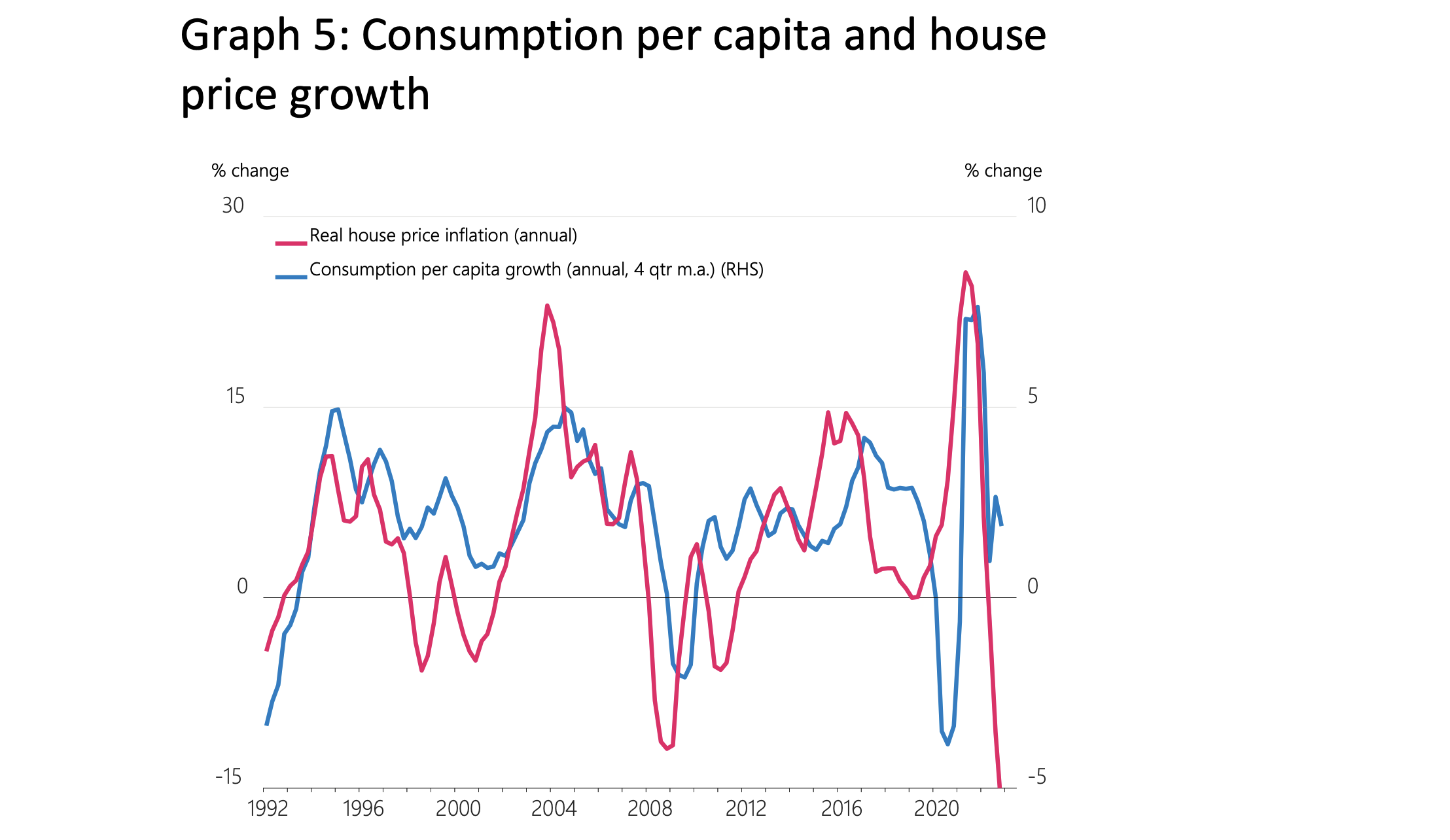
Housing downturns can deepen recessions by curbing household spending and slowing construction and employment. The reverse is also true, though the lift from rising prices is typically smaller than the drag from falling ones.
And it’s not just households. Weak house prices also dent small business confidence and activity, as banks often secure those loans against residential property.
While most economists agree that rapid house price growth isn’t necessarily desirable, many also acknowledge that a broader recovery will be harder without it.
“It sucks a lot of growth out for sure,” Kerr said, when asked what happens if house price gains are removed from Kiwibank’s forecast model.
The state-owned bank expects prices to rise between 5% and 7% in 2026, though it admits it had a similar forecast for 2025 which didn’t pan out. It now expects prices to rise about 2.5% this year and has revised its GDP forecast down from 1.4% to 0.9%.
Residential prices climbed roughly 8% a year in the five years before the pandemic and surged after the 2020 stimulus. Annual growth briefly hit 30%, setting up home-buyers for a painful correction a year later.
The Reserve Bank expects more moderate gains ahead. In May, it projected annual house price growth would settle at 4.2% in the coming years, after peaking at 5% in late 2026.
Housing-lite recovery
Mike Jones, chief economist at BNZ, said it wasn’t clear whether the weak housing market was slowing the broader recovery, or if it was the other way around.
“I tend to think about most of the causation running from house prices to the economy. Like any asset cycle when house prices rise there is a feel-good or wealth effect which goes on to boost consumer spending, housing investment, new construction and the economy more generally,” he said in an email.
“But I think we’re also seeing some causation looping back around in the other direction, particularly at this stage of the cycle.”
Many would-be buyers feel insecure about their jobs and are reluctant to take on large mortgages, especially after watching the previous wave of buyers get caught out.
Jones said lower interest rates had clearly lifted the number of transactions, but prices wouldn’t rise meaningfully until the backlog of listings was cleared.
“That’s no bad thing from an affordability perspective, but a ‘housing-lite’ economic recovery does slow us up relative to what we might have seen in past cycles.”
More butter, fewer builders
Infometrics, an economic consultancy, expects New Zealand’s “patchy recovery” to strengthen through the rest of the year—with or without house price growth.
Fresh forecasts published Friday predicted agricultural exports would lift annual GDP growth to 2% by the second half of 2026.
Chief forecaster Gareth Kiernan said he agreed with Chris Bishop that house prices were already high and unlikely to lead the recovery. His projections assume “pretty flat” price movements.
That would slow the pace of broader economic growth, he said, but was likely a worthwhile trade-off if it improved long-term affordability.
Unaffordable housing is often blamed for everything from poor health and education outcomes to weak productivity growth and reduced business investment.
But Kiernan said it was still bad news for the construction sector, which was being left behind and would likely need to resize for structurally weaker demand.
The government had signalled a lot of infrastructure work ahead of the 2026 election, but “the gap between rhetoric and reality to date remains stark.”
Infometrics expects a slow and uneven recovery. Rural areas tied to agriculture should perform well, while regions reliant on construction or government spending will likely lag.
“Forecast economic growth averaging 2.1% per annum over the next five years represents an improvement from the tough conditions endured by businesses during 2023 and 2024,” Kiernan said in a press release.
“But we do not expect GDP per capita to surpass its 2022 peak until the second half of 2027. The reality is that the economy was extremely overheated during 2022, so a quick return to those sorts of activity levels can’t be expected.
We welcome your comments below. If you are not already registered, please register to comment
Remember we welcome robust, respectful and insightful debate. We don't welcome abusive or defamatory comments and will de-register those repeatedly making such comments. Our current comment policy is here.