

The current lack of capital gains for residential property is not just reducing opportunities for new investors, it may also prompt existing investors who have held their properties for many years to see if they could get better returns elsewhere.
Last week interest.co.nz looked at the indicative rental yields and cash flows that could be available to prospective residential property investors, based on median rents and lower quartile selling prices.
This showed how difficult it would likely be for investors to find a property that could provide a reasonable cash flow if they were purchasing the property with a mortgage.
However, there's a much larger group of existing rental property owners, who are in a very different situation.
They will have owned their properties for many years and many will likely have little or no debt on their investment.
In most cases they will have seen the value of their properties increase substantially since they purchased them and are likely also receiving a healthy rental income from them.
In short, they will be sitting pretty.
However, the market is changing.
Capital gains have virtually dried up. See the interactive graph below which shows monthly movements in the Real Estate Institute of New Zealand's median selling price at both the national and regional levels.
At the same time demand for rental properties from prospective tenants is soft while supply is up, putting downward pressure on rents.
To top things off, the cost of outgoings such as rates, insurance and maintenance costs are rising.
All of which adds to uncertainty about future earnings prospects.
So it may be a good time for established investors to consider whether having their money tied up in a rental property is the best use for it, and whether they could get better returns elsewhere.
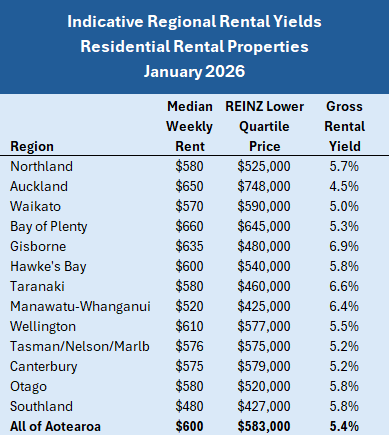
The table below shows the median rents in each region, based on bonds received by Tenancy Services, compared to the REINZ's lower quartile selling price in each region. That enables an indicative gross rental yield to be calculated for each region around the country.
In most regions this gives indicative gross rental yields of between 5% and 6%. The outliers are Gisborne 6.9%, Taranaki 6.6% and Manawatu/Whanganui 6.4%. The only region with an indicative yield below 5% is Auckland at 4.5%.
If you shop around you can get 4.5% on a bank term deposit, for a three year term, which goes up to almost 5% if it's a PIE fund.
That suggests rental properties in most regions, with the notable exception of Auckland, are likely providing a better return that bank term deposits.
However, when making that comparison, investors need to consider that the rental yield figures are gross, which means they would need to estimate the effect expenses such as rates, insurance, maintenance and other property management costs, as well as loss of rental income from periods of vacancy, would have on their returns.
These costs have the potential push down returns considerably, and in low yielding regions such as Auckland, Waikato, Bay of Plenty, Nelson/Marlborough and Canterbury, investors may find they can get better returns by selling their property and reinvesting in something that provides a better return.
In some cases, this could be achieved simply by putting the money in the bank.
However, as poor as the returns may be, this is unlikely to result in a rush for the exists from existing, long term property investors.
As long as their property is not causing them any major problems and they continue to receive a regular income from it, human nature being what it is they more likely to keep their money in a market they know well and are comfortable with, even if the returns have become relatively modest, rather than venture into unknown territory.
But for those on the outside of the market looking for a potential investment, the poor returns could be a major stumbling block to finding something suitable.
The comment stream on this article is now closed.
Median price - REINZ
Select chart tabs

We welcome your comments below. If you are not already registered, please register to comment
Remember we welcome robust, respectful and insightful debate. We don't welcome abusive or defamatory comments and will de-register those repeatedly making such comments. Our current comment policy is here.