
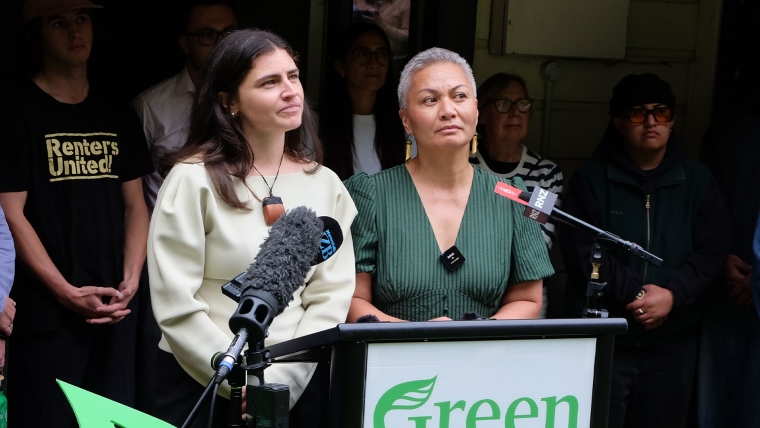
Building "tens of thousands" of public homes, capping rents, ending homelessness and removing interest deductibility for landlords are all on the agenda of a Green Party housing campaign.
The Green Party's campaign, called A Home for Everybody, was released on Wednesday afternoon.
It includes reversing the Coalition Government's $2.9 billion interest deductibility on residential investment property for landlords. It also includes capping rent increases to no more than 2% per year and creating a national register for landlords, property managers and boarding houses “to ensure professional accreditation, transparency, and regulatory compliance across the rental property sector.”
At the announcement, when asked if this was a 2026 election policy, Greens co-leader, Marama Davidson said: "We've got an assortment of packages that are our election campaign policies to come down the line but this is something that we have stood behind for at least the past three elections."
And when asked about whether they had done any costings for the entire proposal, the Greens other co-leader Chlöe Swarbrick said this was a campaign they were running alongside a range of people from the community.
"This does not represent one of the fully costed policies that we'll be putting out at election time, but it is reflective of a lot of the work that we've done over the last 18 months, which has shown, for example, how we could fund these things."
Making their announcement outside a rental home in the Wellington suburb of Te Aro, Davidson said: "In a country like Aotearoa, with our wealth of resources and skills, there is no excuse for people to go without a decent home, let alone any home at all."
“The idea that housing is a human right should not even be controversial. Yet, successive governments have allowed housing to be treated as an investment asset first, and a human necessity second.”
In a statement, Swarbrick said this isn’t rocket science. “Mass building of public housing almost 100 years ago led to decades of stable, affordable homes for New Zealanders,” she said.
“Other countries have shown how sensible, practical policies to strengthen renter’s rights and common sense tax settings, to stop housing being treated as a state-sanctioned casino, means more affordable homes.”
Asked about the tens of thousands of public homes, Davidson said; "we're putting on the table the sorts of ideas that we've stood by for successive terms of government. For at least the last six year, we've said we could end the public housing waiting list in five years if we were to scale up public housing 35 - 45,000 houses, as a starting point".
When it came to who they envisaged as building these public houses, Davidson said; "we also would offer more security for development, so offering for example, 10-year contracts to provide security for developments, with the incentive build in for the right kind of housing to be build, including accessible housing".
"We do see a place for community housing as well to be able to provide ... That would also include iwi, Pasifika-led housing to be able to provide the specific needs that they are accountable to as well."
The Greens would continue to support the current community housing network and system but there also has to be a role for Government, Davidson said.
"Government is able to build at scale that community housing providers may not be."
Asked how they expected to get cross party support for their proposal, Swarbrick said they expect to build support in the community.
"Renters right now, who are paying an arm and a leg for a house that might send them to hospital need to understand that that is not an individual responsibility issue, that is a systemic issue which one and a half million New Zealanders currently face."
Swarbrick said if renters across the country understood that is something that unifies them "then they can unify in building consensus towards the solutions, which means that they can hold every single political party in Parliament accountable to fixing them."
Here’s a breakdown of the Green Party’s housing campaign:
Making homes more affordable
- Build more affordable homes by making sure planning law allow more homes to be built in towns and cities connected to public transport, shops and community facilities
- Requiring councils to enable at least as much development capacity as required by long-term population growth - even in existing urban areas
- Remove regulatory and financial barriers for Māori to build on their own land
- Scale up the Whai Kāinga Whai Oranga programme to fund more Māori housing initiatives
- Reverse National’s $2.9 billion tax deductions for landlords and property speculators
- Ensure accessible housing is affordable by providing funding for housing modifications so disabled people can afford housing that is for for purpose, and strengthen regulations and incentives for the construction of universally designed housing
Renting
- Cap rent increases at no more than 2% per year
- Get rid of no cause evictions, so tenants have longer term security
- Implement an independently certified Rental Warrant of Fitness
- Create a national register of all landlords, property managers and boarding houses
Build more public housing
- Build tens of thousands of new, affordable, and accessible public homes across Aotearoa
- Increase long-term funding and financing for councils and community housing providers so they can provide more public housing in their communities
- Invest in domestic prefabrication and off-site manufacturing to make building public homes easier and cheaper
- Making sure Kāinga Ora and community housing providers are funded to build enough accessible housing to meet the needs of disabled people - instead of leaving it to the market
Homelessness
- Creating a ‘Duty to Assist’ law which would put legal duty on agencies to ensure people have the housing they need
- Reverse the Government’s changes to emergency accommodation eligibility criteria
- Have same-day emergency housing assistance until that person has suitable housing
- Boosting funding for wrap-around support and community organisations
54 Comments
Ouch thats not going to help house prices.
Not going to help the greens get elected either. Muldoon would be proud.
Have they put any thought into this? Why would someone improve a property if they can’t increase the rent? Why would someone build a house to rent if they aren’t allowed to make a profit?
These policies would lead to state only housing, which may work ok when the red team are elected but will receive no investment when the blue team are. It’s not like state housing has a good track record over the last few decades either.
Jimbo the greens will get 10-11% no matter what their policy is, greenies love green.
But this is not going to help Labour get elected, along with the pay equity thing , there are so many bowls of cold sick to eat for that coalition to get elected BUT NAct is not that loveable either right now
That’s what I meant. Greens can’t get elected without Labour, I’m not sure they’ve worked that out yet.
Why would someone improve a property if they can’t increase the rent?
That's a non-issue. Have you seen how the rental market looks like? There are absolutely zero improvements done to those houses since they've been built in the majority of the listings
If you want to see a showcase of how plumbing and finishings looked in the 70s, just open TradeMe in the rental section
The legal requirements fyi
https://www.tenancy.govt.nz/healthy-homes/healthy-homes-standards-what-…
So, they might sell it (at a loss to them) ... and the former tenant might buy it at a price more commensurate with their income and be invested in keeping the property maintained?
What you're asking is the basics of a business asset. Choosing to own a house to rent is a business decision and as such, then the cost of that asset v the income that it will provide are necessary considerations. I agree with caps (not in isolation though) and argue that landlords should be able to expect the tax payer to underwrite their risk, or trap people in renting. I have argued repeatedly that rents should be capped at 25 - 30% of the median take home pay (not gross). That in itself would help address a number of social issues such as child poverty, house affordability, cost of living etc.
NZ housing specu leverage may soon look like the Straits of Hormuz. Long term interest only, in it for the long term specu debt position could quickly turn from fools gold (no capital gains currently) into lead.
🍿
How is a lack of investment in housing a good thing? You guys are weird.
How was over investment where people were using capital gains and equity to outbid FHB and push prices up to 10x income and push private debt/GDP to 150%, a good thing? You guys are weird.
That’s only possible if you can’t build a house cheaper (or at all). Blame council and government handbrakes, not investors.
Not sure about the rest of NZ, but since the Auckland Council allowed people to build houses they’ve been popping up everywhere. Had those private investors not bothered, loads of people would be out in the streets.
No issue with investors who build and add to supply. But certainly had an issue with investors buying up existing houses and outbidding FHBs.
You do concede though that outside of whatever investors are doing, the cost to produce a new unit of housing is super high though, right?
Hence at the moment, sales of sections are pretty tepid and you can get some land for not a huge outlay, yet few are pulling the trigger because the end result costs a fortune to complete.
Stop it. The issue is specu capital just wants to much for the land. They rest can fall into place at market.
Thats the only factor you want to recognize.
There's hundreds of sections available in NZ for under $150k. That's less than what many councils charge as a subdivision cost. If the market could sort out the rest those places should be snapped up like hot cakes.
Instead, to produce something mortgagable and insurable, someone's still up for $500k+
Yeh true but overinvestment doesnt mean you want no investment either. You still need supply.
You appear to have missed the point that the state will build.
As usual not realistic now, with today’s general property settings so deeply embedded. This announcement resonates with the grand assurances of PM elect Ardern in 2017 that such as child poverty would be banished under her prime ministership. Uttering words is a lot easier than making them function. But still, the moral ground of the Greens here is high. Once upon a time governments in NZ did recognise a duty to the people that households should not find difficulty in getting a roof over their heads.Up until the mid 1980s residential finance for occupants was specifically targeted. The government through State Advances and capitalisation of the family benefit, building societies and trustee savings banks plus many solicitors serviced mortgages for clients. However the Lange/Douglas government unwound just about all of that. The major trading banks were allowed to enter the market open slather and quickly mopped up the bulk of the building societies and savings banks and thus the residential property market soon became enveloped as just another function of the big banks’ big business and here we all are today..
Uttering words is a lot easier than making them function.
Bingo. It's pretty easy for the Greens to take the moral high ground as they know they will never be accountable to make it happen and see it through.
Execution is far beyond their capabilities and resources. But that would be true of any of the wingnut and wokester tribes.
Lol, couldn't agree more.
Was the state incapable from the 1930s to the 70s? The state can have the capacity and capability if they have the will....after all they can draw on the same resources as the private sector .
If the state is incapable so is the private sector.
The state was capable then. They standardized on an efficient design and built 10s of thousands of houses quickly and cheaply
In 2020s NZ, the state tries to build houses like they're bespoke houses in a new subdivision. That's already not a cheap way to build, and throw in another 30%+ percent, because despite the government having massive economies of scale, and setting the rules, they can't produce a house cheaper than the private sector.
You do understand that the private sector built those 1930s to 70s houses (for the state)?
Again...if the state is incapable then so is the private sector.
Yes I am aware that. I have outlined several times the process the government of the time used to do a cost effective and large state housing project.
The private sector takes instruction from the government.
In the good old days, the government standardized a design, and dealt with a handful of builders again and again. In the 2020s, they have dozens of architects designing one off builds that they then put out to the tender market. Little consistency.
If the government adopted the right methodology, they could do it.
Have an old Weekly News with photos of that sort of suburb at Nae Nae. Quite honestly Young ones today would not have a bar of it.
Some of the philosophy behind the bespoke approach is that the tenants shouldn't feel like they live in a state house, and if they all look different it'll seem like any other private residence.
Which is nice, but it results in far less houses.
"If the government adopted the right methodology, they could do it. "
And there you have it
Yes. Henry Ford worked it out over 100 years ago yet for some reason we think doing it any other way will get a better result.
The fact our governments don't seem to be able to get basic approaches right calls into question their ability to do anything in the real world.
They're pretty good at outsourcing to consultants to avoid responsibility and keep middle management in jobs.
40% of the labour cost in construction is on white collar employees.
The way the government has approached building in recent years, it'd be well above 50%.
"In 2020s NZ, the state tries to build houses like they're bespoke houses in a new subdivision." Quite right. Two blocks of apartments in NP like that. One was a complete private sector build including the land and sold off to Housing NZ. The other one Housing NZ bought the land before the build. Another a more plain development with two apartment blocks, each block with at least two apartments so four units in total. About the only Housing NZ build that makes sense in the area. I've seen two other houses reno'd on sections which could house more accommodation units than the original single house. Makes me really wonder what goes on in Housing NZ, then and now.
I've seen 4 different houses commissioned on the same piece of land. Different cladding, layouts, colours etc.
And the average Reno cost on those 60 year old houses was $480k.
Whatever priorities they have "delivering as many houses as fast as possible" is way down the list.
But votes will signal an appetite for it. Aspirational perhaps
The Greens ~10% vote is now nothing related to "green" environmental policies, their name change is well overdue to reflect their 1.28 std deviation below the mean of voter intelligence distribution as disaffected communist nutjobs
It's a real conflict in the party. I have voted Green, for environmental reasons, and would love to see more focus and policies there. And ideally not of the "we're going to cancel any projects the last guys approved" which just continues the cycle that NACT have been complicit in.
Without the Greens we wouldn't have the Cap and Trade policy - more focus on sensible policy like this please.
As for the specifics of this announcements, promoting supply is great, interest deductibility I am on the fence with (great incentives, but pretty unorthodox), but rent caps are no good. Work to increase supply to a point where big rent raises simply aren't possible due to competition.
It was always going to go (further) down hill when Shaw left. Genuine nutters now.
Any common sense left with Fitzsimons and Shaw
Down here in Christchurch there has been a noticeable drop in Green Party environmental advocacy, especially on urban matters, since the death Rod Donald.
If the Greens are so lacking in intellect, doesn't say much for the yeasty parties co inhabiting parliment.
Greens still talking up population growth? Improving quality of the living world secondary to squeezing more humans in.
"Mass building of public housing almost 100 years ago led to decades of stable, affordable homes for New Zealanders,”
Well yes, but don't forget a lot of the people now living in shop doorways would have been living in institutions through that era also.
Not a new idea in sight - just a reversal back to the policies which the last Labour government had previously implemented.
Ping pong politics. I find it so tiring and uninspiring.
Opportunity looks to be the party of difference at this stage of the game.
Detail aside - it is good to actually someone in opposition release some policy, I feel there is some growing frustration of Labour's don't say anything approach, when they have a fairly clear runway to try show some leadership
What kind of policy can they release? More spending when interest rates are increasing? More cuts when unemployment is increasing?
They are probably better off being a slightly different alternative to National
Their major issue is their last response got us in the debt shit we are now in, hard to sell that to us a second time, not impossible
On September 17, 2002, in Nashville, Tennessee, President George W. Bush fumbled the proverb "Fool me once, shame on you; fool me twice, shame on me". He said: "Fool me once, shame on... shame on you. Fool me—you can't get fooled again". The gaffe, known as a "Bushism,"
I think the best way to cement this would be to have the Greens do a small 12-20 house subdivision. We can pitch them against any group home builder, and judge them on speed, cost, and quality.
The Greens have just confirmed they nothing about to provide affordable housing.
Noting that any housing that needs Govt money is social housing, not affordable housing.
It's affordable if you're a tenant paying $50 a week.
Although the user Keynes attests it can all be done at NO COST
- govt dept takes on debt using existing assets as collateral
- debt is serviced by a customer who is another government dept
See, free house.
Where's the money coming from?
"This does not represent one of the fully costed policies that we'll be putting out at election time, but it is reflective of a lot of the work that we've done over the last 18 months, which has shown, for example, how we could fund these things."
The Hipkins free money tree
ie you and me
Declarations with no execution plan, and no acknowledgement and rebuttal of unintended, but easily foreseeable, consequences, such as disincentivising rental property building and proactive maintenance by limiting returns and where rents are incentivised to go up by the maximum amount every single year, even if the rate of inflation is lower.
Allied topic and worth a listen. https://freakonomics.com/podcast/why-rent-control-doesnt-work/
If the Greens are serious about getting into government again they will need to substantially improve their candidate selection process so they don't end up with another motley crew like last time
to stop housing being treated as a state-sanctioned casino
And start treating it like a rigged game of lotto - where the government chooses winners and losers.
We welcome your comments below. If you are not already registered, please register to comment
Remember we welcome robust, respectful and insightful debate. We don't welcome abusive or defamatory comments and will de-register those repeatedly making such comments. Our current comment policy is here.