

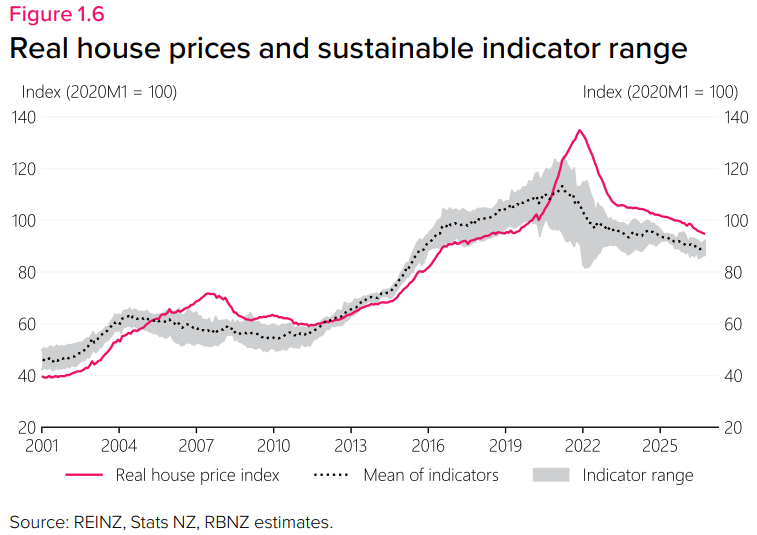
The Reserve Bank (RBNZ) says New Zealand house prices are still at the “upper end” of the central bank’s estimated sustainable range, despite a subdued housing market.
In its latest Financial Stability Report, released on Tuesday, the RBNZ said the country’s housing market has “softened” over the past six months, with weakness persisting in Auckland and Wellington alongside relatively firmer demand in the South Island.
The RBNZ said some borrowers who bought in Auckland or Wellington near the 2021 house price peak with limited equity remain “particularly vulnerable.”
“Even if they continue to meet their loan repayments, lower house prices have reduced equity for some borrowers, making it harder for them to refinance or move home,” the central bank said.
The report noted that the more permissive loan-to-value ratio (LVR) settings introduced in December 2025 have supported first-home buyer activity, while investor activity has weakened.
The December 2025 changes meant banks are allowed to lend more to borrowers with small deposits, with the share of new lending to owner-occupiers with under 20% deposits rising to 25% from 20%, and to investors with under 30% deposits rising to 10% from 5%.
“These settings have supported first-home buyer participation. Despite this, overall mortgage lending growth remains subdued, limiting the build-up of housing-related vulnerabilities. Weak demand for new housing lending has intensified competition for existing borrowers, contributing to strong refinancing activity,” the RBNZ said.
“Sales remain low relative to available listings, giving buyers considerable choice and contributing to softer prices. Industry contacts noted in our liaison meetings that demand for new townhouses was becoming saturated in some locations, with buyers increasingly favouring standalone houses, and pockets of unsold townhouse stock emerging.”
The RBNZ reviews LVR settings annually to ensure they remain appropriate for the current risk environment. In its latest review in July, it found that housing-related risks did not justify any change to the current restrictions.
The RBNZ said weak population growth, elevated ownership costs and plentiful listings are likely going to keep house prices “subdued in the near term.”
“Even after recent falls, house prices remain near the upper end of our estimated sustainable range,” the report said.
The RBNZ defines sustainable house prices as the level that house prices would be expected to move towards over several years, based on underlying drivers such as interest rates, incomes and rents.
'Modest' mortgage growth
Higher mortgage rates and some election-related uncertainty have also weighed on housing demand.
“Mortgage lending growth has been modest, limiting the build-up of housing-related risks,” RBNZ Governor Anna Breman said.
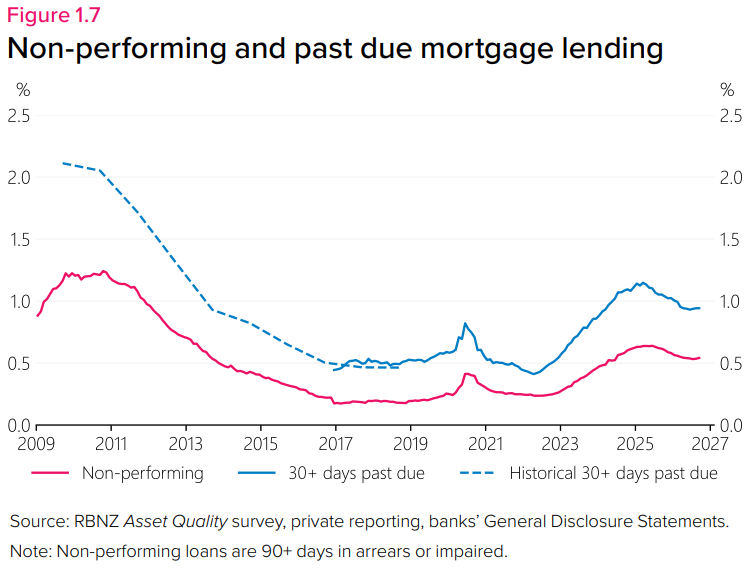
The RBNZ noted that lower mortgage rates since 2024 have supported an improvement in borrower stress metrics, with the share of mortgage lending that is non-performing having fallen from 0.64% in early 2025 to 0.5% in September 2026.
“Lending in default remains higher among high-LVR borrowers, although stress has eased within this group. Mortgagee sales and realised mortgage losses are low,” the RBNZ said.
While early-stage arrears have declined this year as well, the RBNZ is expecting recent increases in mortgage rates and rising unemployment could slow or reverse this improvement.
“We expect the average mortgage rate paid by borrowers to increase from around 4.8% to 5.4% over the next year, based on current mortgage rates and market pricing for future interest rates. Even so, this remains well below the late-2024 peak of 6.4%,” the RBNZ said.
New Zealand’s jobless rate climbed to its highest level in more than a decade in the September quarter, increasing to 5.7% with 174,000 people unemployed.
Since the RBNZ’s May Financial Stability Report, the Reserve Bank has also increased the Official Cash Rate (OCR) by 25 basis points in both the July and September monetary policy meetings, with the cash rate currently sitting at 2.75%.
We welcome your comments below. If you are not already registered, please register to comment
Remember we welcome robust, respectful and insightful debate. We don't welcome abusive or defamatory comments and will de-register those repeatedly making such comments. Our current comment policy is here.