

The Reserve Bank says that the sharp drop in house sales volumes experienced since the introduction of limits on low deposit lending has so far exceeded its expectations.
In its latest Financial Stability Report (FSR) today the RBNZ said that house sales dropped 11% between October 2013 and March 2014, with the drop in sales volumes evenly spread across regions.
"This impact is greater than the initial expectation of a 3-8% drop (over the year to October 2014)," the RBNZ said.
"By comparison, Reserve Bank modelling estimates suggest that, in a counterfactual scenario where the LVR restrictions were not imposed, house sales would likely have increased further in the months since October."
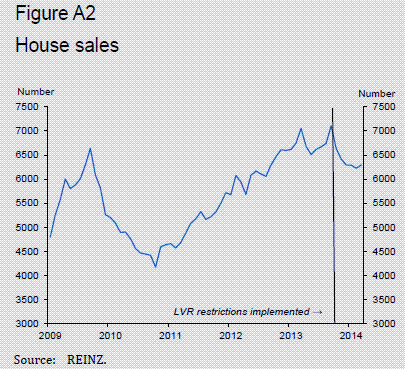
Latest figures for April released by the Real Estate Institute just this week - and presumably not able to be included in the FSR - showed a massive 20.2% year-on-year drop in sales during the month. However, the key unanswered question with those figures is the extent to which having Easter so close to Anzac Day - which itself was next to a weekend - encouraged people to take time away, therefore completely skewing normal house sales patterns.
The REINZ noted that in April the number of sales below $400,000 fell by 31.6% compared with April a year ago. This followed a fall in sales below $400,000 of 21.9% between March 2013 and March 2014.
The RBNZ said today that the drop in house sales does appear "to have been more pronounced in certain segments of the housing market".
"Across different price brackets, the reduction in house sales has been concentrated in lower value house sales. House sales dropped 23 percent between September 2013 and March 2014 in the under-$400,000 value bracket, compared to an 11% drop in aggregate."
The RBNZ said looking at buyer categories, the share of first home buyers has declined slightly since the introduction of LVRs.
"According to data produced by CoreLogic, the first home buyer share of home sales declined to 17% in February, from an average of around 20% over the past two years."
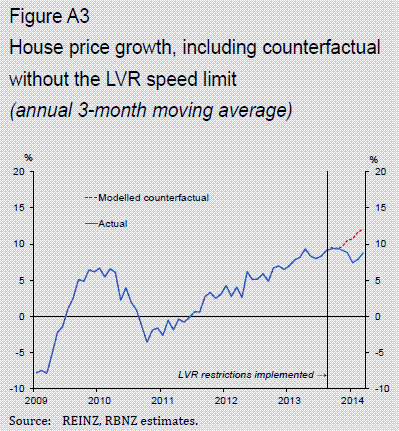
The RBNZ reiterated its view that house price inflation "appears to have moderated" since the implementation of LVR restrictions.
"Measuring this has been complicated by the decline in lower value sales, which has created a significant upward bias in simple measures of house price inflation, such as median house prices.
"The QV quarterly house price index comprehensively adjusts for the composition of house sales, and shows annual growth slowed by 1 percentage point to 9% in the final quarter of 2013.
"Growth in the more timely REINZ stratified price index also slowed in the final quarter of 2013. Despite some adjustments for the composition of sales, this measure appears to have been subject to a degree of upward bias," the RBNZ said.
"Annual growth in this index has generally slowed further more recently, notwithstanding a rebound in the most recent March data. The Reserve Bank estimates that, in the absence of LVR restrictions, annual house price inflation could have been around 2.5 percentage points higher in the year to March 2014 (figure A3)."
The central bank said there were also signs that housing credit growth was beginning to moderate in line with reduced property market activity and prices.
"This slowing is most clearly evident in data from the early stages in the mortgage origination process. Annual growth in seasonally adjusted mortgage approvals and major banks’ new mortgage commitments dropped 22 and 17 percentage points respectively between September 2013 and March 2014.
"With a typical lag of up to three months between initial mortgage approval and final drawdown, and around one month for commitments, these data point to the likelihood of moderation in final housing credit growth in coming months.
"Housing credit growth was losing momentum at the end of the March quarter, with an annualised decline of 1 percent between December 2013 and March 2014."
The RBNZ said there had been few signs to date of homelending "migrating beyond the regulatory perimeter of LVR restrictions".
"Specifically, there is little evidence of either avoidance activity by the registered banks or a shift to non-bank financial intermediaries and other sources of finance. The Reserve Bank will continue to monitor closely for any signs of regulatory leakage from the speed limit. "
We welcome your comments below. If you are not already registered, please register to comment
Remember we welcome robust, respectful and insightful debate. We don't welcome abusive or defamatory comments and will de-register those repeatedly making such comments. Our current comment policy is here.