

By Bernard Hickey
The Reserve Bank of New Zealand has surprised many in political and banking circles by deciding to leave its high LVR speed limit in place because of what it sees as a risk of a resurgence of house price inflation.
Bank economists, Finance Minister Bill English, Prime Minister John Key and real estate agents have all talked up the prospect of an imminent easing or removal of the limit, saying it was always designed to be temporary and had worked to slow housing inflation. Some talked about it being eased before Christmas.
The Reserve Bank itself has previously said it would review the limit towards the end of this year, but has always said it would need to be satisfied that house price inflation had cooled in a substantial way and would not rebound when the hand brake was released.
But the bank doused those raised expectations of an easing of the restrictions in its half yearly Financial Stability Report (FSR), saying the limit would remain in place while the risks of a resurgence of house price inflation remained.
"We have always indicated that the LVR restrictions are a temporary measure," Reserve Bank Governor Graeme Wheeler said in releasing the FSR.
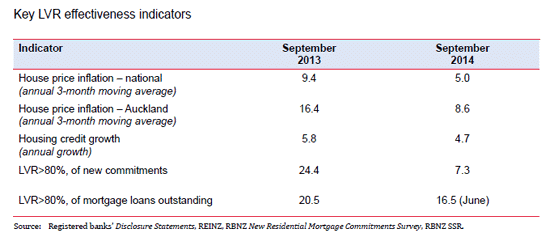
"The reduction in house price inflation and housing credit growth are welcome developments, along with indications of increased residential building," he said.
"However, there remains a risk of a resurgence in house price inflation, particularly in light of strong immigration flows," he said.
"Consequently, we do not consider it appropriate to ease the LVR speed limit at this time."
The bank said later in its report that the bank "intends to ease or remove the restriction when a sustained moderation in house price inflation is achieved, and when there is a little risk of a resurgence in housing market activity."
Dairy debt warning
Elsewhere in the Financial Stability Report, the Reserve Bank warned of an increase in risks in the dairy sector and that New Zealand faced some risks from any financial market disruption from a Chinese economic slowdown.
Deputy Governor Grant Spencer said the sharply lower dairy payout could result in rising loan defaults if it continued at such low levels.
"Lower global dairy prices are in large part due to reduced demand from China, highlighting New Zealand's vulnerability to a slowdown in the Chinese economy," Spencer said.
"Risks arise both from New Zealand's large volume of trade with China, and also from any financial market disruption that could arise from a Chinese economic slowdown," he said.
System sound and stress tested
The bank said in its report that the New Zealand financial system remained sound and its banks were well capitalised with funding and liquidity buffers above the required minimums. Stress tests of all the major banks' portfolios over the last six months showed each bank had the capacity to "manage a range of significant events."
However, there were four key risks, the bank said, including imbalances in the housing market, high levels of indebtedness in dairying, the potential effects of s slowdown in the Chinese economy and the banking system's reliance on offshore funding.
These risks were the same as the bank noted in May, but their balance had shifted.
Housing market pressures had eased since the introduction of high LVR speed limits in October 2013 and the 100 basis point increase in the Official Cash Rate between March and July of this year. But dairy sector risks had increased, the bank said.
Economist reaction
ASB Chief Economist Nick Tuffley said the restrictions had been left in place as he expected and he forecast that the Reserve Bank would leave them in place until the second or third quarter of next year.
"Everything is moving in the right direction for easing the restrictions, but the criteria aren’t met at present," Tuffley said.
"More sustainable price and credit growth have been linked to household income growth. The RBNZ cites household income growth of 4% yoy over the past 5 years. The inference is that price and credit growth that is roughly in line with that number would be “sustainable”," he said, pointing to current house price growth nationally of 5-5.9% and credit growth of 4.7%.
"The risk of resurgence in prices is still very real. The key risk we and the RBNZ see is net migration, which has yet to peak. Although it could start to show signs of peaking by early 2015, in recent months the net inflow has been very strong," he said.
"The RBNZ doesn’t see any evidence that the restrictions are causing significant distortions that outweigh the benefits of the policy."
Political reaction
Labour Housing Spokesman Phil Twyford blamed the decision to leave the high LVR speed limit in place on "National’s housing policy fiasco."
“The Reserve Bank would have lifted LVRs if they had seen any increase in the supply of housing in Auckland," Twyford said.
“This is further bad news for young people looking to achieve the Kiwi dream of buying their own home, and for those in regional New Zealand who are being punished locally for the Government’s failure to fix the Auckland housing crisis," he said.
(Updated with economist and political reaction)
We welcome your comments below. If you are not already registered, please register to comment
Remember we welcome robust, respectful and insightful debate. We don't welcome abusive or defamatory comments and will de-register those repeatedly making such comments. Our current comment policy is here.