

By Greg Ninness
Rents are rising faster than wages in most parts of the country, with the gap widening particularly quickly in Auckland, according to interest.co.nz’s inaugural Rental Housing Affordability Report.
This report tracks movements in average rents around the country and compares them with movements in average after tax pay. It will be published quarterly by interest.co.nz.
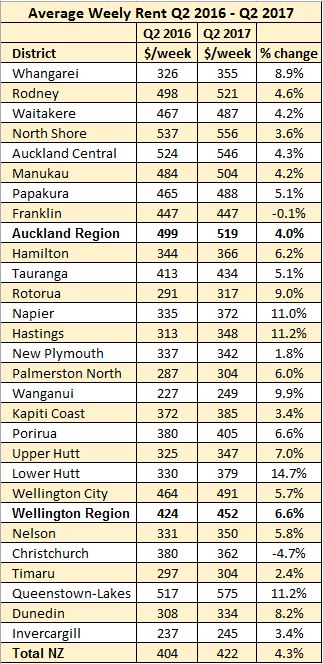
It has found that in the 12 months from the second quarter of last year to the second quarter of this year, the national average rent (based on bonds received by Tenancy Services at MBIE*) increased from $404 a week to $422, a rise of $18 a week (+4.3%).
Over the same period, national average take home pay, (Full Time Equivalent, based on Statistics NZ’s Quarterly Employment Survey, with tax and ACC deductions at IRD’s standard rates*) rose from $918 in the second quarter of last year to $936 in the second quarter of this year, also an increase of $18 a week (+1.9%).
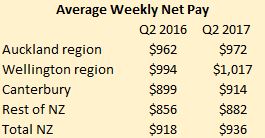
But a bigger concern is that rents are increasing at a faster rate than take home pay, with the figures suggesting that in percentage terms, average rents increased at more than twice the pace of average take home pay between the second quarter of last year and the second quarter of this year.
The situation is particularly acute in Auckland, where the average rent increased from $499 a week to $519 a week, up $20 a week (+4%), while average after tax pay rose from just $962 a week to $972 a week over the same period, an increase of just $10 a week (+1%).
So in Auckland, average rents rose at four times the rate of average take home pay, and in dollar terms, the rent rise was double that of average take home pay.
However there were significant variations in rent rises throughout the Auckland region, ranging from a marginal decline of -0.1% in Franklin to a rise of +5.1% in Papakura.
Papakura and the North Shore were the only parts of Auckland where the average increase in rents was below 4%.
Renters in Wellington are also likely to be feeling the pinch.
Over the same period, average take home pay in the Wellington Region increased from $994 a week to $1017 a week, up $23 a week (+2.3%).
The biggest increase occurred in Lower Hutt where the average rent increased by $49 a week (+14.7%), rising from $330 a week in the second quarter of last year to $379 in the second quarter of this year.
For renters the place to be is Christchurch, which was the only place in the country where the average rent was significantly lower in the second quarter of this year than it was in the second quarter of last year, dropping from $380 a week last year to $362 a week this year (-4.7%).
Over the same period, the average weekly take home pay in Canterbury increased from $899 a week to $914 a week, meaning renters in Canterbury have received the twin benefits of rising pay packets and falling rents.
Average rents were also up strongly in most provincial centres, rising by 11.2% in Queenstown/Lakes, which had most expensive average rent in the country at $575 a week in the second quarter of this year.
There were also strong increases in average rents in Hastings +11.2%, Napier +11.0%, Whanganui +9.9%, Rotorua +9%, Whangarei +8.9% and Dunedin 8.2%.
One point of particular concern in the figures is that while average rents in Auckland are increasing at a similar rate to the national average (4.0% compared to 4.3%), average take home pay in Auckland is only increasing at a little over half the rate of the national average (1.0% compared to 1.9%) and at a much lower rate than average pay in Wellington, Canterbury and areas outside the main centres.
Auckland’s relatively low growth in average net pay could be an unfortunate side effect of the high rates of net migration into the region.
Net migration is running at a record high and is accounting for nearly two thirds of Auckland’s population growth, adding between 40,000 and 45,000 new residents to the city over the last 12 months.
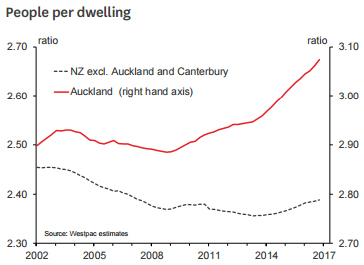
That means migration is the main driver in the demand for more housing which is running well ahead of the rate at which homes are being built.
So migration will undoubtedly be putting upward pressure on rents.
And it may also be contributing to the region’s lower rate of growth in average pay, with some economists believing that current patterns of migration suppress wage growth, particularly for lower paid jobs.
But whatever the reason, the current figures point to Aucklanders who don’t own their own homes being caught between the rock of rapidly rising rents and the hard place of slowly rising wages.
*Notes: Average rents are calculated by interest.co.nz from bond data supplied by Tenancy Services at the Ministry of Business Innovation and Employment. Average Weekly Net Pay is based is on Statistics NZ's Quarterly Employment Survey (Full Time Equivalent, Total Average Weekly Earnings) with PAYE and ACC earner deductions calculated at IRD's standard rates. All figures are rounded to the nearest dollar. These figures will be updated quarterly by interest.co.nz.
You can receive all of our property articles automatically by subscribing to our free email Property Newsletter. This will deliver all of our property-related articles, including auction results and interest rate updates, directly to your in-box 3-5 times a week. We don't share your details with third parties and you can unsubscribe at any time. To subscribe just click on this link, scroll down to "Property email newsletter"and enter your email address.
We welcome your comments below. If you are not already registered, please register to comment
Remember we welcome robust, respectful and insightful debate. We don't welcome abusive or defamatory comments and will de-register those repeatedly making such comments. Our current comment policy is here.