

Nationwide housing values grew at their slowest rate for nearly seven years in the year to December, Quotable Value (QV) data shows, although the government valuer is optimistic the property market will be busy as 2019 activity gets underway.
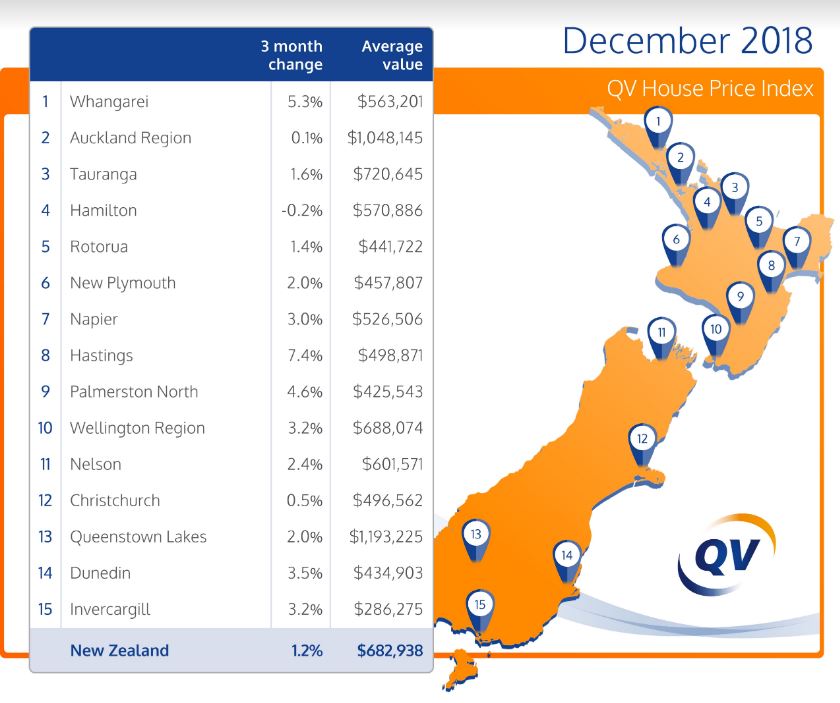
QV says New Zealand wide residential property values increased 3.2% in the December year, and 1.2% in the December quarter. The annual growth rate is the slowest since an increase of 3.1% was recorded in the April 2012 year. Nonetheless the nationwide average value is now $682,938, a fresh record high.
In the Auckland region residential property values dropped 0.4% year-on-year, but increased 0.1% in the December quarter, putting the average value for the Auckland region at $1,048,145.
QV general manager David Nagel sees potential for "a busy property market" in the early part of 2019. In large part this is due to the Reserve Bank's decision, announced in late November, to relax its rules for banks' high loan-to-value ratio (LVR) residential mortgage lending. The changes, which took effect from January 1, mean up to 20%, increased from 15%, of a bank's new mortgage loans to owner-occupiers can have deposits of less than 20%, and up to 5% of a bank's new mortgage loans to property investors can have deposits of less than 30%, lowered from 35%.
"The loosening of the LVR restrictions should enable some new first home buyers and investors to enter the market in the coming months. I don’t anticipate this impact to be overly significant, but it may help drive a busy property market in the early stages of 2019," says Nagel.
“I am particularly interested in the rental market where we’re seeing a lot of competition particularly in the Wellington market. According to the Trade Me Rental Price Index, the cost of rent in Wellington is now very similar to Auckland which really does say something. With the Healthy Homes Bill due take to effect later this year, I’ll be closely monitoring the impact this will have on the supply and costs of rental accommodation," adds Nagel.
The Auckland break down
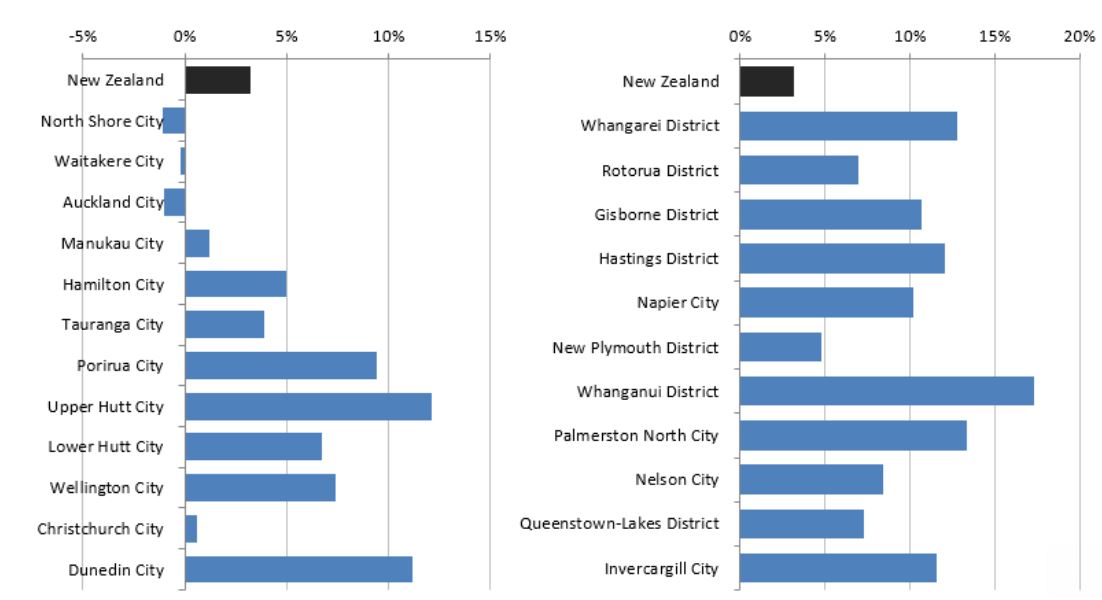
Drilling down into key Auckland areas, North Shore values dropped 1.1% in the December year and by 0.3% in the December quarter leaving the average North Shore value at $1,212,664. Values in the ex-Auckland City Council suburbs dropped 1.0% year-on-year and by 0.1% in the quarter, leaving the average value at $1,233,311. In Waitakere values fell 0.2% year-on-year and by 0.2% in the quarter giving an average value of $822,906. Manukau values increased 1.2% year-on-year and by 0.9% over the quarter to give an average of $906,658. Further out from the city centre, Papakura values rose 0.6% year-on-year and by 0.2% in the quarter giving an average value of $701,230, Franklin values increased 1.1% year-on-year leaving the average at $673,679, and to the north Rodney values rose 1.1% year-on-year giving an average value of $950,940.
“It’s fairly steady here in Auckland, with well-presented properties close to services and amenities continuing to sell well. Investor demand appears to remain fairly steady although possibly it has eased back over the past few months," says QV Auckland property consultant, Hugh Robson.
Wellington values rise & rental competition heats up
In the Wellington region values rose 7.8% in the December year, and rose 3.2% during the December quarter, lifting the average value to $688,074.
Wellington City values gained 7.4% year-on-year and rose 2.3% in the December quarter, leaving the average value at $813,052. Values in Upper Hutt rose 12.1% year-on-year and 5.7% in the December quarter to an average of $526,702. Lower Hutt rose 6.7% year-on-year and 4.2% in the quarter with the average value at $559,319. Porirua rose 9.4% year-on-year 5.3% in the quarter to an average of $591,421. And Kapiti Coast values increased 5.7% year-on-year and 2.2% in the December quarter with the average at $577,030.
“Tight supply, low interest rates, as well as a slight relaxing of the loan-to-value ratios is likely to combine to form a relatively buoyant property market at the start of 2019. Despite this, value growth is expected to continue to moderate over 2019 as affordability issues put a damper on the market," QV Wellington senior consultant, David Cornford says.
“First home buyers have had a strong presence in the market over the last two years and we expect this to continue into 2019, particularly given a slight relaxing of LVRs.”
“The extremely competitive rental market has also meant tenants are increasingly choosing to renew their fixed terms or roll over their leases. It’ll be interesting to see what effect the abolishment of letting fees and increased compliance costs will have on rents over 2019," adds Cornford.
A mixed picture elsewhere
In Christchurch QV says there has been a continuation of recent trends, with values either holding or dropping slightly. Values increased 0.5% over the December quarter, with the average Christchurch value at $496,562.
QV Christchurch property consultant Hamish Collins says real estate agents are reporting most recent activity is from first home buyers in the $350,000 to $450,000 value range.
In Hamilton home values dropped 0.2% in the December quarter, but increased 5.0% in the December year. The average value in Hamilton is $570,886. Tauranga home values rose 3.9% year-on-year and by 1.6% during the December quarter leaving the average value at $720,645.
Values in the Western Bay of Plenty rose 4.9% year-on-year and 3.8% during the December quarter, putting the average value in the district at $654,083.
In Dunedin values surged 11.2% in the December year and rose 3.5% in the December quarter, leaving the average value in the city at $434,903.
Nelson residential property values recorded an 8.4% annual rise, and rose 2.4% in the December quarter. The average Nelson value is $601,571. Values in the Tasman District rose 6.0% year-on-year and 1.0% in the December quarter, with the average value in the Tasman district $589,630.
In the Hawke's Bay Napier values jumped 10.2% year-on-year and rose 3.0% in the December quarter, putting the average value at $526,506, QV says. Hastings values jumped 12.1% year-on-year and 7.4% during the December quarter lifting the average value to $498,871.
Elsewhere in the North Island QV says Kawerau, Carterton and South Waikato lead the way in quarterly growth, with value growth of 22.7%, 9.9% and 9.1% respectively. In terms of annual growth, Kawerau lead the way, surging 30.1% to an average of $245,137, followed by Wairoa at 27.4% to an average of $198,666 and Ruapehu at 20.9% to an average of $206,954.
In the South Island QV says the Southland, Invercargill and Gore regions lead the way in quarterly growth, with increases of 6.8%, 3.2% and 2.6% respectively. Invercargill recorded the strongest annual growth of 11.6% to an average of $286,275, followed by Nelson's 8.4% and Central Otago's 8.4% to an average of $506,706.
More of the same predicted
Commenting on the QV data, CoreLogic head of research Nick Goodall says the December QV House Price Index closed out 2018 in a relatively similar way to the year before, with continued weakness in the bigger cities and inconsistent growth elsewhere.
"2019 is likely to bring more of the same, with many eyes on the Government, Reserve Bank and the banks themselves as they hold so many of the influencer cards,” says Goodall.
Annual change in values
No chart with that title exists.


We welcome your comments below. If you are not already registered, please register to comment
Remember we welcome robust, respectful and insightful debate. We don't welcome abusive or defamatory comments and will de-register those repeatedly making such comments. Our current comment policy is here.