
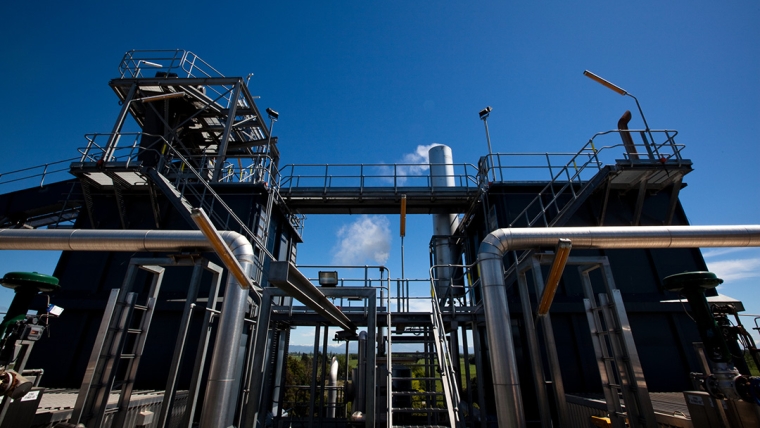
The Government will give Fonterra $90 million to co-fund initiatives that will halve the dairy producer's use of coal as part of a programme to decarbonise New Zealand industry.
Prime Minister Chris Hipkins was set to announce the deal at a Fonterra site in Hautapu on Thursday morning, but the trip was scrapped after the fatal shooting in Auckland.
In a press release, he said the commitment would help the dairy sector transition away from coal much faster.
“This is not just critical for our environment, but for our economy too,” he said.
Fonterra (and other industrial businesses) receive free emissions trading scheme (ETS) units from the government. It was given 51,400 units in 2021, equivalent to 51.4m tonnes of carbon.
This free allocation protects businesses from the rising carbon price, but also weakens their incentive to reduce emissions.
Instead, the Government has created a Government Investment in Decarbonising Industry (GIDI) Fund to help fund lower carbon processes in heavy industry.
It was created with $650 million earned from the ETS, which was paid by emitters that are not eligible for a free industrial allocation.
Fonterra will use the $90m to help fund a range of projects across six of its manufacturing sites, which are expected to reduce its carbon emissions by about 2.1 million tonnes.
This would be the equivalent of taking approximately 120,000 cars off the road and would cover 2.7% of all NZ’s required emissions reductions between 2026 and 2030.
Fonterra plans to invest approximately $700 million of its own money to achieve its decarbonisation target, which was upgraded to a 50% reduction by 2030 (up from 30%).
Hate the subsidy, love the savings
In a tweet, climate consultant Christina Hood said she loved the emissions reductions but hated the subsidy.
“If the ETS were set up better then Fonterra would have the financial incentive to do this themselves. But that will take a few years to correct.”
Emitters are currently able to offset all of their emissions with units created by low-cost permanent pine plantations.
However, the Ministry for the Environment has begun consulting on ways to better incentivise gross emissions — possibly by creating separate prices for offsets and direct reductions.
“The current govt ETS reform consultation is a first step. In the meantime, yep, swallow the subsidy rat and get on with it. We're in a climate emergency and every tonne counts,” Hood said.
Hipkins said these partnerships with big emitters were reducing pollution and ensuring New Zealand industry was keeping up with its international competitors.
“It demonstrates our Government’s commitment to climate action now, and how much further and faster we can go if we make investments sooner, rather than later.”
The Government announced a similar deal with NZ Steel in May, giving the Bluescope-owned subsidiary $140m to build an electric arc furnace at its steelworks at Glenbrook.
Megan Woods, the Minister for Energy and Resources, said both investments would cut emissions locally and reduce the amount of offshore offsets NZ will have to buy to meet its international obligations.
Earlier this year, a Treasury report found the Government would be forced to buy offshore carbon mitigation that could cost anywhere between $3.3 billion and $23.7 billion.
Any extra reductions done in New Zealand reduces the amount of credits that will have to be bought in the future at a yet-unknown price.
The GIDI investment in Fonterra has been forecast to cost the Government about $43 per tonne of carbon reduction. The spot price for ETS units was $49.75 on Thursday morning.
We welcome your comments below. If you are not already registered, please register to comment
Remember we welcome robust, respectful and insightful debate. We don't welcome abusive or defamatory comments and will de-register those repeatedly making such comments. Our current comment policy is here.