
National has unveiled the tax policy it will take into the election, but it depends on the implementation and success of two brand new taxes to be self-funding.
It also depends on revenue from the emissions trading scheme (ETS), which is only expected to continue pumping out cash until some time next decade, while markets decide how much.
The ETS revenue drying up will be a problem for a future government. But the funding of the tax plan depends on $3.7 billion in untested taxes, which critics are already questioning.
A rule change to allow non-residents to buy residential properties worth more than $2 million, in exchange for a 15% tax on the transaction, would be the biggest contributor by far.
A policy document said this would pull in an estimated $2.9 billion in revenue across the four year forecast period — almost half of all the new revenue.
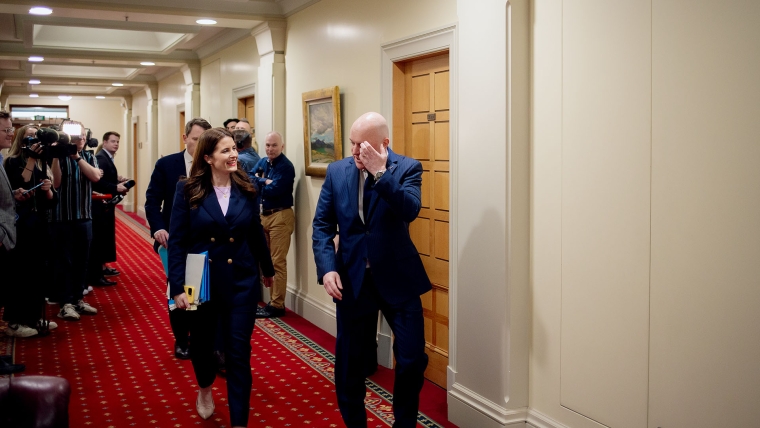
National’s Nicola Willis said money would come from fewer than 2,000 transactions, which would presumably mean each sale would be worth an average of $10 million.
Labour’s Grant Robertson doubted those numbers could be sustained in the long term.
“They are relying on an increasing number of foreign buyers to come in and buy a dwindling number of houses. It simply doesn’t add up,” he said.
“They are saying there would be a never ending stream of foreign speculators coming in to buy … thousands of houses every year, forever.”
The policy document said the revenue was modelled on Quotable Value price data and weighted based on Statistics NZ’s non-resident property transfer data.
There were about 4000 transfers in 2018, prior to the foreign buyer ban, although the data was likely an undercount because it doesn’t include trust or company transactions.
David Parker, Labour’s overseas investment spokesperson, said the forecasts assumed the number of eligible foreign buyers would reach 70% of 2018 levels, when there was no tax.
“It’s impossible to see where all the buyers who could be covered by their tax are coming from. Given they’ve exempted Australia and Singapore they’ve already eliminated 27% of the foreign buyers from 2018”.
A Labour Party press release said National's estimates were "voodoo costings". A phrase Robertson appeared reluctant to repeat in person.
Rolling the dice
The second untested tax involves bringing overseas online gambling websites into the NZ legal system, which National estimated would be worth an estimated $716 million in revenue over four years.
National wants to set up a regulatory regime that would force operators to report their earnings and pay tax, or else have their websites blocked for local IP addresses.
Motivated gamblers could sidestep this measure by using a VPN, but it might be enough of a barrier to motivate overseas companies to register in New Zealand.
Castalia Advisors, a consultancy firm hired to cost the tax package, said the estimates were based on external forecasts of online casino gambling revenue.
Labour’s Revenue and Internal Affairs spokesperson Barbara Edmonds said the Government has been collecting GST on offshore casino platforms since 2016, under the so-called Netflix Tax brought in by the previous National Government.
"The fiscal plan also appears to have had no input from the National’s Revenue spokesperson Andrew Bayly. Mr Bayly knows that GST has been collected from online casino operators overseas since 2016 at a rate of about $37.8 million per year because of a recent Parliamentary question he asked," Edmonds said.
"We also challenge National to provide the costings for the claim that an average of $179 million per year could generate revenue of $716 million over the forecast period. As Andrew Bayly knows, in the seven years since GST has been collected, only a total of $170 million has come from online casinos," added Edmonds.
A bigger problem?
Tax specialist Terry Baucher said either National's numbers were optimistic or gambling was a much bigger problem than anyone realised.
The two remaining revenue measures are more predictable. Preventing commercial property owners from claiming depreciation was standard practice a few years ago.
Treasury forecast the cost of permitting the tax break in March 2020 and National has used this number—$525 million—in its policy.
National would also shift the cost of processing immigration visas onto the applicant. These levies would range between $375 for a student to $2,750 for a partner resident visa.
The revenue was forecast based on the amount of funding allocated to immigration in recent budget documents and included modelling on how the higher costs would impact demand.
Tax is … politics
Baucher said tax policy was ultimately the domain of politics, not economics. The goal is always to rearrange taxes and transfers to benefit your voters.
National has targeted this plan at middle-income families and those who own an investment property — core supporters for the party.
A press release from the Green Party said high-income property speculators would be the biggest winners from a National Party tax plan.
This isn’t obviously true. But property investors will get about $700 million out of it each year.
Green co-leader James Shaw said people on the lowest incomes would miss out, while property speculators line their pockets.
“There are not even crumbs in this policy for students and people on benefits,” he said.
National’s plan zeros in on its supporters and gives them the biggest tax cut. The party’s gift to the wealthiest New Zealanders was protection against wealth, capital or land taxes.
Baucher said this was a problem as there wasn’t much room to raise rates on things which are currently taxable, such as income and consumption.
“The two main parties aren’t serious about tax. They keep shying away from how we will actually pay for things,” he said.
Unconscious uncoupling
The tax plan released on Wednesday was supposedly “decoupled” from the party’s fiscal plan.
Michael Reddell, an economic commentator, said it wasn’t credible to claim the tax plan was detached from the overall fiscal plan.
In a blog post, he said it might make sense if the budget was already balanced or in surplus.
Budget 2023 forecast deficits of about $7 billion this year and next, but are expected to grow by several billion dollars each in the pre-election update.
The first surplus could be in 2027 and net debt peak above 23% of GDP, although comfortably below the 30% ceiling.
The savings and new taxes found to finance the tax cuts, cannot also be used to close the deficit and National was unlikely to reveal a second set of taxes for its fiscal plan.
“To the extent there is genuine bloat, the tax cuts package will have grabbed it,” he wrote.
If National also wants to cut the deficit, they would need to make deeper and more difficult cuts to public services — which they don’t want to do.
“Both Labour and National profess allegiance to the idea of an operating surplus … but seem to have not the remotest interest in telling us what choices they are going to make to get us there”.
Reddell also cast doubt on whether the package would be inflation neutral as promised.
Cutting the Auckland fuel tax would be stimulatory and revenue reaped from foreign buyers could bring fresh money into the New Zealand economy.
However, he noted the whole package was worth less than 1% of GDP and shouldn’t make much difference to inflation either way.
We welcome your comments below. If you are not already registered, please register to comment
Remember we welcome robust, respectful and insightful debate. We don't welcome abusive or defamatory comments and will de-register those repeatedly making such comments. Our current comment policy is here.