
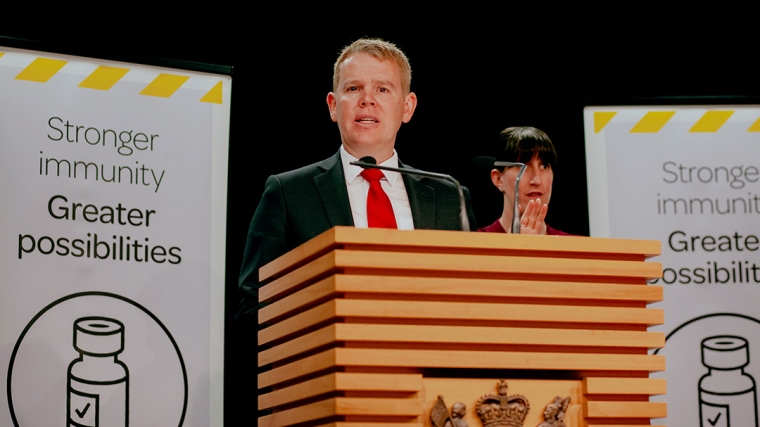
The leader of the Labour Party, Chris Hipkins, said there was a “certain irony” to losing five campaign days to a covid infection as he left self-isolation on Friday morning.
Covid-19 had disrupted “everything over the last three years”, he said outside the Cordis Hotel in Auckland, and now it had disrupted the last two weeks of the campaign.
It's not likely that those five days on the campaign trail would’ve changed the course of the election. Polls show Labour has found a floor at about 26% of the vote.
But any chance to boost those numbers back above 30%, where the party was a month ago, would’ve been severely hampered with the leading man locked in a hotel room.
While politicians don’t like to talk about it, this whole election has been about Covid-19.
Three of the biggest issues in this campaign — the cost of living, crime, and education — are all part of the fallout from the pandemic.
National has repeatedly accused Labour’s spending as being “economic vandalism” but the bulk of new debt came from Covid response programs that had the full support of parliament.
These are things like the wage subsidy, small business loans, managed isolation, and buying vaccines and other health resources.
Slow economic growth and the high cost-of-living are the final turns of the Covid rollercoaster the New Zealand economy is still riding.
The pandemic caused a supply shock, central banks overstimulated the economy, inflation became embedded, and now those central banks are trying to engineer a recession.
There was a crime wave after the pandemic in many countries, but most notably in the United States where the murder rate suddenly spiked.
In many countries, lockdowns disrupted ‘business-as-usual’ crime and forced criminals to form new patterns. This may be the cause of the sudden uptick in ram raids, for example.
Social service agencies and police told the Guardian NZ that the higher rates of crime could be put down to social deprivation, the stresses of the pandemic, and some New Zealanders missing out on Government support.
Less people in the inner city, due to changes in working habits, may also have encouraged more crime. The housing shortage has also left more people living on the streets.
School kids have lost months of learning days over the past three years and that is driving much of the underperformance in education statistics.
A report by the Education Review Office found that covid illness caused a drop in school attendance that has continued even as the infection rate has fallen.
“The cumulative impact of the past three years means that education in New Zealand has ‘Long Covid’ — a situation that will not easily bounce back to business as usual,” the authors wrote.
Some other key issues — such as housing and healthcare — already had structural problems prior to the pandemic, although it hasn’t helped either situation.
Another key feature of this campaign has been division and anger. Hardly a week went by without Karl Mokaraka popping his head over the fence, or a political candidate being threatened.
Even Hipkins would agree the vaccine mandates turned an “otherwise rock-solid response” that united the nation into a source of division and resentment.
At a virtual town hall event, he said high rates of vaccination had helped NZ have one of the lowest mortality rates in the world but he regretted the division that mandates caused.
If he had his time over, he’d try to find a different way.
Labour has not talked about the pandemic all that much in this campaign. The party’s incredible success at preventing deaths has been overshadowed by the inevitable detritus.
And, while most voters are grateful for the Covid response, they are thinking to themselves that they’d rather have the other team in charge of the clean up.
National have a near unassailable lead in the polls now, but the pandemic has one final twist of irony for the incoming government: Winston Peters.
New Zealand First ridden a wave of dissatisfaction, conspiracy theories, and lightly-disguised racism over the 5% threshold — often railing against the Government they helped to install.
Christopher Luxon’s announcement that he would work with Winston (but only as a last resort) seems to have sealed his fate; National will need his votes.
We welcome your comments below. If you are not already registered, please register to comment
Remember we welcome robust, respectful and insightful debate. We don't welcome abusive or defamatory comments and will de-register those repeatedly making such comments. Our current comment policy is here.