
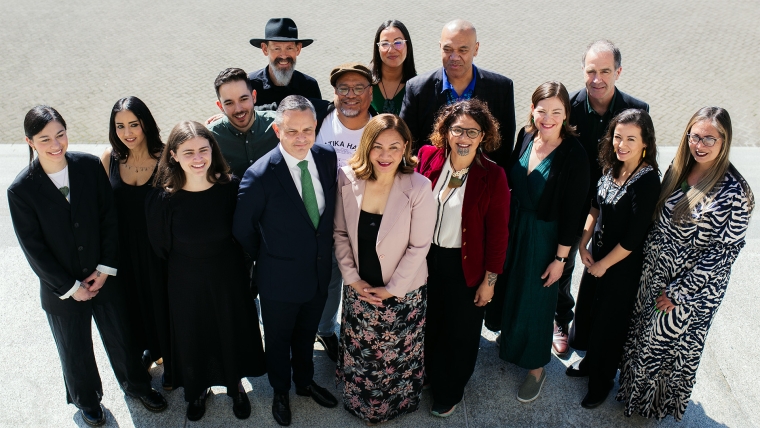
A rejuvenated Green Party caucus says it could work with National on climate and violence protection policy, and that Wellington voters have endorsed light rail.
The 14 successful Green candidates met at Parliament on Wednesday morning for a photo and press conference with co-leaders James Shaw and Marama Davidson.
Election 2023 was a partial success for the party. It gained four extra list seats, seven fresh members, and flipped two Wellington electorates.
Shaw said this should send a message to the incoming National government that voters in the city support light rail and other Green-adjacent transport plans.
Former councillor Tamatha Paul won Wellington Central, former associate transport minister Julie Anne Genter won Rongotai, and the city also elected a Green mayor last year.
Despite the blue wave sweeping electorates, Labour’s Greg O’Connor held onto Ōhāriu. This could be interpreted as an endorsement of left-leaning transport plans.
Shaw said he was hoping National would listen to the “democratic will of Wellingtonians” and support the city’s ambition to build mass rapid transit, such as light rail.
“The National Party said they would be more focused on localism and ensuring local councils were able to focus on their priorities,” he told reporters.
“But then they said they didn't care what Wellington thought, and they were going to drill some holes in Mount Victoria regardless of what local representation thought.”
Let’s get Wellington driving
National’s transport policy document said the Let’s Get Wellington Moving programme had lost its social licence and residents just wanted action.
It will build a second tunnel for two additional car lanes and a separated area for walking and cycling above the road, instead. This will be funded as a State Highway project, and would allow for a faster moving bus network.
“There are a range of cost-effective and sensible projects which should be being advanced as priorities to get the city moving, rather than expensive vanity projects like light rail,” it said.
Waka Kotahi recently bought a piece of land on the Basin Reserve that could be necessary for the light rail project, and the high density housing it would enable.
However, it told The Post it was not proactively purchasing property for the project — which is likely to be scrapped or re-invented.
The Green Party might be able to make a case that voters support light rail in Wellington but it is much harder to argue the same thing in Auckland.
Few of the suburbs set to benefit from the light rail project actually voted for Labour.
The Green’s won Auckland Central, Epsom voted for Act, Mount Albert is still undecided, while Mount Roskill and Maungakiekie turned blue. Only Māngere had a decisive Labour win.
It was hardly a resounding endorsement of the $14 billion tunnelled light rail project, but perhaps support could be rallied for the Greens/Wayne Brown’s cheaper surface rail option.
National plans to scrap light rail and focus on three mass transit bus routes, which it says would be easier to deliver. None are a direct replacement for the light rail proposal, however.
Questioning leadership
Neither James Shaw nor Marama Davidson would commit to staying on as co-leaders for the full Parliamentary term and into the next election.
Shaw and Davidson have operated as a tight-knit team and have a complementary set of skills. It is possible that the two could resign together and allow a new duo to take over.
The pair said those decisions would be made sometime “in the future” once the newly elected members had had a chance to settle into Parliament.
“We’ve got a big new caucus and the primary focus right now is to ensure everyone gets their feet under the table and that we get off to a good start,” Shaw told reporters.
He noted the party, “somewhat famously”, holds an election for co-leaders at its general meeting each year and the next would be in June or July.
Shaw unexpectedly faced a leadership challenge at the 2022 general meeting, when a group of party activists voted to reopen nominations for his spot at the top of the party.
The activists had hoped this would create a vacuum that allowed some other senior party figure to put themselves forward. But it didn’t happen and Shaw was reelected easily.
Possible candidates included Teanau Tuiono, who has been returned to Parliament, and Elizabeth Kerekere who quit the party earlier this year.
Julie Anne Genter ran for the leadership against Marama Davidson in 2018, but only received one-third of the votes.
Meanwhile, Chloe Swarbrick has become one the country’s best-known politicians and could likely take on the leadership, if she wanted it.
She is popular with the public but, unlike Shaw and Genter, she also has strong support within the Green Party membership.
Tamatha Paul, the newly-elected representative for Wellington Central, was recruited by Swarbrick and is considered to be a close ally.
The Greens also endorsed Efeso Collins in the Auckland mayoral race, a decision made by the party’s Auckland chapter but likely involved input from Swarbrick.
Notably, Kerekere’s departure from the party came after she (seemingly) criticised the Auckland Central MP and appeared to involve a behind the scenes struggle over list placing.
To the extent that factions exist in the Green Party, Swarbrick seems to be on the winning side.
Green New Deal?
National has committed to New Zealand’s 2030 and 2050 climate targets but is heading into government with two parties, ACT and NZ First, that do not support either goal.
Leader Christopher Luxon and climate spokesperson Simon Watts have both said the Zero Carbon Act would not be up for negotiation and climate action would continue.
It was Shaw who introduced the bill to Parliament and worked to win the National Party’s support. It ultimately passed unanimously, because Act’s David Seymour missed the vote.
The Green Party co-leader said National had committed to the emission reduction targets but wouldn’t have the policy mix or coalition support to actually achieve them.
“It's going to be an interesting circle for them to square,” he told reporters.
In 2009, National and the Greens signed a Memorandum of Understanding which allowed the two parties to work together on a home insulation and energy efficiency strategy.
Luxon could choose to collaborate with the Green Party on both climate and family violence prevention, which Davidson has worked on, as an alternative to Act and NZ First.
This wouldn’t be a confidence and supply agreement, just support for specific initiatives.
Davidson said fighting climate change and preventing violence was good for all New Zealanders and she hoped National would recognise their expertise in those areas.
But Shaw said neither party had reached out to talk about it yet. The memorandum with the Key government in 2009 wasn’t formed until six months after the election.
“If there is anything like that kind of arrangement, it will be something for the future. They have to stick together, what is obviously going to be, a very awkward coalition in the meantime,” he said.
When reporters asked if the pair had a message for Luxon and Seymour about working with Winston Peters, Davidson answered: “Thoughts and prayers”.
The new Green MPs are: ecologist Lan Pham, chief executive Hūhana Lyndon, campaigner Steve Abel, councillor Efeso Collins, project manager Scott Willis, scientist Darleen Tana, and councillor Tamatha Paul.
We welcome your comments below. If you are not already registered, please register to comment
Remember we welcome robust, respectful and insightful debate. We don't welcome abusive or defamatory comments and will de-register those repeatedly making such comments. Our current comment policy is here.