
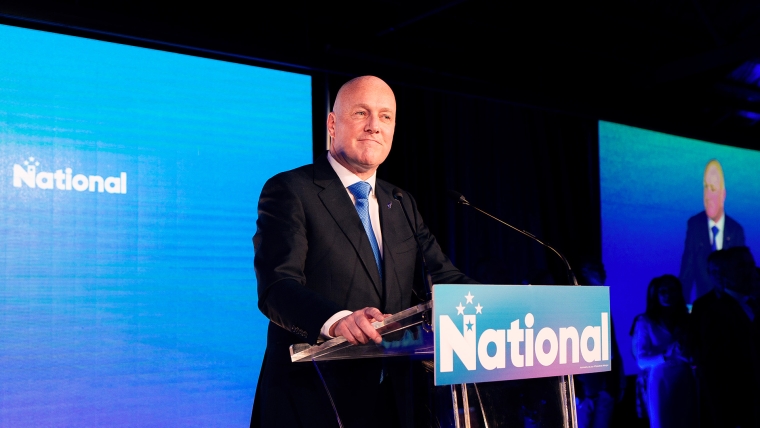
The centre-right coalition has lost two seats in the final vote count and National will need to reach beyond its preferred partner, the Act Party, and strike a deal with New Zealand First.
National won 48 seats in the final count, which was announced by the Electoral Commission on Friday, while Act held the same 11 seats as on election night — a total of 59 between them.
This is likely to increase to 60 after the Port Waikato by-election but the pair will still need support from NZ First, which won eight seats, to form a government.
The Green Party and Te Pāti Māori picked up the seats National lost, bringing them a total of 15 and six successful candidates each.
On election night, Labour held narrow leads in the Te Tai Tokerau and Tāmaki Makaurau electorates which had been held by Kelvin Davis and Peeni Henare, respectively.
By the final count, Takutai Tarsh Kemp had won a 4 vote majority over Henare and Mariameno Kapa-Kingi had beaten Davis by 517 votes. The losing candidates will be able to request a recount.
The Electoral Commission said Te Pāti Māori winning six electorates, and only 3.1% of the party vote, would result in a 122 seat Parliament.
The seat count will grow to 123 after the Port Waikato by-election on November 25 and means National will need 62 seats to command a majority in the house.
Labour did not pick up any extra seats in the final count but did manage to overturn a couple of electorates. Rachel Boyack won Nelson with a 29 vote majority and Phil Twyford recaptured Te Atatū by 131 votes.
Losing a couple of electorates isn’t all bad news for National as it allows them to bring five MPs from its list, where it had some key candidates at risk of not making it to Parliament.
Paulo Garcia held onto his lead over Deborah Russell in New Lynn, making him the first National Party candidate to win the electorate in the past sixty years.
Helen White has hung onto the Mount Albert electorate, a famous Labour stronghold that almost turned blue for the first time in history.
Labour has wound up with a total of 17 electorate seats and 17 list seats, a total of 34.
Luxon's 'last resort' scenario
During the campaign, National leader Christopher Luxon described this scenario as a “last resort” and called on voters to support just National and Act.
It looked, early on election night, like that prayer may have been answered but by midnight the majority had been chipped away to just one seat.
“There are many votes still to be counted, but on current numbers it looks like National and Act will be in a position to form the next government,” Luxon said, in his 11pm election night speech.
He also congratulated Winston Peters on NZ First’s return to Parliament and expressed appreciation for the offer to “help where needed”.
National has lost at least one seat to special votes in every election since 1999, and so Luxon reached out to Peters almost immediately.
Coalition negotiations have been quietly bubbling away ever since, with Luxon reportedly focused on building “relationships and chemistry” with NZ First and Act.
All three party leaders have made promising comments about the possibility of forming a government within a week of the final vote count being released.
While there are notable personality differences between the trio, they share a similar set of policy goals which should make it easier to strike a solid governing arrangement.
The sticking points will be on climate policy, the pension age, Maori–Crown relations, and distribution of ministerial portfolios.
A total of 603,257 special votes were cast in 2023 election, equivalent to 21% of the total, which was up from about 17% in both 2020 and 2017.
Voter turnout was 78.2% of those enrolled, down from 82.2% and 79.8% in the prior two elections, and proportion of possible voters that was enrolled was 94.7%
We welcome your comments below. If you are not already registered, please register to comment
Remember we welcome robust, respectful and insightful debate. We don't welcome abusive or defamatory comments and will de-register those repeatedly making such comments. Our current comment policy is here.