
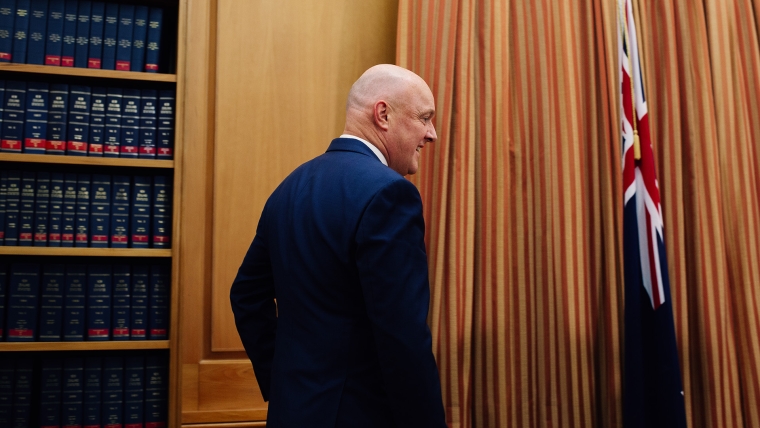
With the party votes counted and the final balance of power known, National leader Christopher Luxon can crack on with coalition negotiations and getting into government.
But he won’t commit to a deadline — the leaders of Act and New Zealand First have both said it would be possible to finalise an agreement in the coming week, while Luxon is not so sure.
He has decided not to travel to the Pacific Islands Forum on Tuesday and wouldn’t commit to flying to the Asia Pacific Leaders Forum on Wednesday next week.
“At the end of the day, I’ll take as long as it takes to get a strong, stable government in place for New Zealand. If that means I don’t make APEC, then so be it,” he said.
“I’ve only got one job at the moment, and that is to build a strong and stable government”.
He said the final vote tally was roughly as expected and that good progress had been made in coalition negotiations while the special votes were counted.
National won 38.06% of party votes and picked up 43 electorates, although it wants to see a recount in Nelson and Mount Albert which Labour won by just 20 and 29 votes, respectively.
Labour leader Chris Hipkins said he would support a recount in Tamaki Makaurau, where a Te Pāti Māori candidate appears to have overtaken the incumbent Peeni Henare by four votes.
Deputy party leader, Kelvin Davis could also seek a recount in his electorate in which he trails the Te Pāti Māori candidate by 500 votes. He has previously said he would resign if he lost.
Banks Peninsula and Te Atatu are the only other electorates with small enough margins to consider a recount, but none of these will have any effect on which parties are in power.
The Act Party ended up with 8.6% of the party votes and 11 seats, while NZ First won 6.1% of votes and 8 seats. National will need support from both parties to form a Government.
David Seymour, leader of the Act Party, explicitly ruled out sitting around the Cabinet table with Winston Peters prior to the election. He walked back that statement after the final results were announced, revealing it would be possible after all.
"I said that at a time when it appeared unlikely that we'd get to this particular point and now we're here we've got to respect the will of the voters,” he told reporters at a press conference.
It might be tempting to interpret that as a sign National has been pursuing a full coalition agreement with both parties, but Luxon wouldn’t be drawn on the question when asked.
He did say there were questions to be asked of the Electoral Commission, citing a number of issues with the process and counting of the special votes.
The easy vote cards were slow to arrive at households, there were problems at voting booths on election day, and some have called for special votes to be reported as they are counted.
Losing Māori & Auckland
Hipkins said the Labour Party would have to spend some time reflecting on why it performed so poorly in both Auckland and Māori electorates.
These are traditionally key areas of support for the party and will need to be won back in the future.
“We do need to spend some time reflecting on Auckland, in particular. The Labour Party has lost a lot of support there over the past two years,” he told reporters.
Labour’s internal poll numbers dropped “significantly” in late 2021 and early 2022, at the end of the long lockdown, and it wasn’t able to regain that support over the past 18-months.
He would reflect on the result and make sure the party did re-engage with Auckland and rebuild its support in the city.
However, Māori were still supporting Labour with their party vote and appeared to have been splitting their votes strategically, he said.
“It could well have been that Māori voters were trying to strengthen the overall number of Māori in Parliament”.
Labour ended up with 26.9% of party votes and won 17 electorates, for a total of 34 seats.
Te Pāti Māori picked up 3.1% of votes and six electorates, while the Greens won 11.6% for a record 15 seats — including three electorate wins.
Hipkins said the Labour Party, and its allies, would be “formidable opposition” but it is still an open question as to whether he will be its leader.
The caucus will meet in the next few weeks and likely hold a leadership vote before the end of the year, which Hipkins is expected to contest.
“I’ve still got a bit of fight left in me, I think there is an important job to do. The Labour Party has always been very good to me and I am still absolutely committed to the Labour Party”.
There are not many candidates to take his place. David Parker has reportedly been weighing up a challenge, but few others have the public profile or appetite to make a bid.
We welcome your comments below. If you are not already registered, please register to comment
Remember we welcome robust, respectful and insightful debate. We don't welcome abusive or defamatory comments and will de-register those repeatedly making such comments. Our current comment policy is here.