
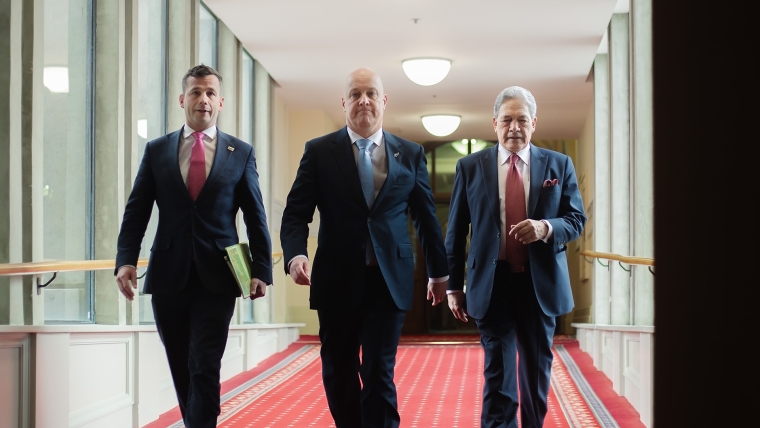
The Coalition Government has finished its first proper week in charge of Parliament and has wasted no time pulling apart the legislative legacy of the previous Labour government.
It has already repealed the Clean Car Discount scheme, Fair Pay Agreement laws, and removed the employment mandate from the Reserve Bank Act.
These were three signature policies from the 2020 Labour government and the 2017 Labour-led coalition government, and there’s still more to come.
Early next year—if not next week—the new Government will repeal the Resource Management Act replacement, the Three Waters/Affordable Water Reform, and Smokefree laws.
The latter move is so unpopular with the medical community that the brand new Health Minister, Shane Reti, appears to be unwilling to front the repeal.
Casey Costello, a New Zealand First MP and Associate Minister for Health, has been delegated the job. The policy was originally supported by Act and NZ First, but not National.
Happy losers
You might think the Labour Party, watching all this unfold from the opposition benches, would be distraught. But no, it is oddly relaxed and upbeat.
One interpretation may be that the party feels like the Coalition Government is moving too fast and will be overwhelmed by public backlash.
New Zealanders voted for change but some are getting more than they asked for.
This is purely anecdotal, but I spoke to an enthusiastic (if not very politically-engaged) National Party voter in Auckland last week who was baffled by “all the Māori language stuff”.
There are, of course, many voters who want to see pushback against ‘woke-ism’ and ‘Māori-fication’ but most are only bothered by these things if the basics aren’t going well.
How many other ‘Get New Zealand Back on Track” voters are surprised by the “Let’s Take Our Country Back” and “Real Change” policies that are coming through?
Labour hopes the answer is “a lot”, although there is no evidence of that. The only poll since the Coalition took over showed a statistically insignificant fall in support for the governing trio.
Still, the party’s deputy leader Carmel Sepuloni pushed this idea in a Parliamentary debate earlier this week.
The smoke-free and te reo Māori policies were like a bad circus she once attended, in which the performers botched their tricks and made the audience question their professionalism.
“I think there are a number of New Zealanders who bought tickets to this political circus and are asking themselves the same question right now,” she said.
Perhaps it is equally likely that the new Government has spent its honeymoon period getting some contentious policies out of the way and the rest of its agenda will prove popular.
On message, off message
Nicola Willis, the Minister of Finance and National’s deputy leader, has been trying to keep the conversation focused on inflation, the cost of living, and the economy in general.
She said the Labour Party and its allies were struggling to adjust to the change in Government and the new direction New Zealand had chosen.
“They're feeling a little uncomfortable about their new situation, and I think that New Zealanders around the country would welcome me reminding members opposite why they lost and why they no longer control the Government benches,” she said in the debate.
“That's because over their six long years, they managed to preside over an economy that worsened and made the outcomes for New Zealanders worse”.
Her laser-focus on the issues that put her in Government was quickly undermined by her coalition partner’s desire to zoom in on subjects that secured them 6.08% of the vote.
New Zealand First would “bring rigour and common sense to the hysteria surrounding climate change,” Shane Jones proudly announced.
Even though climate change is not in the top five issues, as tracked by polling firm Ipsos, it is still a “big worry” for respondents with 25% selecting it as a top issue for the future.
Were those voters happy to hear Jones brag about how the new Government would restart oil and gas exploration, and encourage mining on conservation land?
“We are not going to meet the 2030 dreamy, fairy-tale, aspirational figures that we'll be freeing ourselves of fossil fuels as a source of generating energy,” he said.
Meanwhile, the Government’s Climate Minister, Simon Watt, was in Dubai pushing for a global agreement to “phase out” fossil fuels and take more action to combat global warming.
The two perspectives were not in direct conflict with one another, since oil and gas are still needed in the transition to clean energy, but the harmony was sounding awkward.
Finally, there is the Act Party. Deputy leader Brooke Van Velden had a moment in the spotlight as some employment law changes were made, but the party has been otherwise sidelined.
Perhaps it shouldn’t be surprising that NZ First had picked up two percentage points from Act in that poll we mentioned earlier?
But really, it is too early for all and any of the speculation this column has indulged in.
The new Government is still getting its feet under the desk and the micro-dramas of these first weeks will be quickly forgotten in the New Year — now only days away.
We welcome your comments below. If you are not already registered, please register to comment
Remember we welcome robust, respectful and insightful debate. We don't welcome abusive or defamatory comments and will de-register those repeatedly making such comments. Our current comment policy is here.