
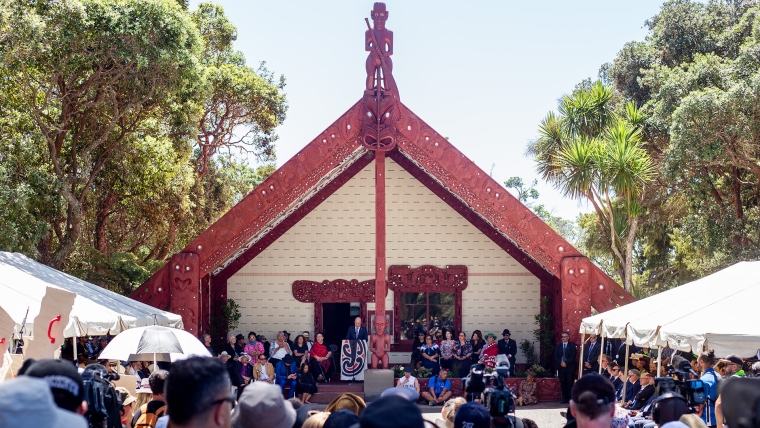
Prime Minister Christopher Luxon almost didn’t get to speak at Waitangi following a powhiri welcoming the Coalition Government onto the marae.
Many speakers challenged the Government for proceeding with the Act Party’s Treaty Principles Bill which would redefine the interpretation of Te Tiriti O Waitangi.
Protestors drowned out speeches from the Act and New Zealand First parties and Luxon was only able to make his remarks after being led onto the porch of the whare to speak.
Sadly, his speech fell flat. Rather than respond to the issues raised by a series of speakers, he mostly talked about his economic development programme.
He did say the struggle to understand the Treaty was part of New Zealand history and “that work” was still happening and would continue.
The rest of the speech was a regular stump speech outlining the priorities of his new Government: cut regulation, grow the economy, improve education, crack down on crime, and so on.
It was these things that would help Māori and non-Māori “get ahead” and would be where he was focused. He didn’t answer calls to toss out the Treaty Principles Bill.
Work to do
Pita Tipene, chair of the Waitangi National Trust, said he’d hoped to hear the Prime Minister speak about Te Tiriti and He Whakaputanga (the Declaration of Independence).
“There was a focus on outcomes and actions, which is good, but we are here at Waitangi because we needed to talk about Te Tiriti O’ Waitangi more”.
Luxon later said he was just responding to prompts related to the Waitangi Forum which were what would the country look like in 2040 and what needs to be done to get there.
Tipene said the various parties involved in the debate were “talking past each other” and the relationship with the new Government was progressing at a “glacial pace”.
He echoed the words of Waitangi National Trust chief executive, Ben Dalton, who summed up the day’s speeches as showing that “we’ve got a lot of work to do”.
In a press conference on Tuesday, Luxon reiterated that the National Party didn’t support a referendum on the Treaty and didn’t have any “intention” to do so in the future.
Referendum struggles
The Act Party looks increasingly isolated with both its coalition partners signaling they will oppose the Bill after its first reading and block it from becoming law.
In a press conference, Act Party leader David Seymour said he hoped public support during the select committee phase could convince National and NZ First to vote in favor.
Opponents of the Bill want the Prime Minister to scrap it before it goes through public submissions to the select committee stages which could potentially be divisive.
Shane Jones, deputy leader of NZ First, said it was significant to see different leaders from the key Māori groups—Rātana, the Kīngitanga, and Ngāpuhi—sitting together as mana whenua.
“Generally, they come together when there is a common foe. I hope today I didn’t represent a common foe,” he said.
We welcome your comments below. If you are not already registered, please register to comment
Remember we welcome robust, respectful and insightful debate. We don't welcome abusive or defamatory comments and will de-register those repeatedly making such comments. Our current comment policy is here.