
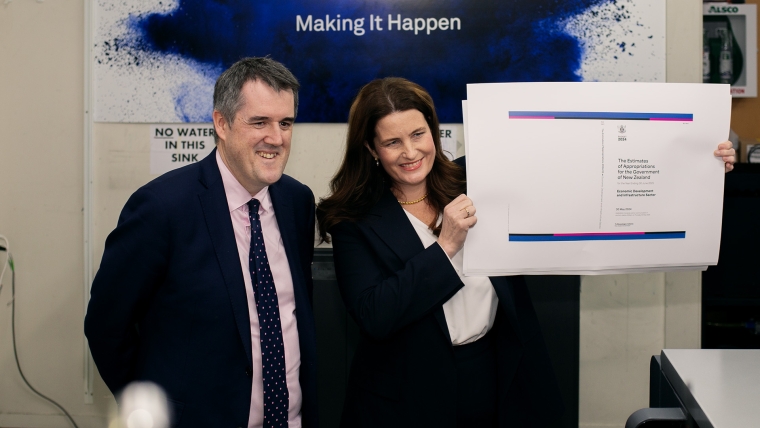
The Coalition Government will release its first annual budget at 2pm today (Thursday), revealing details of how they will spend roughly $140 billion of public money in the year ending June 2025.
Most of this money flows automatically into the big departments which provide basic services such as superannuation, health, education, social benefits, and servicing debt.
But governments get to add new spending each year—called an operating allowance—which is used to cover cost increases in existing departmental budgets and fund new policies.
Finance Minister Nicola Willis has given herself permission to add up to $3.5 billion of new operating spending in Budget 2024, but has suggested she will spend less than that.
In addition to the new spending, the Coalition has also asked departments to cut their baseline budgets by up to 7.5% to create room in the overall budget for tax cuts.
It has also continued Labour initiatives which asked the same departments to trim their budgets by up to 2% and reduce spending on contractors by $400 million each year.
Finally, Willis has also announced there will be 240 individual initiatives that will have their funding cut or reduced. All of these cuts loosen up a lot of money to be reallocated.
The proceeds of these savings should be funnelled in cutting income and property taxes, or redeployed into so-called “frontline services” such as nurses and police officers.
Pre-budget announcements
The first policy announcement for Budget 2024 was back in March, when Willis announced a up to $75 rebate on early childhood education fees at an annual cost of about $180 million.
It was released early to give Inland Revenue time to work with early childhood education providers to set up an easy to use rebate system for parents.
Another $67 million was allocated to upskill primary school teachers on structured literacy and other resources to support students learning to read.
Associate Education Minister David Seymour got to announce $478 million in funding to allow school lunches to continue for two more years.
Choosing cheaper lunches for Year 7 and older kids would save roughly $100 million in each of those two years, relative to how the Labour Government had funded the programme.
He also secured $38 million in annual funding for charter schools, an Act Party policy.
Another 810-beds will be added to Waikeria prison, 685 Corrections staff will be hired and given a pay bump for an annual cost of about $500 million.
Defence Minister Judith Collins announced soldiers' annual pay will be boosted by $41 million, and another $408 million will be spent on equipment over the next four years.
Winston Peters protected the Ministry of Foreign Affairs and Trade from the departmental budget cuts and got to announce $6 million annual funding for a mental health charity — a New Zealand First party policy.
Money for 1500 new social houses was found by cutting the First Home Buyers Grant and redirecting $140 million to community housing providers over the next few years.
Pharmac was promised a $400 million annual boost in the Budget, to cover cost pressures, but hasn’t yet been given any money to fund any new medicines.
What we don’t know
The big announcement in the Budget will be long-promised income tax cuts. While they are sure to be delivered in some form, some have speculated they may be downsized or delayed.
National’s election policy was a roughly 11.5% adjustment to tax brackets and some targeted tax credits to focus those savings on middle income earners and families.
A median wage earner would have got a $1300 annual tax cut under that plan, while higher income earners were set to save $1040.
Households with two incomes and $300 in weekly early childcare costs could have saved up to $6552 a year — but fairly few families actually met this criteria.
Willis has not been willing to promise the exact same size tax cuts will be delivered later today and the party’s tax calculator has been taken offline.
A new calculator with the official policy details will go live on the Treasury’s website at 2pm and we’ll publish a story breaking it down for readers here on Interest.co.nz.
Economists and journalists will also be looking closely to see whether the tax cuts are fiscally neutral as Willis has promised. Even neutral tax cuts could be inflationary in the short-term if they are delivered before the savings and revenue measures take effect.
The Reserve Bank has said it will have to look closely at the details of the package before it can make any assessment as to whether it might affect interest rates.
The full details of departmental spending cuts and defunded government initiatives will also be released and closely watched for controversial choices.
Fiscal outlook
Alongside each budget, the Treasury publishes a set of fiscal and economic forecasts which give the public some insight into the years ahead.
Most economists expect growth forecasts to be downgraded as the Government agency factors in tighter monetary policy and falling productivity.
This could mean deficits and debt levels get bigger as less economic activity means tax revenues fall while spending on social services often increases.
Willis will be expected to present a spending plan demonstrating a credible path back to an annual surplus at the end of the forecast period in 2028.
Speaking to reporters on Wednesday, she said the Budget would set out a high-level fiscal plan for the next three-to-10 years that would set the economy up for future growth.

We welcome your comments below. If you are not already registered, please register to comment
Remember we welcome robust, respectful and insightful debate. We don't welcome abusive or defamatory comments and will de-register those repeatedly making such comments. Our current comment policy is here.