
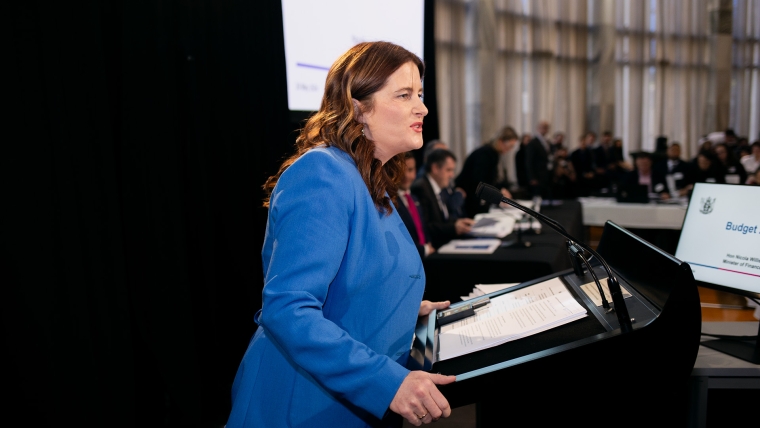
Finance Minister Nicola Willis has delivered on her promise to lower taxes while also reducing spending relative to what Labour had planned prior to the election.
But many of those gathered in the Beehive lockup had a similar summary: it was a bit underwhelming. There were few surprises in the thick wad of undecorated documents.
Tax cuts were delivered almost exactly as promised during the election campaign. The only change was the Working For Families abatement threshold won’t be lifted in 2026 anymore.
There will also be a slight delay to the start date, which will now be the end of July. From August onwards, working New Zealanders will have a little more cash in their pockets.
Economists at BNZ calculated the biggest beneficiaries of this policy—those earning about $60,000—would get an effective wage increase of about 1.8%, or just over $25 per week.
Veteran economic columnist Brian Fallow quipped it was “not so much a tax cut, as a tax scratch” which would not fix the underlying, ongoing problem of fiscal drag.
Besides the $3.7 billion tax package, most funding increases went towards cost pressures in core public services and already announced policies.
Treasury’s economic forecast downgrades were sober reading but were still more optimistic than other institutions have predicted, including the Reserve Bank.
Fiscal hawks were unhappy that a conservative Government will be spending more than Grant Robertson did in 2019, while those on the left were displeased with the size of the cuts.
The always-provocative Taxpayers Union called it “The Mother of all Disappointments” riffing off Ruth Richardson’s infamous 1991 budget, which they would like to see repeated.
Tax cuts only compensated for half of inflation since 2011, spending would remain higher than under Robertson, and the operating surplus had been pushed back a year, they said.
The Public Service Association, meanwhile, said the Government had decided tax cuts for landlords and higher income earners were more of a priority than quality public services.
Billions of dollars a year were being taken out of the services “which underpin a thriving economy and support the health and wellbeing of New Zealanders”.
There was some modest praise. Federated Farmers said it was pleased to see the “non-negotiable” funding items, such as for biosecurity, hadn’t been cut.
"Just like the average farmer’s budget, the Government doesn’t have a lot of spare cash laying around to spend on nice-to-haves and optional extras," president Wayne Langford wrote.
Zero-budgets
Perhaps the biggest surprise was that Willis opted for even smaller operating allowances than she had promised in the National Party’s fiscal plan.
She added $3.2 billion of new spending in Budget 2024 but will only add $2.4 billion in each subsequent one. This effectively means running zero-budgets in the next few years.
Treasury warned annual cost pressures would completely absorb these spending limits and any new initiatives would have to be funded by shifting money from something else.
Craig Renney, the chief economist at the Council of Trade Unions, said the future operating allowances meant the Government was planning on making cuts in budgets “year after year”.
Independent economist Cameron Bagrie said Budget 2024, with all its cuts and controversies, would look relatively relaxed compared to the next ones.
But with New Zealand stuck in a structural deficit, the Coalition Government will have to be frugal if it wants to halt growth in public debt and deliver a surplus.
Martin Foo, an analyst at S&P Global Ratings, said the annual budget attempted to balance election promises against the practicalities of a slowing economy.
“To achieve debt stabilisation, discipline on the expenditure side of the ledger will be crucial, in our view,” he said.
Public debt levels didn’t pose a risk to the country’s AAA local currency credit rating, and were likely to stabilise at around 35% of gross domestic product. S&P Ratings uses its own net debt measure.
Other ways forward
Labour’s finance spokesperson Barbara Edmonds said her approach to tackling the structural deficit would’ve been to find policies that boosted productivity.
“What we're not seeing enough from the government is around building the productive side of the economy,” she said.
She has previously said the party was aware spending needed to be reduced and that Robertson’s savings initiative was a good first pass at the problem.
“We wouldn't have done tax cuts, because it just wasn't worth it in the current economic environment,” Edmonds said.
Labour leader Chris Hipkins said any small benefit New Zealanders received from the income tax cuts would be consumed by other costs which would go up.
Not the least of these are interest rates, which he believes will be held higher for longer due to income and property taxes boosting inflation.
While the tax cuts are more than fiscally neutral over the forecast period, some economists worry they will be inflationary when they first arrive — right at the most frustrating moment.
The central bank is most concerned about short-term inflation and is simultaneously worried about the economy getting too weak in the longer-term.
Stephen Toplis, head of research at BNZ, said the fiscal impulse for the year ahead had risen to +0.3% from the -2.4% that had been estimated previously.
“We think that, on balance, the fiscal position will make the Reserve Bank more nervous. It’s not the tax cuts per se but the fact that the fiscal impulse is larger,” he said in a note.
Toplis also said some of the Treasury's forecasts may be too optimistic. Unemployment could go higher than 5.3% and the Official Cash Rate, currently 5.5%, was unlikely to settle lower than 3%.
If the economy proves to be less resilient than expected, the Government may struggle to achieve its fiscal goals despite tight spending plans.
“Typically, governments underestimate the slump in corporate tax that occurs during downturns. We think that there is a very real risk that this mistake is repeated,” he said.
Hold the line
Budget 2024 plans for core Crown expenses to grow just 0.8% in each of the next four years, adjusted for inflation, and to be cut deeply on a per capita basis.
Willis’ fiscal plan and Treasury’s forecasts suggest that core Crown expenses would be equal to 31% of the country’s total economic output by 2028.
That would still be larger than any budget in the six years prior to the pandemic and net core Crown debt would only have been reduced by 1.3 percentage points.
Eric Crampton, an economist at the NZ Initiative, said it was politically and practically difficult to unwind spending increases that had occurred in recent years.
For example, Labour significantly lifted benefits. Suddenly reversing those types of increases would cause material hardship for households reliant on that income.
Instead, the Coalition was planning to put future increases on a much slower track and allow the size of the economy to catch up with overall spending levels.
This was the approach Bill English used to recover from the Global Financial Crisis and the Christchurch earthquakes, and deliver a surplus after just six years.
Some commentators say these years of zero-budgets were responsible for a rundown in public services and were only achieved by racking up today’s infrastructure deficit.
Regardless, Crampton said using the same strategy now may be less effective as NZ’s productivity and economic growth rates are weaker than they were a decade ago.
Just “holding the line” on spending might not be enough to actually achieve the forecast surplus in 2028, particularly if new costs keep cropping up.
He pointed to a fiscal cliff in the police budget as an example. The department has been given $120 million to cover “critical cost pressures” in the coming year but not in subsequent years.
This was not unlike Labour’s pre-election forecasts which showed a hypothetical path to surplus that looked improbable if you delved into the details, he said.
It would be easier for the Government to achieve its fiscal goals if it delivered on housing reform, actually boosted productivity, and went big on social investment.
*Additional reporting by Eric Frykberg
We welcome your comments below. If you are not already registered, please register to comment
Remember we welcome robust, respectful and insightful debate. We don't welcome abusive or defamatory comments and will de-register those repeatedly making such comments. Our current comment policy is here.