
By Chris Trotter*
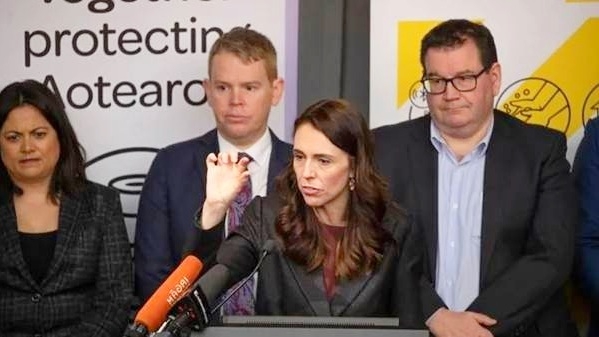
Labour's 'no-show' at the public hearings of the Covid Royal Commission, Phase Two, has provoked considerable public criticism. Many New Zealanders clearly regard the behind-closed-doors testimony of Jacinda Ardern, Grant Robertson, and Chris Hipkins as an insufficient response to the biggest crisis to hit New Zealand since the Second World War. It is their contention that the Prime Minister, Finance Minister, and Health Minister, whose party won three years of unbridled power on the strength of their early Covid successes, are under an obligation to answer for their later Covid failures, with the doors wide open.
Many other New Zealanders dismiss this argument as unpersuasive. They point to the well-established precedent that Ministers asked to appear before Royal Commissions of Inquiry should not be asked to respond to questions in public. If a deep and instructive examination of significant events is the primary goal of these inquiries, then the openness and candour required of leading political players is best elicited in private.
It is difficult to interpret the counter-arguments to this precedent as anything other than confirmation that what those advancing them are seeking isn’t so much a public inquiry as a public trial. Certainly, that is the contention of Ardern, Robertson, and Hipkins, who, as seasoned politicians, have little difficulty in identifying their opponents’ true motivations – even when cloaked in the pious language of constitutional propriety.
Robertson has openly asserted that what those clamouring for him and his colleagues to be forced to front-up and face the people are actually seeking is a “show trial”. Inasmuch as most of the great show trials of history have been a toxic mixture of politics, ideology, cruelty, and social vengeance, and that any public appearance of the three key Covid leaders before the Royal Commission could hardly avoid encompassing all of the above, then the former Finance Minister’s charge carries considerable weight.
There can be little doubt that the dangerous volatility associated with such a spectacle weighed heavily in the Royal Commission’s decision to refrain from using its power to subpoena the former Labour ministers. The simple logistics of such an exercise would have been daunting in the extreme.
Try to imagine the scene that would have unfolded outside the Royal Commission venue on the day Jacinda Ardern was scheduled to appear. Fans of Game of Thrones will recall Cersei Lannister’s humiliating walk of shame through the streets of Kings Landing. There would be the same spittle, the same schadenfreude, the same delirious exultation, as the despised former prime minister was forced to run the gauntlet of her enemies’ triumphant hate.
A massive Police operation would be needed to assure Ardern’s safety. And even when/if she was delivered safely to the Commission’s hearing-room, it would be impossibly dangerous to admit members of the general public. Even the news media would have to be screened. The Commissioners could hardly admit those outlets made notorious by their coverage of the occupation of Parliament Grounds by anti-vaccination mandate protesters. Nor could they hope to prevent the manipulation of the official video record of the Commission’s proceedings by practiced purveyors of mis-, dis-, and mal-information.
Small wonder the Royal Commission decided against subpoenaing the former prime minister.
Commissioners would also have been aware of the danger in calling Robertson “to the stand”. In the case of the former Finance Minister the risk lay not in facilitating a carnival of anti-Ardern hatred, but of giving official cover to the concerted ideological counter-attack that has been mounted against the reasoning that made possible the authorisation of $60 billion of government spending to keep New Zealand Inc. afloat during the Covid emergency.
Once again with considerable justification, Robertson has branded those responsible for these attacks as practitioners of “hindsight economics”. The term is apt, because in looking back the defenders of neoliberal economics are confronted with an awesome demonstration of what the state can do when considerations of collective welfare are accorded precedence over the shibboleths of fiscal rectitude.
From the point-of-view of these protectors of the status-quo it is vital that the actions of Robertson and his colleagues be denounced publicly and stridently as “fiscal vandalism” on a scale comparable to the recklessness of the socialist government of Venezuela.
The former Finance Minister must be pilloried mercilessly for responding to the panic-stricken pleas of New Zealand businesses, a huge number of which would have been forced to let go their staff and shut their doors without the timely and generous intervention of the New Zealand state. Also for consignment to the Memory Hole are the dire Treasury predictions of economic collapse and mass unemployment that was bound to follow if the Ardern-led government failed to take decisive action against the Covid threat.
Instead, New Zealanders must be encouraged to focus their minds on the later scenes of the Covid drama. Reviewing the consequences of Labour’s emergency measures, not recalling their causes, is the optimal neoliberal course. It certainly does not help the cause of discrediting Labour’s pandemic response if people’s memories are encouraged to recall the terrifying scenes being broadcast out of Italy, the UK, India and the USA, as the global epidemiological fires burned out of control.
Equally unhelpful are recollections of the “let them die” brigade. Those dismal economic scientists who from the very start perceived the acute ideological danger of putting human-beings’ lives ahead of the remorseless calculus of free market exchange. Ardern’s and Robertson’s critics would rather people did not remember how much more comforting it was to be described inclusively as one of the “team of five million”, than to be evaluated casually as just another member of the “herd”.
It certainly was not helpful of Act’s Brooke van Velden to publicly declare that: “[When] it came to Covid we completely blew out what the value of human life was, completely, I’ve never seen such a high value on life.” Those sort of statements, no matter how justified from the dispassionate perspective of an actuary, tend to prompt all manner of disturbing questions, most of them better left unasked.
The Royal Commissioners, on balance, may have felt that this sort of discourse, conducted in a context which, with every passing day, took on more and more of the character of an ideologically-motivated prosecution, was unlikely to contribute to the general credibility of its final report.
Calling Chris Hipkins “to the stand” offered even less hope of conferring credibility upon the Commission’s ultimate findings. Allowing the friends and allies of the incumbent government to put the current Leader of the Opposition “on trial”, on television, would constitute an act of such blatant political manipulation that no Royal Commission of Inquiry with the slightest concern for its perceived probity could countenance such a move.
But, what about accountability? What about the botched roll-out of the Pfizer vaccine? What about the socially divisive vaccination mandates? The rigid border controls? The inhuman quarantine regulations? What about the Auckland Lockdown that went on, and on, and on, until Aucklanders began to fear for their sanity? And what about the enormous powers seized by the state and wielded, seemingly without restraint, over people’s lives and livelihoods?
These are the questions which the Second Phase of the Royal Commission was tasked with answering – and answer them it will. But not by resorting to something akin to a show trial. Not by giving the angry occupiers of Parliament Grounds the spectacle of popular vengeance and retribution they longed for, and which Winston Peters winked at. Jacinda is not Cersei.
The global Covid-19 Pandemic was the biggest crisis to grip this nation in eighty years. So huge was it, and so deadly in its effect, that only a medically, legally, fiscally, and politically mobilised state could hope to manage it. It is probable that the measures adopted by the Labour-led Government would have been adopted with equal determination – and success – by a National-led government. Why? Because, in the face of this massive threat, we were New Zealanders before we were anything else.
Jacinda Ardern, Grant Robertson, and Chris Hipkins could not see the end from the beginning. No one could. If we were all of us placed in the dock at the end of our lives, and accountability demanded of us for every word spoken, every action taken, every mistake made; then who among us could hope to escape conviction?
*Chris Trotter has been writing and commenting professionally about New Zealand politics for more than 30 years. He writes a weekly column for interest.co.nz. His work may also be found at http://bowalleyroad.blogspot.com.

We welcome your comments below. If you are not already registered, please register to comment
Remember we welcome robust, respectful and insightful debate. We don't welcome abusive or defamatory comments and will de-register those repeatedly making such comments. Our current comment policy is here.