
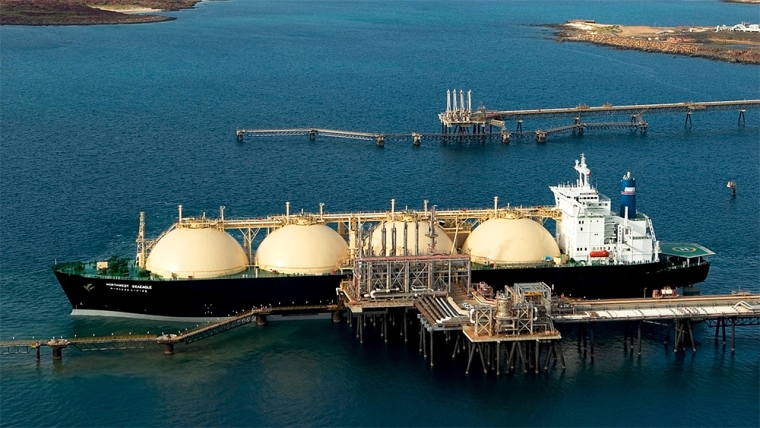
The Government says a liquefied natural gas (LNG) import facility could be operating as soon as 2027 or early 2028 to remove the risk associated with dry years.
This comes as Energy Minister Simon Watts, on Monday afternoon, announced the Government would contract to build an LNG import terminal, located in Taranaki. LNG is natural gas that has been cooled and liquified so it can be transported easily.
“New Zealand is experiencing a renewable electricity boom, but a rapidly declining gas supply has left our electricity sector exposed during dry years, when our hydro lakes run low,” Watts says.
“The result is greater reliance on coal and diesel, and ultimately higher electricity prices, putting more financial pressure on families and making businesses less competitive.”
Watts says the decision follows extensive analysis and the first stage of procurement. In October, the Ministry of Business, Innovation and Employment (MBIE) began a procurement process for an LNG import facility.
Now, the Government has shortlisted leading proposals and is progressing to commercial contracting. It aims to sign a contract by mid-2026.
“Located in the Taranaki, the project will create jobs during construction and provide long-term skilled roles once operational, reinforcing the region’s role at the heart of New Zealand’s energy system,” Watts says.
Cost 'north of a billion dollars'
Speaking to reporters at a post-Cabinet press conference, Watts says the cost of the LNG was "subject to commercial negotiation, which is underway but you're looking at north of a billion dollars."
A government fact sheet provides more details around the costs but suggests when it comes to the cost of the LNG, there's two parts to it: the cost of providing and operating the LNG infrastructure, and costs directly associated with the import of LNG into the country.
These costs will be determined through procurement processes.
"The first of these (the cost of the infrastructure) will be incurred every year, regardless of whether New Zealand uses the facility or not," the fact sheet says.
"This will be paid for via a levy on electricity. The levy for the infrastructure is paying for the insurance that LNG provides. It is therefore appropriate that the electricity system bears this cost."
When it came to the cost connected with importing LNG, this would be paid by users of gas produced from LNG.
The availability of LNG in a dry year is expected to reduce electricity prices by at least $10 per megawatt (MWh), the Government says. Albeit an indicative estimate of a levy on electricity to pay for the LNG facility is between $2 and $4/MWh.
"By 2025, higher energy prices are estimated to have reduced New Zealand’s Gross Domestic Product by $5.2b (1.25%), lowered real wages by 1.4%, cut household spending by 1.65%, and worsened the trade balance by $275m," the fact sheet says.
"Because energy is a core input across the economy, lower electricity prices improve business cost structures, investment certainty, and productivity—suggesting total economy-wide benefits exceed direct electricity cost savings.
"Modelling commissioned by MBIE suggests that compared to a scenario where gas prices continue to rise, an LNG terminal that can effectively cap gas prices, would mean GDP is $1.2b better off per annum by 2035."
Watts did not directly answer questions about what the cost would be to households due to commercial negotiations taking place.
"The advice in regards to the benefits of the downward pressure on the price of electricity well exceed the cost to put this in place," he told reporters.
There were a range of figures, Watts says, "because we've got about six players still on the shortlist but we will be moving by June to lock that down to one player".
However, the Taxpayers' Union says based on last year's total electricity generation, households could end up paying between $40 to $90 each while The Post suggests the levy is likely to equate to about $15 to $30 per household per year on average.
In terms of facility size, Watts says: "The concepts that are on the table at the moment are probably the equivalent of what you would see in Australia or Singapore or slightly smaller but this would be something you would consider normative in an international environment ... In terms of volume, you're looking at about 12 PJs (petajoules) of gas to be able to come in over that winter period."
Watts says this would have a duration lifetime of more than 15 years.
'We're going to get on and make this happen'
"I'll be really clear, Cabinet has made a definitive decision to build an energy terminal. We're not going back to Cabinet for a follow-up conversation. That decision has been made ... we're going to get on and make this happen."
Prime Minister Christopher Luxon says the LNG import terminal does not preclude the country from expanding in batteries or renewable energy. "We've got a massive renewables boom underway at the moment."
"We're going to continue to accelerate renewables but we need to get rid of the dry year risk. That is the single biggest thing that is the impediment to our energy strategy in New Zealand and we can de-risk that and lower the forward curves on pricing," Luxon says.
"We also don't want to just have one option. More optionality gives us more choices and therefore more resilience."
Watts says the Government will design an import model that will aim to bring LNG in large shipments.
This would be “only when needed” as a way to minimise exposure to international gas prices and keep the door open for new technologies, he says.
“Access to LNG will support many gas-dependent industries to consider their long-term energy needs and invest accordingly, by reducing the risk of supply disruptions and extreme price volatility."
“Just having a reliable back up is expected to save Kiwis around $265 million per annum by reducing price spikes and lowering the risk premium built into power bills that exist because of supply challenges, equivalent to around $50 per annum per household,” Watts says.
“If domestic gas supply continues to decline and drive-up gas prices, the availability of LNG is estimated to be worth $1.2 billion per annum to the New Zealand economy by 2035.
“Access to LNG is also expected to protect around 2000 jobs from the economic impact of rising energy prices and gas shortages.”
'New gas tax'
Labour leader Chris Hipkins says the LNG import terminal isn't going to make New Zealand more energy independent.
"At a time when New Zealanders are already struggling with the ongoing cost of living challenges that they face, they're now being hit with a new gas tax by the current government," Hipkins says.
"It's another kick for New Zealand households, another increase in the cost of living for them and they're going to get nothing in return for it."
Hipkins says he doesn't think it will reduce power prices. "Most New Zealand households are on a fixed rate power plan and it isn't going to reduce that at all."
"Power bills are likely to continue going up. I think, if anything, they're trying to make the argument that this will decrease the rate of increase in power prices."
Hipkins says there are other ways to do this. "A billion dollars would buy you a hell of a lot of solar panels and batteries, which would save households a significant amount of energy."
When asked if Labour got into government whether they would honour the LNG import terminal agreement, Hipkins didn't directly answer, saying; "well goodness only knows whether this is ever actually going to happen."
Market ‘not willing to respond’
Interest.co.nz reported in October that the Government would consider paying for an LNG import terminal after efforts to encourage the private sector to develop one failed.
A report into the energy sector written by Frontier Economics found NZ’s high reliance on hydro power created a risk of supply shortages when rainfall is low, particularly during winter when electricity demand is at its highest.
This “dry year risk” pushes up energy prices and creates economic disruptions that have been driving industry out of New Zealand, the report says, and the risk gets more pronounced as reliance on renewable energy increases and the market has been unable or unwilling to find a solution.
The report says this was due to Government intervention in the market, particularly preventing oil and gas exploration.
“We have identified that this is a problem caused by Government policy driven risk that requires solutions by Government — there is no point waiting for a market response to these Government induced risks. Indeed, the market has demonstrated it is not willing to respond,” the report says.
Comparing LNG with other options
MBIE prepared four alternative options to compare with LNG - this took into account cost, timeliness, impact on electricity prices, flexibility and wider impacts.
These options included a new thermal generation plant to run on either coal or biomass, a combination of new and converted ‘peaking’ plant which would run on diesel, a new unit at Huntly Power station with new and converted diesel peakers, and a combination of LNG importation and refurbishing the Taranaki Combined Cycle plant.
Talks of an LNG import terminal have been an unsurprising mixed bag - with support from GasNZ and Port Taranaki, while other organisations have shared their concerns.
In November, Parliamentary Commissioner for the Environment Simon Upton wrote to Watts, saying: “My main concern is the self-reinforcing path dependence that LNG import could set up in New Zealand’s energy system.”
“Much will depend on the scale of the investment: a billion-dollar conventional scale facility will cast a much longer shadow than a smaller scale ‘shuttle’ operation.
“Either way, the prospect of a government-sponsored LNG import facility raises questions about why the Government would favour the interests of one sector over another.”
“Intervention on LNG certainly won’t help the investment case for a range of competing solutions – torrefied wood pellet processing, pumped hydro, or demand response, for example," says Upton.
Upton went on to write: “New Zealand has a long and less than distinguished history of sponsoring expensive ‘solutions’ without fully understanding the consequences.”
The following month, over 20 organisations signed an open letter, urging the Government "not to proceed with taxpayer subsidies for an LNG import terminal".
The open letter was signed by groups like Rewiring Aotearoa, 350 Aotearoa, Public Service Association. Sustainable Energy Association New Zealand and Lawyers for Climate Action NZ.
“We believe there are more cost-effective, homegrown solutions than LNG to meet our dry year energy needs, provide reliable, affordable energy for industry needs, lower energy bills for all customers and improve national productivity while advancing our transition to decarbonisation,” the open letter says.
The organisations say having an LNG Terminal would “keep power prices high”, “would not make our energy system more secure” and “also carries a heavy climate burden - roughly 60% more emissions-intensive than conventional fossil gas according to the IEA (International Energy Agency), and will make it harder to meet our climate targets and international obligations”.
Watts says further details on the procurement process and project milestones will be shared over the coming months.
We welcome your comments below. If you are not already registered, please register to comment
Remember we welcome robust, respectful and insightful debate. We don't welcome abusive or defamatory comments and will de-register those repeatedly making such comments. Our current comment policy is here.