
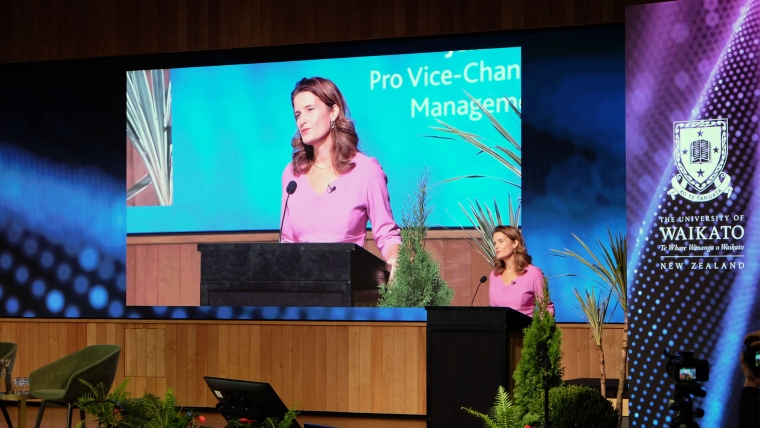
During her speech at the New Zealand Economics Forum, Finance Minister Nicola Willis had a question for Labour leader Chris Hipkins and finance spokesperson Barbara Edmonds.
“Will they commit to retaining investment boost as a permanent fixture of our tax settings to unlock growth? Or will it be sacrificed to fund higher spending?”
Growth, investment and fiscal credibility were themes of Willis’ speech, and she also talked up the Government’s investment boost tax policy.
The investment boost tax policy was the centrepiece of the 2025 ‘Growth Budget’ offering a $1.7 billion annual tax incentive for investments in productivity-enhancing capital assets. The policy allows businesses to immediately deduct 20% off the cost from their taxable income, and still claim depreciation on the remaining 80% over time.
This effectively brings forward the tax benefit and lowers the cost of investment by shifting some of the risks and opportunity costs from firms to the Crown. This encourages earlier and larger investment in productive assets than would otherwise occur, and Treasury estimated in 2025, it will increase gross domestic product by up to 0.5% over the next five years.
Inland Revenue data released on Thursday (and also shared by Willis at the forum) finds 40% of firms who took part in the survey say it increased their investment spending over the past year, including 1% reporting a significant increase directly because of the policy.
In a statement, Willis says: “Looking ahead, the impact is even clearer. Nearly half of firms planning to invest over the next five years say Investment Boost is positively influencing those plans, with 14% expecting a large increase in investment as a result.”
Speaking to the crowd, Willis says New Zealand’s productivity growth has lagged behind comparable economies.
“And the consequences are clear. Lower wages, less fiscal headroom for investment in public services - from medicines through to classrooms, fewer globally scaled firms.”
“And in my view, too much reliance on population growth and house price growth rather than genuine productivity gains,” Willis says.
“Productivity responds to incentives. Productivity is not resolved through one silver bullet but ongoing, substantive, systemic reform. And when people are confident that work is happening and barriers are being addressed, then they can own assets.
“They can invest in capital and earn a return without those settings being constantly reopened. When they know that there is that certainty, they invest more and they invest earlier. And that’s why the Government is explicitly backing investment, ownership and productivity enhancing settings.”
Willis says productivity growth is the only way the country would grow wages sustainably over time.
“The IRD (Inland Revenue) and the Treasury have been emphatic in their advice to us that this policy will lift the size of our economy and lift wages over the medium term. But there is a broader issue that needs to be confronted with this policy.”
The investment boost will only work in the longer term, if businesses believe it will endure, Willis says.
“Firms do not invest in long-lived capital, plant, machinery, buildings if they think the tax rules may change at the change of an election.
“So my question today to Mr Hipkins and his colleague Barbara Edmonds is pretty straightforward. Will they commit to retaining investment boost as a permanent fixture of our tax settings to unlock growth? Or will it be sacrificed to fund higher spending?”
Willis says the Government’s position is clear. “We back ownership, we back investment and we back productivity enhancing tax settings."
“And I would put to you that those who say they are on the side of growth and productivity but would sacrifice this effective policy are speaking out of both sides of their mouth.”
Willis says business investment decisions depend on confidence.
“And as you know, there's strong evidence here and overseas that uncertainty around tax policy in particular has a chilling effect on investment.
“When businesses hear ongoing debate about capital gains taxes, wealth taxes, inheritance taxes or new taxes on investment, savings, incomes, they delay decisions. They reduce their scale or they take their capital somewhere else.”
Willis says: “So for me, good economic policy isn't about novelty or relitigating the same arguments every three years.”
“It's about credibility, consistency, giving people the confidence to invest, train and build for the long term.”
‘Tax policy certainty needs to span successive governments’
Speaking to reporters after her speech, Willis says when the investment boost policy tax first came out, “Barbara Edmonds said it was her favourite thing in our budget. Deborah Russell, of course who lauds her significance as a tax practitioner, said that it was good policy, and it felt to me like we’d achieved bipartisan consensus”.
Since then, Willis says Labour has gone on to announce "massive spending commitments" and has become “much quieter on whether they would retain investment boost”.
Willis says feedback she has had was concern from firms is that if they embark on projects that are large developments which take several years on the basis of getting the investment boost tax credit, “and then a Labour government comes in and removes that tax credit, we’re left very much out of pocket”.
“My plea is one which is this is really good tax policy reform that’s good for the country. Let’s have bipartisan consensus, that we commit to it for the long term.”
“The point is that tax policy certainty needs to span successive governments.”
Banking
Asked about any potential tax changes when it comes to banking, Willis says the Government is in consultation with the banks on how they ascertain their foreign bank holdings in terms of their branches.
“I've been clear that we are looking at whether or not those measures are working. That's an active IRD consultation.”
And as part of the ongoing banking competition work, Willis says they have been looking at the comparability of our tax settings.
“And this is, I think, is the normal course of business. IRD is constantly looking at the integrity of the tax system, whether it’s working as intended and that work continues.”
Asked if this could include a bank levy like the one in Australia (on top of the deposit compensation levy), Willis says “we are looking at the comparability of our tax settings. [The] bottom line for me is that I want to ensure that New Zealanders are getting the best banking services they can at the least price."
“I want to make sure that we have a genuinely competitive system that is fair. And so the measure by which I would judge any potential change, which I have not recommended to my colleagues at this stage, is will this actually deliver better for New Zealanders when they're using banking services.”
Willis says she wants to ensure the country has a competitive banking system and to ensure that the tax system has integrity.
“The IRD constantly is looking to see: are our tax rules working as intended? Are they being interpreted as intended? Are they keeping up with national developments? Are they keeping up with developments, particularly in Australia and elsewhere? Because we don’t want to be in a situation where New Zealand’s tax settings are out of date.
“We want to be in a situation where they are appropriate.”
We welcome your comments below. If you are not already registered, please register to comment
Remember we welcome robust, respectful and insightful debate. We don't welcome abusive or defamatory comments and will de-register those repeatedly making such comments. Our current comment policy is here.