
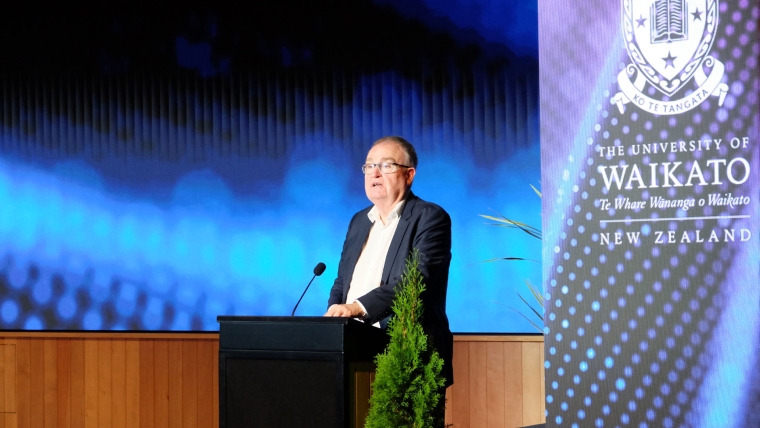
The Treasury is focused on enhancing transparency around the key fiscal challenges that lie ahead in the rest of this decade and the 2030s, Secretary and chief executive to the Treasury Iain Rennie says.
Treasury also plans to start a programme involving the budget system to ensure it meets the needs of whoever is in government, he told the audience at the New Zealand Economics Forum in Hamilton on Friday.
“Many of the foundations of the current public finance system have been relatively stable since the 1990s. But our view is the emerging challenges means that our current framework won’t be fit for purpose within the next decade if we don’t continue to renew them," Rennie says.
“We are working on how to change that.”
‘Weather these storms’
“Over the past year, the shift from the rules-based multilateral order to great power competition has become more pronounced. The global boom in AI-related investment has strengthened and concerns about the fiscal sustainability of major economies has increased,” Rennie says.
There’s also heightened volatility in global markets and while New Zealand may be a small waka in "turbulent seas," it can "take big choices that will put us in a position to weather these storms."
Superannuation forecast are part of ‘chill headwinds’
Referring to Treasury’s long-term fiscal statement, long-term insights briefing and investment statement, Rennie says those reports lay out a clear diagnosis.
“Ageing is already materially lifting up expenditure and will continue to do so in the next decade, outpacing revenue growth."
“Without changes to policy settings, New Zealand’s debt track trajectory will be unsustainable in the long run.”
Treasury’s most recent forecast finds that the number of people receiving superannuation in New Zealand will grow from 928,000 in 2024/2025 to 1,084,000 in 2029/2030.
“That growth is equivalent pretty much to the entire population of Tauranga in just four or five years. The extra superannuation in 2029/2030 of about $7.7 billion compared to 2024/2025 is equivalent to 22% of the growth in the entire tax revenue that we are projecting over that period.”
Rennie says issues about superannuation are not just issues about the future.
“They are part of the chill headwinds that are confronting the government now and certainly whoever will be [in] government in the next parliamentary term."
Rennie says fiscal responses to shocks should be timely, temporary and strictly targeted.
“The Crown’s balance sheet is larger and more complex than ever. Wiser investment, better asset management and a stronger understanding of risk is needed to prevent the balance sheet deteriorating.”
What Treasury has learnt from these reports
The first lesson, Rennie says, is: “It is good management to expect bad luck.”
He says New Zealand should prioritise rebuilding its fiscal buffers.
Rennie says New Zealand is still in a stronger position to address its fiscal challenges than comparable countries facing similar conundrums.
“Despite this, public debt is at its highest point for 30 years and higher than Treasury had previously forecast.”
Some of this deterioration was due to the Global Financial Crisis, the Canterbury Earthquakes and Covid-19.
Rennie says since the late 1980s, the fiscal cost of government responses to economic shocks has averaged to be around 10% of gross domestic product every decade.
“But the cost of these responses has not been matched by savings between shocks. The nature of Treasury’s forecasts and projections mean that we never explicitly include the expected impact of these shocks … We don’t know when these shocks will come but we need to plan to expect them.”
That’s why New Zealand needs to rebuild its fiscal buffers, he says.
The second lesson, Rennie says, is that hard work lies ahead and fiscal consolidation needs to be a focus for the next term of Parliament.
New Zealand has a structural deficit and the government is still spending more on existing public services and on new initiatives than it receives in revenue, he says.
“The only economies that have larger structural deficits in New Zealand currently are a few economies in Eastern Europe that are facings existential security threats from Russia, the State of Israel, and France and the United States which have dysfunctional politics when it comes to fiscal policy.”
Rennie says the Government had made an important start with its focus on spending restraint and “charting a consistent and medium term approach to fiscal consolidation.”
“Failing to close the structural deficit over the next few years will mean future governments will face harder choices to confront long-term fiscal pressures.”
Rennie says Treasury’s reading of successful fiscal consolidations across developed economies is that they are sustained across multiple terms of government.
He says lesson three is that a multi-pronged strategy across all government expenditure, revenue and the balance sheet will be more effective.
This would require governments using a combination of those three levers and reducing some expenditure programmes to make sure public services are delivered in a way that’s consistent with medium-term sustainability, he says.
“Looking broadly across government is important … Secondly, raising revenue while maintaining predictable law-based tax settings that reduce economic distortions. This could include consideration of longer term reforms in the tax system that could open options to raise more revenue efficiently."
"More effective balance sheet management. This means being discerning about how much and how well New Zealand does public investment.”
Rennie says we need to move the debate beyond how much we invest to how well we are investing.
Rennie says the last lesson is that new challenges are emerging in the global economic environment and this environment which fiscal policy operates has become more fragmented and more financially complex.
“Maintaining fiscal space, retaining confidence in the management of our public finances are not abstract objectives. They are practical ways of ensuring New Zealand can absorb shocks that are wholly outside our control.”
Capital investment and innovation
Rennie says New Zealand should focus on innovation and capital investment.
The country has low capital intensity and we’re not creating or adopting new technology at the rates we should be, he says.
These aren’t separate problems, he says, as technology diffusion and capital investment are intertwined.
“When firms invest in new equipment, they’re often embedding new technologies into their operations and upgrading their business processes to match.”
Rennie says New Zealand’s expenditure on research and development “will always constitute a tiny fraction of global effort”.
“We will always depend significantly on adopting innovations developed elsewhere. And that adoption typically requires capital investment.”
Rennie says there are four areas that affect capital investment and innovation. These are: importing, foreign investment, input costs and access to finance.
“Looking at human capital, we find another puzzle,” he says.
“We are producing skilled people. The challenge appears to be on the demand side. We may not have enough frontier firms operating at the levels that can fully utilise advanced skills.”
Rennie says this creates a fiscal challenge as skilled people spend most of their productive years overseas.
And when we look at productivity distribution, New Zealand’s frontier firms - the top 10% - aren’t as productive as those in comparable economies, he says.
“New Zealand’s distribution is relatively flat and stable, indicating our frontier firms are not driving productivity growth.”
Capital investment, innovation policy, skills development, and industry structure aren't independent challenges. They're interconnected elements of our productivity system, Rennie says.
No single policy will bend growth curve upwards
Rennie says whoever is in government will need to maintain momentum across a broad front.
“The nature of this economic reform is that no single policy will bend that growth curve upwards.”
He says a sustained and predictable path will be needed to build confidence that helps New Zealand attract global investment and talent.
And it will also give confidence to individual New Zealanders and New Zealand firms to save, invest and educate, Rennie says.
Making choices with care
Rennie says we don’t need to solve every problem in one swoop.
“The future will unfold in ways we can’t fully anticipate. And good strategy is not about fixing every outcome in advance but acting in ways that preserve options."
“An adaptive approach asks us to tackle the pressures we can see clearly, strengthen the foundations that endure and leave those who follow with room to respond as circumstances change.”
Rennie says the longer we wait, the fewer choices remain and the sharper they become.
“The challenge to ourselves, the call to action for Treasury and our partners in public service is to seize the moment and advise on the choices that matter, the critical policy decisions for the next term of Parliament and the reform pathways we can seek for the decade ahead.
“If we can make those choices with care, we can build resilience, maintain fiscal space and sustain trust in our institutions. This will give New Zealand the capacity to steer its own waka and to approach an uncertain future with confidence.”
We welcome your comments below. If you are not already registered, please register to comment
Remember we welcome robust, respectful and insightful debate. We don't welcome abusive or defamatory comments and will de-register those repeatedly making such comments. Our current comment policy is here.