
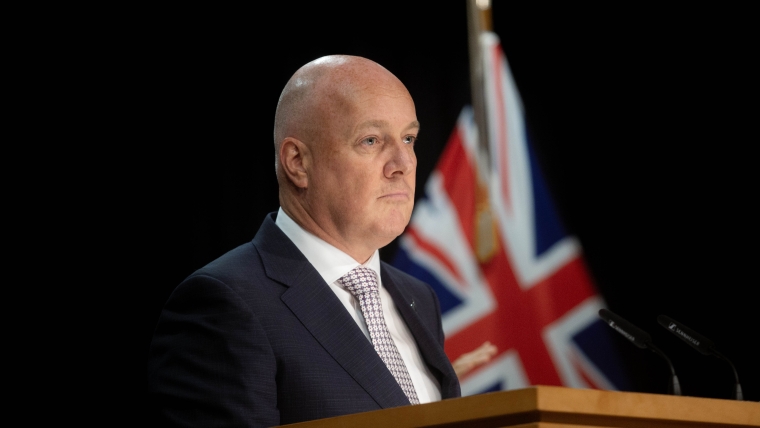
Prime Minister Christopher Luxon is walking into a pivotal political week as he denies speculation of his position as leader following a damning poll released publicly last Friday.
Luxon will be chairing Cabinet on Monday, which also comprises his coalition colleagues ACT and NZ First. At 4pm he will be hosting his post-Cabinet press conference.
Luxon will be faced with questions from media about his leadership after his party’s disastrous 28.4% poll result released on Friday in the latest Taxpayers' Union-Curia Poll.
More significant for Luxon, he will be facing his colleagues during the National Party caucus meeting on Tuesday - many of whom would be losing their positions should the polls be reflected at the election. National currently has 49 MPs in Parliament - party support in the Curia poll pulled that down to 36.
Luxon on Newstalk ZB on Monday denied he was considering his position over the weekend and he had “no idea” where that rumour - which was widely spread among political circles following the poll released on Thursday evening - came from.
“I got back in from the events on Friday and realised all hell had broken loose, really, and taken on a life of its own,” he said.
“As a politician banging on about the media and criticising the media - that's just a fruitless exercise to nowhere, and it's a week when I then don't get to talk about the things that I need to be talking about, which is actually the economy.
Asked if the pressure was mounting, Luxon said, “No, there's pressure in this job every day”.
Luxon told TVNZ’s Breakfast he doesn’t “need polls to tell me as to what's on New Zealanders minds”.
“I talk to them every day, and it's really obvious they need us to fix the economy so they can lower the cost of living. It's as simple as that, and that's what this election is going to be all about.”
There was no point in public polling he would consider stepping down, he said.
“The New Zealand public don't want me focusing on polls. What they want me doing is focusing on them and making sure that every minute I've got of a day is actually focused on making sure we're getting things better for them.”
“These are not the numbers that we would want to see on election day, and they won't be happening on election day, I can tell you that.”
40 Comments
"fix the economy so they can lower the cost of living" - can he possibly achieve both? To fix inflation (which is now over 3%) he needs to cool (break) the economy. Unless inflation does indeed come back to target by itself (seems unlikely to me especially if crude remains elevated) and we get economic growth with the current OCR setting (also looking less likely with a war and higher energy costs).
The only solution I can see is to change the RBNZ mandate to temporarily allow <4% inflation, either by giving back their dual mandate or changing their target. But that is pretty much interfering with the independent reserve bank, banana republic type stuff.
Unless something very lucky happens, I think he's a bit stuffed. He's pretty much hedged his bets on inflation and the economy being fixed before the election, but I suspect this war changes everything.
You cannot have political positions without personalities coming to the fore and foremost, that of a Prime Minister. It is eight months from an election and not only is the never all that much popularity of the Prime Minister sagging, so too are the economic prospects for which he will be held accountable by the electorate. In just over two years in the role, Mr Luxon’s ability to articulate and message the government’s achievements have not improved in fact given recent examples, they have deteriorated. Now that his leadership is under real scrutiny the ever vigilant hounds in the media will be increasingly up and at him at every opportunity and on present form you would be hard pressed to believe he will handle that onslaught convincingly.Then there is the nearing commencement of the election campaigning wherein it is, again from recent examples, probable that even a basic question might be answered by an embarrassing bumble of words. Just on those two factors alone Mr Luxon’s is weighing in as the opposition’s greatest asset. The consequences of handing the election to the alternative form of government does not appear to occur to him.
Could reduce GST back to 12.5% or 10%.
Temporarily or permanently? He would then be breaking another promise to get back to surplus.
Then they would have to cut expenditure even further without the taxation to delete their spending.
Ironically it's looking like he'll lose in the same way and for the same reasons as Ardern. Struck down by a cocktail of economic problems that are not necessarily of his making, especially personally, then devoured by the media.
I'm not too keen for us to descend into Australia-like politics where PMs are taken down every 2 years though.
No fan of PM Ardern but she could communicate and articulate when it counted. Her leadership over the terrorist attack and at the onset of the pandemic was exemplary. That is the point, that is the foremost duty of the role and not only is our present Prime Minister failing badly in all aspects of that, it appears his ego prevents him from putting the nation’s interests first and that his prestige is more important to him than the consequences of a change in government.
I do think the role should be split between a Communications Director who fronts the media and an actual policy wonk who keeps the ship on track. Historically we've valued this uber-role in the likes of captains, presidents and CEOs where they're both technically competent and excellent communicators under pressure, but in the modern era everything they say is written by someone else anyway. May as well just put that someone else directly on the podium, as most companies with a PR person already do.
Those are not the same reasons as Ardern, who together with Robertson (abetted by Orrs knowall intransigence) threw billions of taxpayers money / increased govt debt at every squeaky wheel with insignificant lasting benefits & had / still has the mainstream media cheering her on
Debt was 46% of GDP in 2023 and is 56% of GDP now. What have we got for the debt National have added?
https://www.statista.com/statistics/436529/national-debt-of-new-zealand…
Its not only about the amount of debt, its also about how big your economy is, and National have not grown the economy like Labour did.
"National have not grown the economy like Labour did"
& thank God for that. As above: temporary debt fuelled sugar hits to the chosen dependency demographic with no lasting results are not helping NZ (also eg Nationals token tax cut).
So increasing debt and no growth (Nationals last 3 years) is better than increasing debt and good growth (Labour's last 3 years)?
Also keep in mind that when National were elected Labour had got CPI down from 7.3% to 5.6%, and it was 4% in Mar 24 a few months later (surely not the result of the new government who were mostly on holidays for that period)
I'd be wary calling the growth under Labour "good growth". Yes they grew the economy 20% over 6 years, and that's great on the face of it, a lot of that growth came from the various sugar hits and induced growth in real-estate adjacent sectors like construction and professional services.
We didn't really set the country up with new industries and new paradigms, The closest we came was a massive commercial construction boom from 2020 when it was determined that nobody would ever again go to an office or a shopping mall, and the country was woefully short of Amazon-scale warehousing to handle a transition to 100% online shopping. Whoops on that one.
What's depressing is the kind of growth achieved there doesn't appear possible anymore, without rising house prices. And rising house prices aren't possible in a stagflatoinary environment. We're stuck, whoever is in charge, for a while.
Sure, I meant good to mean a high amount rather than quality. But either way increasing debt with no growth is worse.
Yeah agreed. Increasing debt at a faster rate than the growth it's causing is not great though, unless that debt is investing in something that will continuing growing autonomously. NZ has a bit of a habit of pouring in more resources into something than we get out of it.
We need growth to lead us to surplus, not just political kudos.
National have not grown the economy like Labour did.
Arguably throwing cash around like a lolly scramble, and having the level of money in circulation spike enormously due to increased private debt (more mortgage debt) does make people feel good and spend more. But as with most forms of overindulgence, there is always a sobering comedown to reality and recovery. NZ wants it to be like 2021 again with money and jobs galore, however the only time we have been close to sigh high levels of employment since 1991 is 3.66% in 2007 right before the GFC when things were heaving as well.
The very existence of a "mainstream media" singular blob is part of the narrative that destroyed that government. One side of the media telling us we can't trust "mainstream media". The billboards are still up telling us that 70% of people don't trust the media. All your talking points came, more or less, from that mainstream media of Hosking's brand. It has some truth to it, but requires a very lazy interpretation of the situation. As others have pointed out, spending since the change of government has been no more productive or well targeted, nor any lower, yet the mainstream consensus remains that Labour's spending was of lower quality. I hope you'd agree this bias, that now runs both ways, is unhelpful for holding governments to account.
The bias does not run both ways.
https://www.kiwiblog.co.nz/2026/03/how_the_press_leans.html#comments
You're speaking gobbledygook Jimbo.
You cannot reduce inflation (aka cost of living) by increasing the RBNZ manadate to allow a higher level of inflation in the economy.
You are basically saying 'lets solve the cost of living problem by allowing more inflation (ie cost of living) in the economy'.
It doesn't make any sense.
When a National minister says they're fixing cost of living, it means:
- Mortgage payments
- Rates
- Regulatory fees like consents
- Taxes
- Supermarket prices, but not butter
- Petrol prices
It does not mean:
- Decreasing rents
- Regulating monopolies
- Increasing minimum wage
- Anything else inflating outside the above
In that regard, keeping RBNZ on a permissive leash is a way to control what they want to control and ignore the rest, because you can blame it on RBNZ or Trump anyway.
Yes well the only people that have seen a reduction in costs are probably landlords under the National government - but even that might be a stretch by the time you add in the increased rates/insurances etc.
So pretty much delivered nothing for the vast majority of the country - and the young have packed up and gone elsewhere.
Only a thin slice of landlords benefited from the reinstatement of interest deductibility in actuality.
Those with large mortgages had low interest rates under most the previous government, so the amount they could deduct was, for a time, small anyway. Their costs generally were lower. The grass was greener.
Those without mortgages weren't benefiting from low interest rates, but also weren't able to deduct anything, so no impact.
As interest rates increased at the same rate that deductibility phased out, the absolute amount of the deduction remained the same, though the interest rates were causing the pain.
There was a brief lethal period of high interest rates and 0% deductibility, but it didn't last long enough to cause much impact. So the "savings" to landlords were savings really on tax they would've had to pay but never did.
You can solve the cost of living problem by increasing wages / employment which requires a growing economy. 4% cost increase for a year or two wouldn't be that terrible.
Increasing the OCR due to higher fuel prices probably won't reduce CPI by much in any kind of a hurry. But it will reduce employment, GDP and wage growth.
No higher wages will be for the few not replaced by AI
I don't think that will his main worry before November.
Again that doesn't make any sense. To grow the economy at 4%, if you allow inflation to run at 4% (which you suggest we do above), then you need nominal GDP growth of circa 8% before applying the GDP deflator.
Where the hell is that level of growth going to come from?
sadly this is a left way of thinking
The left care about the workers, the right about the pensioners?
What do you think he can do before November? Maybe a temporary fuel excise cut to reduce inflation, but then what happens when its reversed?
Would be better to advance the change to RUCs / zero fuel tax
When he says he's "bringing down" the cost of living, is that in the Nicola Willis way, which means "putting downward pressure on the upward stampede" or actually reducing something?
The only way I can see that playing out via the economy is through wage increases, which may imply inflation.
At this point he'd be better off taking focus off the economy, otherwise that'll be his downfall. Focus more (for better or worse) on his interventionist work on cost of living, like rates caps and maybe building deregulation and the like.
Next I want hear how kiwis have also told him to fix health, and how he'll do that by fixing the economy too.
So I think there's a pretty good chance of Labour/Greens taking over the economy again next election (I'm impartial on this as I don't intend to vote either Labour nor National).
Standby for another round of massive government spending from the left - and for those who don't know, increasing the flow of money into the economy with a fixed quantity of labour is going to cause more inflation. ie when more money flows into the economy but you don't increase the quantity of goods and services produced, you end up with higher prices (more aggregate demand chasing a stable level of goods/services). Just what happened under Labour/Greens in their last period in Government.
Inflation and interest rates will most probably go up, not down if they win the election.
Be careful what you wish for.
I just don't think so. Labour is what people tick to send a message to National at this point in the poll cycle.
Voters are still wary of what TPM will mean if they vote Labour. A 3 way with TPM wouldn't be very stable, and I think voters are wary of 3 way coalitions in general now. But if Labour pull up their polling to the extent they don't need TPM that changes things - it would signal that the current coalition has no chance of winning.
At that point, Winston jumps ship, prior to the election probably. He wouldn't want it to be ambiguous about what he was planning to do.
And we then have a semi-repeat of 2017, though I wouldn't expect the way they govern to be recognisable. It would probably be quite an interesting government because Winston would want some big hits in for people to remember him by. He's more likely to get that kind of thing alongside Labour than with Act in the mix, so it could be his finale piece.
Yesterday I was strongly wondering whether Luxon might call a snap election rather than quit at this juncture. Now I don't think he will. I think he'd rather bleed out his party than give up his dream of being a famous PM.
You are associating Covid inflation with Labour even though it happened all around the world even to countries with conservative governments. What happened in Labour's first term before Covid?
They had Winston Peters keeping them under control/more centrist in their policies during the first term (and I actually think that was a reasonable coalition government), before deciding they had 'a mandate' to completely lose their minds and behave like a bunch of out of control socialists with no understanding of how crazy their economic policies were - well after they were required to stimulate the economy. All they did in the second term was deeply harm the economy by allowing inflation to run waaaaaay to hot, and they were one of the primary causes of it (massive government deficit spending).
Some truth there, but remember, at the time, they were running a playbook based on the GFC and Canterbury stimulus. Those rounds didn't produce meaningful inflation, even though the sums of money involved were similar proportionally. As of 2020/2021, I simply don't think anyone anticipated inflation was even possible anymore. The RBNZ had been in a war on deflation for the preceding 5-6 years and was considering desperate Japan-like measures to heat the economy. It wasn't until later in 2022 that even the opposition suggested inflation was possible, though it likely confused them at the time too.
And all of that is probably because we were reliant on importing deflation from China, which was holding everything together. The supply chain shock, compounded by China's covid response, was enough to decouple the realities of our economy from the world for long enough that inflation went wild. I can imagine this will be studied in depth over the next decade to figure out how and why that happened.
"As of 2020/2021, I simply don't think anyone anticipated inflation was even possible anymore"
Haha well there were a few of us on here warning that we could see a 5% + OCR in the near future as a result of what was happening (excessively low OCR and excessively high fiscal spending) - to which I for one was told was 'completely impossible because the housing market would never survive it'. Well this happened, and nearly all of us are still here to tell that tale and the world has not ended.
So you see, it is still possible to anticipate inflation when the conditions are pointing towards it being more likely than not.
I was warning people in early 2021 that we were massively overcooking things and you only needed to look at the trends in swap rates and government bonds to see that collectively governments and central banks needed to take their foot off the accelerator (either both, or one or the either - e.g. raise rates but keep fiscal stimulus going - or keep rates steady but significantly reduce fiscal spending).
Have a look at the US 10 year bond - specifically in the Jan - Mar 2021 period.
https://tradingeconomics.com/united-states/government-bond-yield
It was saying 'red alert' - current conditions are hugely inflationary - the world isn't heading into a deflationary spiral and that the economy is running too hot. Change is needed - but it took the Fed another year until they figured out what was going on and what needed to happen. By which point it was far too late and caused a lot of needless suffering for people.
Yes indeed. That's called inertia. If all the people who dealt with inflation previously have put their feet up and retired, nobody knows what to make of it when it comes back. Good for you if you saw that coming, but you were up against MMT arguments on the other side that relied on an argument that inflation isn't real.
Can make similar arguments about house prices dropping. When selling our place in early 2023 I asked the agent what she thought of the media saying house prices might drop 20%. She laughed and said if that happened she'd go bankrupt. Well, she's still around, after selling our house for 24% less than she appraised it for.
There really wasn't a heck of a lot of effort put into economic fundamentals during the worst of the covid waves. Governments everywhere were tied up trying to be the first to develop a vaccine, then the first in line to order one, for whatever amount of money it took. The whole culture of governments was "spend now, think later" through that time. Oppositions were enabling, because who wants to be blamed for getting it wrong? Yes, there has been a hangover from that looser environment, unsurprisingly. But still worth remembering that not everything is about the money.
Luxon told TVNZ’s Breakfast he doesn’t “need polls to tell me as to what's on New Zealanders minds”.
In my experience, most politicians will resort to arrogance once they know they're on thin ice. Luxon no exception.
Yes that sentence is a combination of cliche and naivety isn’t it. Starting to look like an unfortunate stranded small whale and the harder it tries to recover itself, the deeper the hole it digs itself into.
Something worth viewing (Patrick Boyle) for the ones wanting a return to rising house prices. Im very happy with Luxons work rate and focus on the economy, we need to play the long game.
We welcome your comments below. If you are not already registered, please register to comment
Remember we welcome robust, respectful and insightful debate. We don't welcome abusive or defamatory comments and will de-register those repeatedly making such comments. Our current comment policy is here.