
By Isabella Weber & Gregor Semieniuk*
The US blockade of maritime traffic entering and leaving Iranian ports in the Strait of Hormuz—a critical waterway through which Iran was previously preventing the passage of most ships—is intensifying the global energy crisis. If Iran’s seaborne exports are interdicted on top of the energy exports of the Gulf countries, nearly 25% of total traded crude oil will be missing from global markets. Net oil-importing countries will be hit the hardest. Already, countries in Asia and Africa are facing energy shortages, which will only worsen.
In such a crisis, allowing market prices to determine how oil is rationed amounts to submitting to the law of the jungle. High-income countries outbid low-income countries, enabling the wealthy to maintain their energy use, while the poor are priced out. This was a key lesson of the COVID-19 pandemic (with critical medical supplies) and the 2022 energy crisis: in times of crisis, market allocation leads to grossly unjust outcomes. The extremely volatile prices we have witnessed in recent weeks are not rational arbiters of supplies, but an expression of animal spirits reacting to the latest social-media posts by US President Donald Trump and speculations about the future course of the war.
There is a better way. Instead of allowing market panic to dictate distribution and pricing, policymakers should pursue multilateral coordination to defend a price ceiling in global oil markets and allocate scarce resources in a way that meets people’s essential needs and minimizes the economic fallout. Put simply, the world needs an oil buyers’ club.
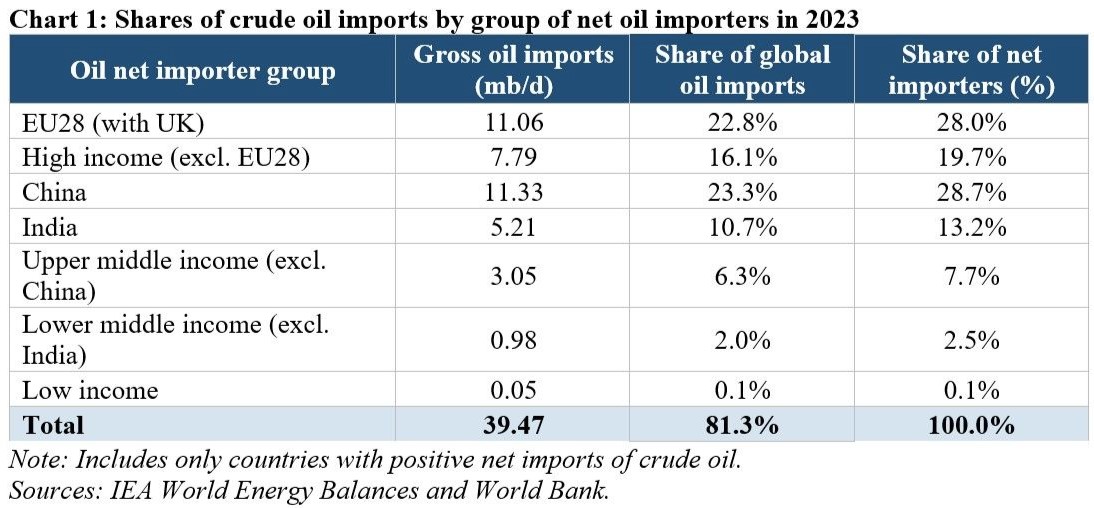
The European Union should take the lead. Accounting for 23% of global crude oil imports (Chart 1), the EU28 alone have substantial buying power. They demonstrated as much during the last crisis, when they imposed a European emergency gas-price cap. But this time the shortfall is larger, and oil is more fungible globally, so it would be important for other net importers to join. More participants will make for a more powerful mechanism.
The EU should aim, first and foremost, to bring in other high-income countries that are major refiners of imported oil—notably, Japan, South Korea, and Singapore. Since low- and middle-income countries have few means for outbidding their high-income counterparts on global oil markets, they have every incentive to participate.
If China—the world’s largest oil importer, accounting for 23% of the total—also decided to join, the importers’ club would have the market cornered. In 2023 (the latest year for which the International Energy Agency provides complete global data), net importers purchased slightly more than 80% of globally traded crude oil. This means that, together, net importers could effectively act as a monopsony—like a monopoly, but on the demand side. All net importers of crude oil would immediately benefit from lower prices.
EU-China coordination also would send a powerful geopolitical message, demonstrating the EU’s ability to conduct an independent foreign policy. If China did not join, the EU would have a rare opportunity to take the lead in forming a meaningful global alliance that includes Global South countries—no small feat for a bloc that has been struggling to find its place in a world of intensifying superpower competition.
The buyers’ club should cap oil prices for physical delivery at a level that would still be very attractive for exporters—say, $100 per barrel. (For comparison, Sri Lanka recently paid $286 per barrel of oil delivered, and European buyers are now paying $150 per barrel of North Sea crude.) As for allocation, because low-income countries account for only 0.1% of global imports, they should be allowed to maintain their pre-war import levels. All other countries would reduce their imports by the same share: if about 25% of global exports are missing, a 25% reduction in pre-war imports should be agreed.
Refiners in the club would be prohibited from making windfall profits and required instead to sell onward with margins prevailing in non-war times to domestic buyers and to other club members, thereby preserving the capped price for refined products like diesel and liquefied petroleum gas. It is important that club members commit to maintaining pre-war levels of refined-product exports. The alternative—acquiring oil at low cost thanks to everyone’s participation, but keeping a larger share for themselves—would cause the club to break down. The buyers’ club could be extended to refined oil products imported from outside its members.
Countries with positive net exports of crude oil could also be enticed to join the club, strengthening it further. For starters, crude exporters that import substantial volumes of refined oil products, such as Angola and Ecuador, might want to secure the lower price afforded to club members. More broadly, exporters might want to anchor domestic oil prices to the club price, thereby preventing higher domestic fuel prices from hurting local consumers. If the buyers’ club also introduces a price floor—say, $65 per barrel—oil exporters who join would enjoy more stability going forward. The floors could be written into long-term supply contracts.
The buyers’ club would protect livelihoods, limit inflation, and help contain recessionary pressures. It would also deliver fiscal savings, which could be invested in the swift expansion of low-cost, low-carbon alternatives. Renewable-energy deployment and electrification should be accelerated. Public transportation should be made free. Domestic energy-saving schemes, which ensure the fair allocation of scarce resources, should be democratically legitimized and designed in ways that guarantee basic needs and the viability of industrial systems.
The buyers’ club does not create the shortages; they are there anyway. The club is a mechanism for spreading the cost more equally, building solidarity among importers, and preventing costly bidding races while the emergency lasts.
Amid a crisis of multilateralism, an oil buyers’ club might seem utopian. But the idea is not new. A similar scheme for allocating raw materials was implemented for allied countries during World War I. A multilateral oil buyers’ club is precisely the kind of bold initiative that countries need to weather the current crisis—and that the world needs to strengthen preparedness for future shocks.
For the EU, leading an initiative built on distributional fairness would amount to more than good economic policy. As the world order crumbles, it would strengthen the bloc’s position as a global power that stands for peace and cooperation.
*Isabella M. Weber, Associate Professor of Economics at the University of Massachusetts Amherst, is Climate Policy Fellow at the Roosevelt Institute and the author of How China Escaped Shock Therapy: The Market Reform Debate (Routledge, 2021). Gregor Semieniuk is Associate Professor of Public Policy and Economics at the University of Massachusetts Amherst. Copyright: Project Syndicate, 2026, published here with permission.
We welcome your comments below. If you are not already registered, please register to comment
Remember we welcome robust, respectful and insightful debate. We don't welcome abusive or defamatory comments and will de-register those repeatedly making such comments. Our current comment policy is here.