
By Chris Trotter*
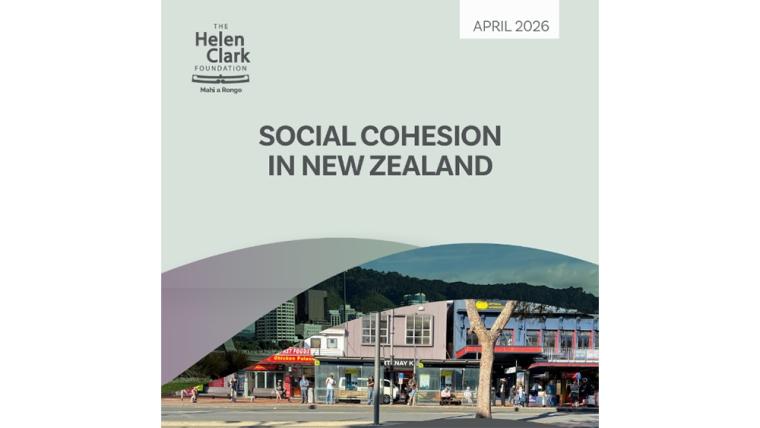
More than one in ten New Zealanders believe that their country’s political system is failing and should be replaced. This is easily the most dramatic statistic to emerge from the Helen Clark Foundation’s second report on Social Cohesion in New Zealand.
One can only speculate about how the former revolutionaries of the Socialist Unity Party (SUP) would react to this news.
“If only ….”, perhaps?
For the serious revolutionary, ten percent-plus of the population calling for root-and-branch change is an excellent starting point. For the quarter-century that the trade-union-based, Moscow-aligned, SUP engaged with the New Zealand political system (1966-1991) it was never able to count on such a large potential audience.
The Marxist-Leninists of the SUP operated in that period of post-war New Zealand history characterised by rising living-standards, full-employment, historically high levels of home ownership, and a succession of “bourgeois” governments which generally strove to deliver on the promises their respective parties had printed on the tin.
Trying to coax a revolution out of working-class New Zealanders raised in these circumstances was a near-impossible ask. Even members of the SUP who had been hosted by and travelled throughout the “Soviet Bloc” many times would, when pressed closely, concede that if they had to choose where to live, then they would choose New Zealand over any of the countries of “actually existing socialism”.
Ironically, it was during the last five years of the SUP’s existence, 1984-1991, that the seeds for a catastrophic collapse of social cohesion in New Zealand and the emergence of a potentially revolutionary fraction of the population were sown.
Had the ideological rigor of the Communist Party of the Soviet Union, fatally undermined by the reforms of Mikhail Gorbachev and collapsing completely following the entire Soviet system’s implosion in 1991, endured to stiffen the sinews of the SUP’s leaders, then New Zealand’s recent political history might have taken a very different course.
As events unfolded, however, not only did the Soviet Union and its antipodean satellite the SUP blip off the screen in 1991, but so, too, did the working-class-led New Zealand trade union movement.
When Bill Birch and his advisers were drafting the Employment Contract Bill in the run-up to the 1990 General Election, they fully anticipated having to give away up to a third of its clauses.
So radical was the Bill that its National authors were fairly certain that the union resistance it was bound to generate would be forceful enough to cause the Government to back-off and offer a compromise. So weak was the response of the Council of Trade Unions, however, that in spite of massive street demonstrations against the Bill, the government was able to pass it into law more-or-less unchanged.
Stripped of effective trade union representation and protection, the New Zealand working-class which, thanks to Rogernomics, had already lost the representation and protection of the Labour Party, simply disappeared from the New Zealand political stage.
What passed for trade unions in the aftermath of the Employment Contracts Act were the largely middle-class state-sector unions comprised overwhelmingly of well-credentialled and well-paid public servants. It was the interests of these “workers” that the Labour Party was now electorally-driven to defend.
From this richly fertilised soil the seeds of social incohesion, sown by the effective dismantling of the post-war social-democratic state between 1984 and 1991, sprouted and grew into the bitter harvest described in the Helen Clark Foundation’s report.
It is important to note that the 11 percent of the more than 2,000 respondents who favoured root-and-branch reform of New Zealand’s political system represent only the end of a much broader spectrum of discontent. In the words of the Report:
“Only 12% of New Zealanders believe the system of government works fine as it is, down 4 percentage points from 2024. 37% believe it needs minor changes, 33% believe it needs major changes, and 11% believe it should be replaced entirely.”
Just under half (44 percent) of New Zealanders believe that their system of government is in need of a major shake-up. Most of this angry and dissatisfied fraction of the population fall into the category of, to use a favourite political cliché: “doing it tough”.
Indeed, material security and general satisfaction with the political system are (entirely unsurprisingly) closely intertwined. This socio-economic relationship also works in reverse. Material insecurity breeds political dissatisfaction.
With material insecurity now driving the political responses of nearly half the population, the full failure of Labour’s and National’s neoliberal experiments stand exposed. What both of the major parties have been extraordinarily successful in accomplishing, however, is the profound and enduring disempowering of its principal victim, the New Zealand working-class.
In this regard Labour, by preventing the permanent alienation of the working-class component from its electoral coalition, has played by far the most important role.
An astonishing number of workers and their families continue to vote for the Labour Party. Their dogged loyalty bearing testimony not only to the enduring power of deeply embedded political myths, but also to the Labour Party’s skill at eliminating all serious electoral rivals to its left.
National’s contribution to the three-decade-long exclusion of working-class interests from the nation’s political discourse has been its skill at presenting the working-class as the “other”.
In the 1930s, the overwhelming majority of the New Zealand population was of European ethnicity. While this demographic picture persisted, questions of social and economic equality could not be avoided by the insertion of ethnic and cultural distractions.
By the 1990s, however, the nation’s blue collars were increasingly found around brown necks. The deeply embedded racism of New Zealand’s settler society made it easier to ignore these brown-skinned casualties of neoliberalism. National’s line of attack on the issues of welfare and crime made it easy for conservative voters to dismiss “these people” as their own worst enemies.
With poverty increasingly presented as self-inflicted, the idea that it was the rest of society’s responsibility to “do something” about social injustice and inequality found significantly fewer supporters than it had it the days of Michael Joseph Savage’s “applied Christianity”.
The upshot, according to the Helen Clark Foundation’s latest report is a society divided into three parts:
“The experience of social cohesion is not uniform. We found three distinct groups: 30% are connected, who experience high cohesion across all dimensions; 41% are ambivalent, who experience middling cohesion and low participation; and 28% are alienated, where they are disconnected from traditional civic and social connections, but are often engaged in protest, online and other activities.”
Any self-respecting Marxist-Leninist will be smacking his lips about now! A tenth of the population ready for root-and-branch change. A quarter feeling “alienated” and “disconnected” from the existing socio-political infrastructure and who are ready to engage in protest and “other activities” on the streets.
What the report is describing here is a container of petrol and a box of matches.
Worse, two-fifths of the the population, ambivalent about the wisdom of continuing to back the status quo, appear to be one serious government blunder away from striking a light.
Since it's April, let’s recall the Irish Easter Rising of 1916. The ambivalent Irish majority, still loyal to the British Crown were initially disposed to condemn the “mad Fenians” who caused the destruction of a perfectly good Central Post Office. But then the English, as only the English can, miscalculated. They bound the wounded James Connoly to a chair and shot him, along with 15 of his comrades, in Kilmainham Gaol.
This is how the great Irish poet, William Butler Yeats, summed up the consequences of that serious Government blunder:
I write it out in a verse—
MacDonagh and MacBride
And Connolly and Pearse
Now and in time to be,
Wherever green is worn,
Are changed, changed utterly:
A terrible beauty is born.
There is evidence in the Report that here in Aotearoa-New Zealand, 110 years after Yeats’s poem, a terrible beauty may also be emerging.
Among all the New Zealanders surveyed by the Helen Clark Foundation, which group demonstrated the strongest sense of belonging? In spite of all the obstacles placed in their path, it was Young Māori. Fully 87 percent of Māori under-30 reported a sense of belonging.
Change would appear to be coming. Big change. Change the SUP of the 1980s would neither have understood, nor sanctioned. As a working-class trade unionist from Timaru once quipped: “The SUP would rather keep control of the losing side that lose control of the winning side.”
Terrible? Beautiful? Both at the same time? Regardless of the face it presents, the New Zealand Revolution, if it is to qualify as a revolution at all, will have to be home-grown.
*Chris Trotter has been writing and commenting professionally about New Zealand politics for more than 30 years. He writes a weekly column for interest.co.nz. His work may also be found at http://bowalleyroad.blogspot.com.
We welcome your comments below. If you are not already registered, please register to comment
Remember we welcome robust, respectful and insightful debate. We don't welcome abusive or defamatory comments and will de-register those repeatedly making such comments. Our current comment policy is here.