
By Chris Trotter*
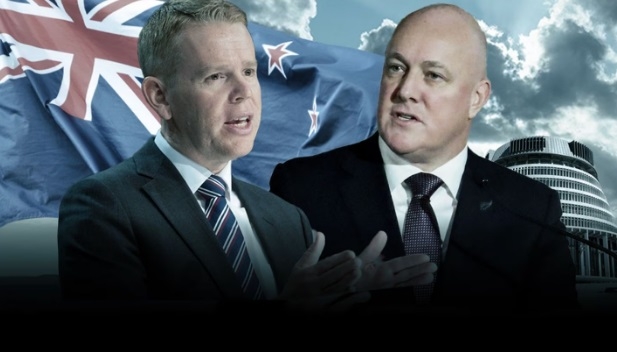
Wayne Brown started it, Liam Dann thought it was a good idea, Audrey Young started allocating portfolios. What is it about the idea of bringing together National and Labour in a “Grand Coalition” that turns otherwise shrewd commentators into naive fantasists?
The central attraction of a Grand Coalition lies in its implied promise to take the politics out of politics. The central assumption fuelling this attraction is that there is more which unites the two major parties than divides them. Remove this assumption and the absurdity of the Grand Coalition proposition is laid bare.
In mitigation of the fantasist assumptions of political commentators who should know better (Yes, Matthew Hooton, I’m looking at you!) some concession should be made for the fact that this blurring of political differences is made much harder to resist when one’s understanding of politics is almost entirely formed by the behaviour of professional politicians.
Because these beings are indeed very similar. Almost all of them are drawn from the professional-managerial class – that is to say they are tertiary educated, well-remunerated, and socially secure – and the overwhelming majority of the people they interact with; staffers, public servants, lobbyists, journalists; are the same. Fundamentally, these people share very similar life experiences.
More importantly, this sameness extends to how most politicians define the realm of the possible. Key ideas about economic and social policy are shared by just about everybody who participates in the political arena. The only parties attempting to operate outside this broad policy consensus are the Greens and Te Pāti Māori.
The rhetorical attachment of the Greens and Te Pāti Māori to ideas well outside “mainstream thinking”, and their dismissal by “mainstream politicians” as non-serious political players is far from accidental. To insist that the world can be run according to principles substantially different to those that have guided global policy since the 1980s is to court accusations of either heedless eccentricity or conscious mendacity.
More bluntly, the “mainstream” dismisses the Greens and Te Pāti Māori as either mad or bad. Usually both!
This rush to dismiss the parties unwilling to acknowledge and/or embrace the orthodox reveals a great deal about the ideological predisposition of those favouring a Grand Coalition. The very idea of Chole Swarbrick, or Debbie Ngarewa-Packer, seated at the Cabinet Table appals mainstream commentators. Indeed, the participation of such radical voices in any discussion of serious economic and social policies is perceived as illegitimate.
“Fringe” parties participating in Parliament is one thing, but those same parties participating in Government, well, that is something else altogether.
The argument that parties representative of either minorities with a clear claim upon the conscience of the nation, or of a size too big to be ignored by any truly democratic politician, should, nevertheless, be excluded permanently from wielding executive power cannot be construed as anything other than authoritarian.
Only an authoritarian would insist that unorthodox ideas be rigorously excluded from all consequential policy debates on the spurious grounds that other participants may end up being convinced of their arguments.
Historically, this dog-in-the-manger approach to political power is most closely associated with the reactionary forces restored to power following the defeat of Napoleon Bonaparte in 1815. By suppressing every emancipatory movement and silencing its adherents, however, the Ancien Regime was conceding the battle of ideas without a fight. Exclusion and suppression is what governments do when they have run out of arguments.
Those advancing the proposition of a Grand Coalition are doing so in wilful blindness to the fundamental socio-economic inequalities which free-market capitalism produces.
There is a very good reason why nation-states like New Zealand are dominated by two major political parties. Societies like ours are divided between those in possession of material security and social status, and those who are lacking in both.
The nineteenth century British prime minister Benjamin Disraeli (who was also an accomplished novelist) understood the evolution of British capitalism very well and grasped the crucial importance of adapting his Conservative Party to its social consequences. In his 1845 novel Sybil; or, the Two Nations he has one of his leading characters spell them out:
“Two nations; between whom there is no intercourse and no sympathy; who are as ignorant of each other’s habits, thoughts and feelings, as if they were dwellers in different zones, or inhabitants of different planets; who are formed by a different breeding, are fed by a different food, are ordered by different manners, and are not governed by the same laws […..] The RICH and the POOR.”
As the right to vote was extended ever more widely across these emerging industrial societies (including colonial New Zealand) the parties representative of Disraeli’s “two nations” gained an ever-sharper focus. Revolution was avoided by the parties of the rich promising to govern for the whole nation, and by the parties of the poor undertaking to keep the capitalist system intact.
The result was what might best be called “one nation democracy”: a political system geared towards keeping the gap between the rich and the poor as narrow as possible, and to enlarging public participation in the nation’s social and political life.
The point to emphasize here is that “one nation democracy” is unachievable without two parties.
The inescapable social and economic inequalities of the capitalist system, if they are not to generate a violent rupture, require constant political expression. The rich need to feel protected, and the poor need to feel they have a chance. Those feelings will never find acceptable representation in a government composed of politicians who believe that technocratic management can magically make all the contradictions disappear.
I find it impossible to believe that Wayne Brown, Liam Dann, Audrey Young and Matthew Hooton, whose experience of matters political and economic is vast, are not aware of the unhealthy consequences of Grand Coalitions – everywhere.
In Germany, the recourse to this form of prophylactic governance by the two main parties (a description less-and-less applicable to both the Christian Democratic Union and the Social-Democratic Party) has not tamed the extremes of left and right. On the contrary, it has only made them larger, hungrier for power, and much more likely to let democracy itself go down the plughole with the two big parties’ exclusionary bathwater.
The Irish example cited (at length) by Audrey Young offers an even bleaker picture.
To more-and-more Irish citizens the behaviour of the Grand Coalition of Fianna Fail and Fine Gael is being interpreted as a conspiracy against the essence of the Irish nation. Secure in their confected parliamentary majority, the governing political duopoly has initiated and overseen an unmandated demographic revolution.
The consequences of the Grand Coalition’s mass immigration policies have been dire. Rioting, arson, ethnic hatred, rampant political polarisation: such are the fruits of Ireland’s technocratic managers. Fruits that Audrey Young is suggesting should be transplanted to New Zealand soil.
The psychological impact of political homogenisation in general, and of Grand Coalitions in particular, usually boils down to: “Fool me once, shame on you. Fool me twice, shame on me.”
One has only to contemplate the events of the weekend just passed in the United Kingdom to obtain some measure of what happens to a country when the “two major parties” so betray their supporters that they find themselves abandoned en masse by voters in pursuit of stronger, more intoxicating political brews.
Disraeli was right, capitalism does indeed create two nations. Which is why any refusal to recognise that reality of “the RICH and the POOR” in the electoral configuration of our representative democracy can only endanger its long-term survival.
In the end, the cannot be only one.
*Chris Trotter has been writing and commenting professionally about New Zealand politics for more than 30 years. He writes a weekly column for interest.co.nz. His work may also be found at http://bowalleyroad.blogspot.com.
We welcome your comments below. If you are not already registered, please register to comment
Remember we welcome robust, respectful and insightful debate. We don't welcome abusive or defamatory comments and will de-register those repeatedly making such comments. Our current comment policy is here.