
sign up log in
Want to go ad-free? Find out how, here.

Labour finance spokesperson Barbara Edmonds says the only tax policy Labour will campaign on is its capital gains tax

Public Policy / news
Labour finance spokesperson Barbara Edmonds says the only tax policy Labour will campaign on is its capital gains tax
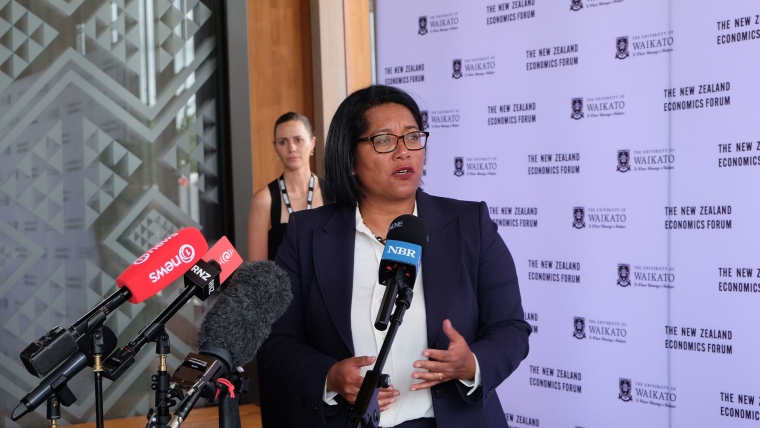
Barbara Edmonds speaks to reporters.
Labour's finance spokesperson Barbara Edmonds. Image source: Mandy Te

The only tax policy Labour will campaign on is its 28% capital gains tax on residential and commercial property, Labour’s finance spokesperson Barbara Edmonds says.

On Sunday, the Green Party released its election year tax policy, saying it'll; "make sure the super-rich and big corporations contribute their share, reduce tax on salaried and waged workers, and fund the critical social services we all rely on.”

Some of the Greens’ proposed tax policies include an inheritance tax and returning the corporate tax rate to 33% from 28% for big corporations like energy companies, banks and supermarkets.

Alongside this, the Greens put forward a proposal to introduce a bank levy of 0.06% on the liabilities of banks who have more than $100 billion in liabilities [ANZ NZ, ASB, BNZ and Westpac NZ] and enforce a 5% withholding tax rate on the profits that big tech companies like Google, Microsoft, Facebook, Uber, Visa and Mastercard send offshore.

When asked by interest.co.nz on Monday what Labour’s stance on the Green Party’s other proposals - like the bank levy and raising the withholding tax rate for big tech companies - was, Edmonds said: "Labour has committed to one tax policy: a simple targeted capital gains tax, which nine out of 10 New Zealanders will not pay.”

In October, Labour announced it would campaign on a 28% capital gains tax on residential and commercial property. 

Labour's capital gains tax proposal would exclude family homes, farms, KiwiSaver, business assets, inheritance, and other valuables.

“Every dollar raised will be ring-fenced for health, including a new Medicard providing three free doctor’s visits a year for everyone."

“The Greens can speak to their own tax policy, but Labour's been very clear that a simple, targeted capital gains tax is the only tax policy Labour will campaign on," Edmonds said.

Her comments echo that of Labour leader Chris Hipkins who, following the Greens’ announcement on Sunday, said Labour would not support a wealth or inheritance tax, according to RNZ.

"We're keeping it simple and we won't be supporting things after the election that we've made very clear before the election that we won't support."

'Hunger Games policy'

Speaking to reporters at National’s annual conference on Sunday, leader Christopher Luxon called the Green Party’s tax policy “crazy.”

He said it was not what New Zealand needed and it would put a “wrecking ball” through the country’s economy.

ACT leader David Seymour called the Greens’ tax policy a “Hunger Games policy.”

Seymour said New Zealand needed more wealth, more successful companies, more millionaires and more billionaires.

“For every billion-dollar company built on blood, sweat, tears and imagination, there are jobs, opportunity, and the inspiration that some Kiwi, somewhere, can build the next one.

“For every small business that takes a chance, employs another person, and serves more customers, there is risk. People who use the mortgage on the home where their children sleep to employ others don’t deserve to be whacked even harder by the taxman. If Government takes more when their risk taking succeeds, fewer people will take the risk. We will all be poorer, thanks to this Hunger Games policy."

We welcome your comments below. If you are not already registered, please register to comment

Remember we welcome robust, respectful and insightful debate. We don't welcome abusive or defamatory comments and will de-register those repeatedly making such comments. Our current comment policy is here.

9 Comments

Once the system is set up, how do we know it won't creep? 

Up
3

I'm creeped out by it already.

Up
8

The prospect of gigantic and complex asset registers is what does my head in. A bonanza for accounting firms. 

Up
2

The Green tax policy seems to be at odds with the small business sector, where to transfer a private family enterprise between generations, that's in the capital-intensive business of making real, physical products, is going to get clobbered by its valuation.

And that Labour won't announce tax policy beyond a CGT announcement, that was forced by a leak some months ago, doesn't inspire confidence.

Up
5

In New Zealand,

fewer than half of small businesses survive their first five years

, and only about a quarter to 30% are still operating after a full decade. [1]

The attrition rate is steep, typically tracking as follows:

  • Year 1:

    Around 86% survive.
  • Year 2:

    60% to 70% are still operating.
  • Year 5:

    Fewer than 50% make it past their five-year mark.
  • Year 10:

    About 27% to 30% are still standing.

    [1, 2, 3]

97% of NZ businesses are classified as small

https://www.mbie.govt.nz/business-and-employment/business/support-for-b…


Up
2

Not quite sure what point you're trying to make. Most enterprises here are cottage industries and employ most of the people working in the private sector.

A portion of the companies formed are special purpose vehicles - companies formed to do specific things like a particular property development project and insulate the master developer from liability - and get wound up when their purpose is served.

Up
2

Why would anyone be concerned about CGT or inheritance tax if your business is highly unlikely to survive 10 years.....you will have siphoned any advantage off long before the business is wound up.

Up
5

But what of the 30% that remain, that were set up for the long term and succeed as part of capitalism's creative destruction?

Many will strive but only the best make it, and get-rich-quick short termism is a disease in NZ that has severely damaged efforts to diversify our economy.  

I've worked in NZ startups that have gone from three guys in a garage to employing 400+ people in less than a decade, and others that have been in business for decades and employ in excess of a thousand people. 

They tend to be the long term employers, are profitable and therefore pay tax, and if they are doing something real the capital intensity can be very high. That increases the company's valuation, even if return on capital can be not that great.

People keep companies private for a number of reasons, not least of which is being enslaved to shareholder dividend expectations that undercuts development. 

Half a dozen people in a CNC or additive machine shop can easily have several million dollars of equipment. What happens if that passes to the next generation? Are they expected to take an unsustainable loan to pay a tax bill? It reads as penalising risk taking and success. 


Up
0

The 30% that remain are not typically your capital intensive start ups that have grown from 3 guys in a garage to employing 400+....if they were they would no longer be a SME.

A business such as you describe will be generating sufficient income to meet its obligations above depreciation ...assuming it stays domiciled in NZ, which they seldom do even now.


Up
0