
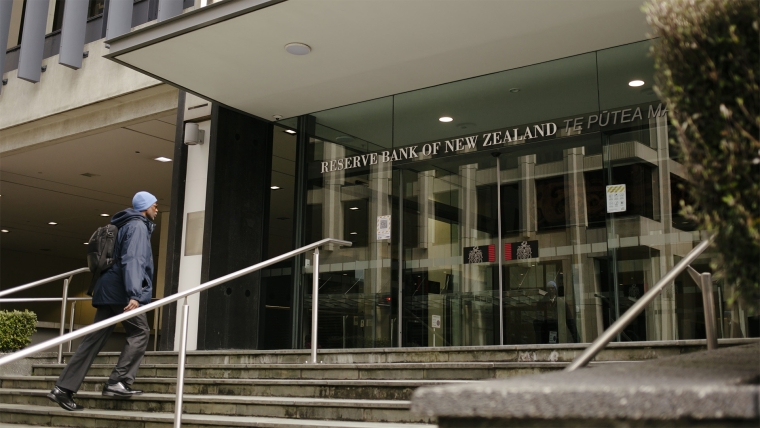
A government commissioned independent review of the Reserve Bank's monetary policy response to the Covid-19 pandemic says it started well but lost its way, and should have been quicker to stop stimulating the economy.
The review was launched by the Government in February this year and is being released some five years after the pandemic's peak. Finance Minister Nicola Willis said in February the review's purpose was to identify lessons New Zealand could learn to improve monetary policy response for future major events.
The review was done by Athanasios Orphanides, former governor of the Central Bank of Cyprus and former Reserve Bank (RBNZ) assistant governor David Archer. They note that while Consumers Price Index (CPI) inflation surged to a 32-year high of 7.3% in 2022, unemployment fell to an "unsustainable historic low" of 3.2% in late 2021.
The review makes 12 recommendations and notes; "unprecedented macroeconomic support and its unexpected effectiveness, together with resilience on the part of households and businesses, generated a stronger recovery than the MPC [RBNZ Monetary Policy Committee] was expecting."
“As inflation accelerated away from [the RBNZ's 1% to 3%] target, [the] MPC decided to stop adding stimulus, but without sufficient urgency. The real policy interest rate – rarely discussed in MPC communications – continued to decline, and reached historic lows, even after the MPC communicated withdrawal of stimulus and hikes in the nominal Official Cash Rate (OCR)."
A real interest rate is the nominal, or stated, interest rate with the rate of inflation removed from it.
“As a result, the economy overheated to an historically extreme degree. Inflation rose as far as 7.3%, 5.3% above target, and the unemployment rate fell to 3.2%, an unsustainable historic low, necessitating a costly reduction in economic growth and employment to restore stability," the review said.
“With regards to monetary and fiscal policy interactions, with the benefit of hindsight, the combined stimulus, while appropriate in the early stages, was too strong for too long.”
The RBNZ itself has conducted research into the costs and benefits of its Large Scale Asset Purchases (LSAPs), which it used in 2020 and 2021 as monetary policy stimulus after the OCR was cut to 0.25%. The RBNZ bought $53 billion worth of government and local government bonds on the secondary market via the LSAP, with the plan this would lower borrowing costs to households and businesses by injecting money into the economy.
But Willis called the RBNZ review “a window dressing exercise” saying it had marked its own homework.
Orphanides and Archer noted the pandemic threw up huge challenges. They called the MPC's initial response “praiseworthy" and "rapid."
"For New Zealand, innovative monetary accommodation was provided," the review said.
The review pointed out that the early adoption of a “least regrets strategy” helped get ahead of the potential for a “compounding collapse” and the rollout of the LSAPs “prevented [bond] market dysfunction from becoming part of the problem.”
Alongside an “equally impressive [government] fiscal response”, the RBNZ’s policy actions gave the NZ economy “a timely and much-needed boost”, the review said.
LSAP 'later contributed to excess demand'
But “unprecedented macroeconomic support and its unexpected effectiveness, together with resilience on the part of households and businesses, generated a stronger recovery than MPC was expecting," the review says.
With concern about downside risks, the review said it took a full year for policy to adjust to the reality that the initial economic stimulus had already achieved the intended result.
“Unexpectedly positive incoming data were discounted, and upside risks to the inflation outlook downplayed.”
“Negative Interest Rate Policy (NIRP), a powerful and flexible tool, was inexplicably not ready for implementation. Some new policy tools were, later, rushed into action with insufficient forethought," the review also pointed out.
The uncertain environment had made it difficult for the RBNZ to recognise that enough stimulus was in place, the review said, which led to the central bank expanding the scale of LSAP “beyond what was needed.”
“As a result, what began as a useful tool, later contributed to excess demand.”
The review also pointed out that “several guardrails” had been lowered by the RBNZ and Parliament before Covid-19.
“The law was altered to introduce a dual mandate, adding scope for discretion and guiding the MPC to focus less on price stability.”
This refers to the addition of maximum sustainable employment to the the RBNZ's monetary policy targeting alongside inflation.
“The Bank curtailed systematic scenario analysis, previously used to widen the decisionmaker’s field of view. In the design of the new MPC’s operating arrangements, an opportunity was missed to encourage diversity of thought – instead a preference for consensus decision-making and united external communication was chosen.”
'Vulnerabilities in policy strategy were the main factor'
The review said: “A core element of our message is that policy framework vulnerabilities that are modest in normally uncertain times can and did allow policy mistakes in times of great uncertainty."
"A different group of intelligent people, under the same framework, would risk making the same mistakes. Rather than data limitations or the absence of hindsight, we argue that vulnerabilities in policy strategy were the main factor.”
The review makes 12 recommendations:
- The MPC should develop a monetary policy strategy “that addresses unknown vulnerabilities and is more robust to uncertainty” than in the period under review
- The MPC should formulate monetary policy in a more “systematic manner and rely less on discretion than observed in the period under review. Constraining discretion is key to successful inflation targeting”
- “Greater emphasis should be placed on real interest rates” with the reviewers saying “the Monetary Policy Statement (MPS) should include real OCR paths implied by the nominal OCR paths and the associated inflation projections”
- Near-term inflation developments should be more in focus
- The MPC should agree on the specification of the policy rule in the forecasting model “for reasons of consistency in the preparation of forecasts and greater transparency on discretionary adjustments to policy”
- Prescriptions from one or two simple rules selected for their “robustness characteristics in the New Zealand context should be presented in the MPS for the current and next quarter. This serves as a crosscheck on current policy”
- Renewed focus on scenarios is welcome
- Alternative Monetary Policy (AMP) instruments should be periodically reviewed and tested to ensure continuing operational readiness for implementation in an evolving financial landscape.
- When forecasting or constructing scenarios, “endogenous fiscal responses to significant economic developments should be allowed for”
- MPC should “institutionalise evaluation of a broader distribution of plausible policy paths”
- The RBNZ should “allocate sufficient resources to support the effective functioning of the MPC, including policy research and analysis to support diverse perspectives in policy deliberations”
- Section 121 and 208 of the Reserve Bank Act should be re-evaluated as it “creates risks to monetary stability”. The review says: “The RBNZ Board should not have the authority to refuse to implement the MPC’s monetary policy”
The Government has commissioned more policy work from the Treasury over institutional issues around Section 121 and 208 of the Reserve Bank Act that Archer and Orphanides pointed out were constraints.
While these sections weren’t in force during the period Archer and Orphanides were looking at, the review said “for the benefit of ensuring that monetary policy has the necessary capacity in future such episodes, it is worth asking what would have happened if either had been in force.”
‘Important we learn those lessons and do not repeat mistakes of the past’
Willis said the review showed the RBNZ "was too slow to take its foot off the accelerator when the economy recovered more strongly than expected."
“The review concludes that the initial response to the pandemic from the RBNZ’s MPC was appropriate and effective, but monetary policy stimulus remained in place too long," she said.
The review’s recommendations are primarily for the RBNZ and the MPC and focus on strengthening monetary policy decision-making under uncertainty, Willis said, and she expected the RBNZ to consider the recommendations report publicly on its response.
“The Government also acknowledges the review’s recommendations around the interaction between financial governance and monetary policy and will consider further advice,” she said.
“The COVID-19 pandemic constituted an unprecedented economic shock. It has taught New Zealand some painful lessons. It is important that we learn those lessons and do not repeat the mistakes of the past," said Willis.
RBNZ Chairman Rodger Finlay welcomed the review's findings.
“On behalf of the Board, I welcome the findings of the independent review. The Governor and wider Reserve Bank team will carefully consider the review report and use its insights to help inform future practice,” Finlay said.
RBNZ Governor Anna Breman said the review’s findings would be carefully analysed by officials, noting the RBNZ has already undertaken a number of actions in response to lessons from the 2020-2022 period.
"The independent review offers additional insights that we will carefully consider alongside this work. Its findings could help inform improvements across the Bank, including initiatives underway to strengthen our modelling infrastructure and work in support of our 2028 advice on the Monetary Policy Committee Remit," said Breman.
We welcome your comments below. If you are not already registered, please register to comment
Remember we welcome robust, respectful and insightful debate. We don't welcome abusive or defamatory comments and will de-register those repeatedly making such comments. Our current comment policy is here.