
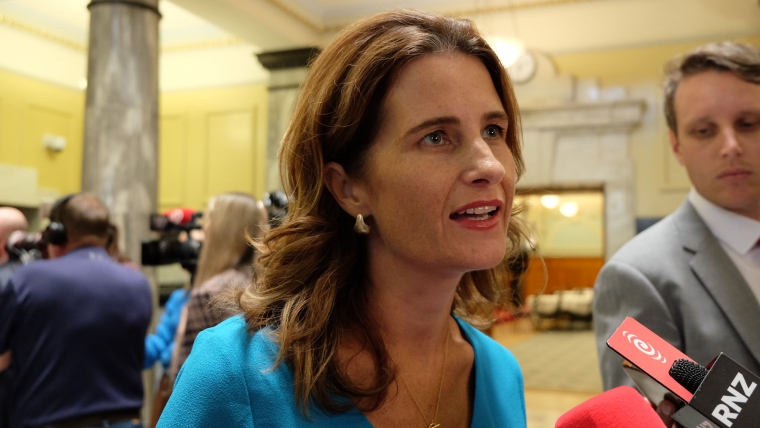
The Government is launching an independent review of New Zealand's monetary policy response to the Covid-19 pandemic.
On Wednesday, Finance Minister Nicola Willis said the purpose of the review is to identify any lessons the country could learn to improve monetary policy response to future major events.
“The Reserve Bank of New Zealand [RBNZ] took unprecedented action in response to the Covid-19 pandemic."
"This included reducing the Official Cash Rate to 0.25%, and the use of additional monetary policy tools, including a Large Scale Asset Purchase (LSAP) programme," Willis said.
“These actions helped to preserve jobs and keep businesses afloat, but the indirect impacts included decades-high inflation, and losses of about $10.3 billion on the LSAP programme and a significant spike in asset values with house prices increasing 30% in one year.
“The purpose of the review is to learn from experience."
The independent review will focus on "decisions by the [RBNZ] Monetary Policy Committee (MPC), and analysis provided by the Reserve Bank to support those decisions", Willis said.
"This includes MPC decision making and communication, the use of additional monetary policy tools, and the coordination of monetary and fiscal policy.”
The independent review will be done by Athanasios Orphanides and David Archer.
Orphanides is a former governor of the Central Bank of Cyprus, member of the Governing Council of the European Central Bank, and a professor of the Practice of Global Economics and Management at the Massachusetts Institute of Technology.
Archer is a former Reserve Bank assistant governor and former head of the Central Banking Studies Unit at the Bank for International Settlements.
The review is expected to be done in August and publicly released in September.
Speaking to reporters on Thursday, Willis said the Reserve Bank went through "a window dressing exercise of doing their own review of what they've done and gave themselves essentially full marks".
"At the time in opposition, I was frank, I said 'they've marked their own homework. That's not good enough. If I was the Finance Minister, I would commission an independent review' and today, that's what I've done."
Willis said the timing was good because the Reserve Bank had a new governor, a "refreshed" board and a "refreshed" Monetary Policy Committee. "I can tell you they are open to examining these questions."
She said she thought it was important the Reserve Bank "be given a reason to reflect on the decisions that were made".
"And actually as the Finance Minister, that should I be put in a position in the future where there is a major economic event that requires monetary and fiscal response that I have appropriately learned the lessons of history."
LSAPs
In October, Reserve Bank chief economist Paul Conway made a speech about the use of alternative monetary policy tools at a Citi Australia & New Zealand Investment Conference.
Research released alongside the speech assessed the costs and benefits of the Large- Scale Asset Purchases (LSAPs), which were used in 2020 and 2021 as monetary policy stimulus after the Official Cash Rate was cut to its lower limit of 0.25%.
The LSAP programme, or quantitative easing (QE), saw the Reserve Bank (RBNZ) buy about $53 billion of Government and local government bonds from private investors to lower long-term interest rates and support borrowing during the pandemic. This decision was widely criticised after the Bank hiked rates to fight inflation, crystallising losses on its bond portfolio of roughly $10.5 billion.
But Conway said RBNZ research found the LSAP’s direct cost was offset by its indirect benefits. It first restored market confidence, then lowered long-term interest rates which held down the exchange rate and supported exports.
“By boosting economic activity during the pandemic, LSAPs increased government tax revenues. This higher revenue almost entirely covered the direct losses from LSAPs, leaving consolidated Crown debt virtually unchanged over the medium term,” he said.
Still, Conway said the policymakers would have preferred to use negative interest rates if that tool had been available in 2020. The research showed similar economic results as the LSAP but without a cost to the Crown balance sheet.
RBNZ’s research also showed the LSAPs did not contribute materially to the subsequent rise or peak in inflation, although broader policy reviews have found the central bank should have tightened policy sooner to fight inflation.
The International Monetary Fund came to a similar conclusion in 2023 research, and Former Governor Adrian Orr often defended the policy as being worth the cost.
Speaking to interest.co.nz in October, Conway said: “So the Reserve Bank bought the government bonds at scale to provide additional monetary policy stimulus once the Official Cash Rate hit its effective lower bound. And what I will say about those losses is that they’re very easy to quantify and they’re very easy to see … But the benefit of LSAPs is harder to see and harder to get a handle on."
"I think one of the most obvious benefits that you can see is that LSAPs kept wholesale financial markets operating over the pandemic," he said at the time.
“What we find is LSAPs, as pretty much anticipated by the Monetary Policy Committee at the time, they did lower longer term interest rates which got the currency to depreciate a bit more than it otherwise would. And they did generate additional economic activity which in turn, did stimulate tax revenue for the government.”
Conway said once those broader effects were taken into account, the increase in tax revenue largely offset those mark-to-market losses.
“I should say this is based on one model. This is just where we’re at. It’s not the last word, but it’s where we’re at.”
When asked if the central bank would consider LSAPs in the future if there was another pandemic-like event, Conway said “that’s absolutely where we’re at currently”.
But LSAPs are not a day-to-day thing, he said.
“You don’t just reach for your LSAPs when you want to stimulate your economy. You use the OCR for that. But in extreme conditions, our research to date shows that there’s clearly a need for having the capability to do LSAPs.”
We welcome your comments below. If you are not already registered, please register to comment
Remember we welcome robust, respectful and insightful debate. We don't welcome abusive or defamatory comments and will de-register those repeatedly making such comments. Our current comment policy is here.