
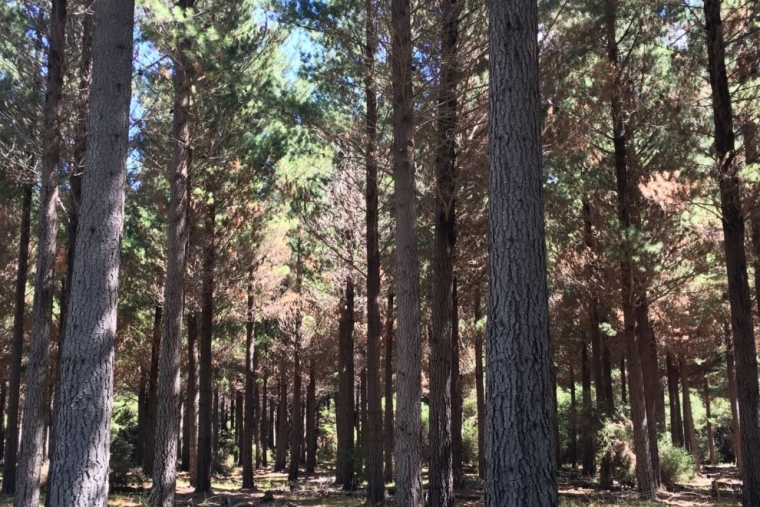
New Zealand’s Zero Carbon Bill is based on the assumption that carbon farming through forestry provides a climate-change solution, at least until the arrival of new technologies that allow New Zealand to move away from fossil fuels.
In contrast, Environment Commissioner Simon Upton has suggested that using forestry for carbon-dioxide offsets is not the away to go. He contends these should only be used to offset the shorter-lived agricultural gases.
The Government does not agree with Commissioner Upton for reasons that can be readily appreciated. Without carbon sinks provided by new forests, there are no big tools in the kitbag to get anywhere near zero carbon.
Accordingly, carbon farming of forests is going to remain of fundamental importance for as long as the Government is aiming to reduce net emissions of carbon dioxide. Some of the consequences have not been foreseen.
New Zealand already relies on forestry to reduce its net emissions of carbon dioxide. In 2017, forest sequestration of carbon dioxide was assessed at 24 million tonnes compared to gross emissions elsewhere in the economy of around 40 million tonnes. Note, here I am focusing just on carbon dioxide and not the other greenhouse gases. For a discussion on the specifics of short-lived methane go here.
The starting point for carbon farming is to recognise that credits can only be claimed for one rotation of trees, typically around 28 years under New Zealand conditions for radiata pine, or longer for slower growing natives.
At the end of the first rotation, the carbon credits that have been claimed throughout the growth cycle are a liability attached to the land title. This means that the land can in all likelihood never be used for any other purpose than carbon forestry. This is because the carbon unit liabilities associated with the previous carbon credits would have to be repaid based on current value thereof.
Whether or not it is actually worthwhile harvesting the trees at maturity time will depend on the value of sequestered carbon at that time relative to log prices, combined with specific rules relating to repayment of the carbon liability.
Until recently, carbon credits were seen as a nice little cash-flow earner during the growth cycle but the main game was still the harvest value of the logs. That is now all changing.
The key reason is that the value of carbon within the NZ Emission Trading Scheme has been increasing rapidly. In 2014 the price was well under NZ$5 per tonne. Right now, it is between $24 and $25 per tonne.
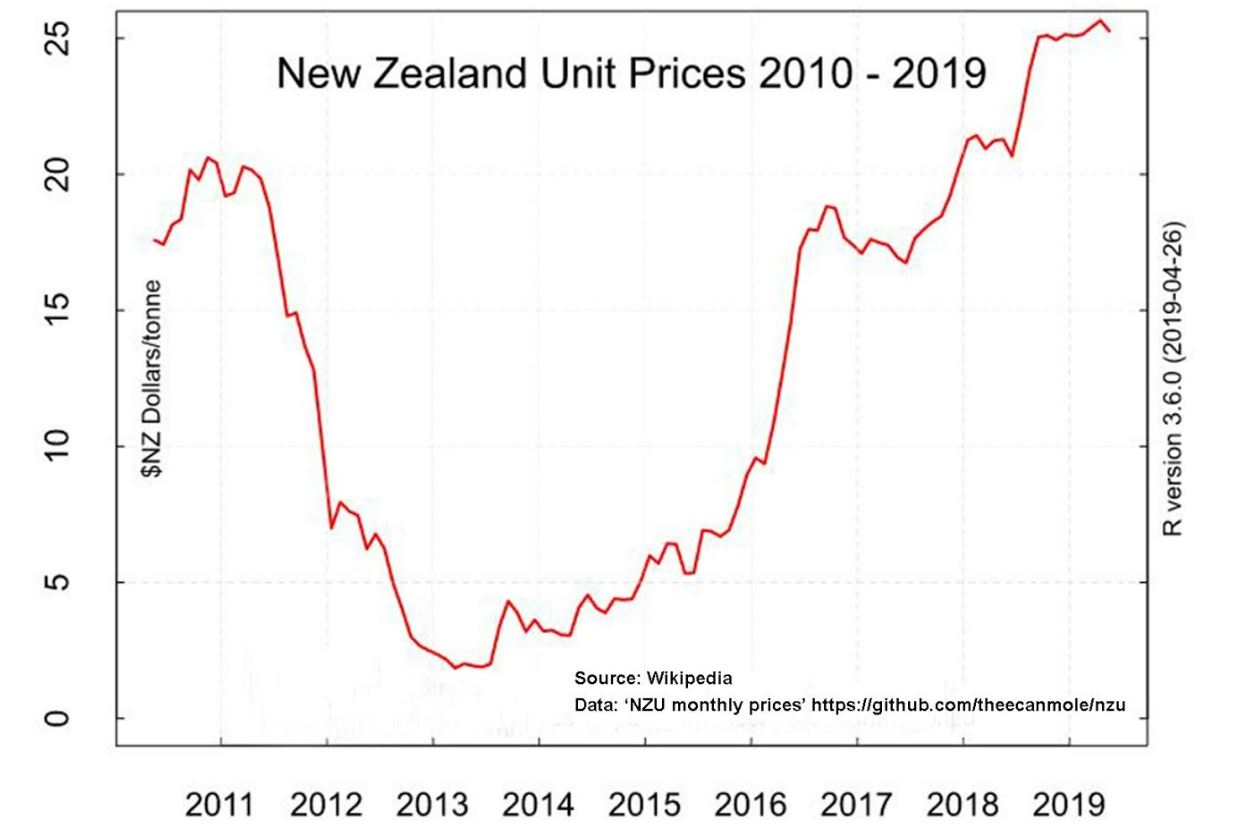
Under current legislation, there is a carbon price cap of NZ$25 per tonne, but there is a very good likelihood of this being removed within the next three years – that is the current Government plan. The price of carbon would then be likely to rise in line with rising international prices
The carbon price could in time go to $100 or even higher. Even if it only goes to $40 per tonne, or even less, then the forests may never be harvested. The EU price is already over $40.
Most of New Zealand’s forests have foreign owners. With current policy settings for ownership of forestry land, this foreign ownership will increase further. Here is the reason why.
For big foreign entities, the notion of having within their portfolios some New Zealand forests for carbon farming looks very attractive. As part of a balanced portfolio, any risks can be managed. In relation to the low returns on equities that can be earned elsewhere in the global economy, the returns look truly stunning.
An overseas entity can buy the land, plant it in trees, receive some Government subsidies, and then sit back and take the stream of income from carbon credits over the next 28 years. And then write off the original investment in the same way that a spent mine is written off.
If I were advising any such foreign entities, then that is exactly what I would be saying to them. Governments have set the rules, and now here is the opportunity to play the game.
Of course, it does not require me to tell them that. Their own advisers are telling them, and the game is now on.
At the end of the 28 years, the land can simply sit there, with its unharvested forest, with large carbon liabilities attached to it, and providing no further income to either New Zealand or anyone else. From the investor's perspective that is fine – it has served its purpose and been a great investment.
The option of harvesting the forest might still be considered, but in the context of a bonus. In any case, given that many new carbon forests, as a cost saving measure, will not be thinned or pruned, the harvest value may well be limited.
From New Zealand’s perspective, this does not seem quite so flash. In effect, New Zealand has had an initial benefit from the inward flow of funds to purchase the land, and then has spent the next 28 years paying the foreign owners for the forestry carbon credits to balance off its own emissions elsewhere in the economy.
As for future generations of New Zealanders, they will have some green trees to look at, but the land itself can no longer be used for anything because of the crippling carbon liabilities attached to the land title.
In debates about foreign ownership of farmland, it is sometimes claimed that the foreign owner cannot export the land. It is still here earning an export income for New Zealand. But in the case of carbon forestry, the foreign owner can effectively capture in one rotation the economic benefits in perpetuity.
Another key insight is the recognition that the equilibrium price of carbon needed to ensure that emitters change their behaviour is much bigger than the price required to make carbon forestry profitable. For example, at a carbon cost of say $100 per tonne, a motorist purchasing 1000 litre of petrol per annum would still see their costs only rising by about $5 per week and hence make minimal behaviour changes. That same price of carbon could see a liability attached to a hectare of mature forests of between $60,000 and $90,000.
So, what is the solution?
The first step it to remove the OIA exemption that allows foreign entities an automatic right to buy New Zealand farms as long as they put it into forestry. There needs to be a brake put on.
The second step is to place limits on the price paid for forestry carbon credits. That would mean keeping a cap on the selling price to the Government by forest owners for carbon credits, but could also mean the Government then selling those credits to emitters elsewhere in the economy at a higher price. That could be a nice Government earner.
The third step would be to pause and take a deep breath. Let’s quietly work through the hidden consequences and the solutions.
Now, all of this is going to be controversial. Given the conflicting interests of the various parties, it can be no other way.
*Keith Woodford was Professor of Farm Management and Agribusiness at Lincoln University for 15 years through to 2015. He is now Principal Consultant at AgriFood Systems Ltd. His articles are archived at http://keithwoodford.wordpress.com. You can contact him directly here.
52 Comments
Well said Keith. Many people only consider the 'here and now' argument to carbon zero and don't have on their radar what the 'Billion Trees' programme is potentially, really going to be leaving for our future generations. Just as NZ is supposed to reach Carbon Zero in 2050, if these carbon credit forests are simply left to rot and not felled and replanted, then what is the real legacy that will be left to future generations.
Unintended consequences, then eh?
- Unharvested plantations because the C liability > (net harvest value + replanting and tending costs)
- The unharvested plantations are mainly Pinus Radiata - not exactly the Glorious Native Cover that the cheerleaders may have been wishing for
- Osmosis effects throughout the 'carbon economy' if prices need to be capped or more generally diddled with
- The C credits are all effectively Exported - no different in economic terms to offshoring the interest or dividend flows from the four-pillar banks
Oh what a tangled Web we weave
When first we practise to Deceive.......
Why would an investor manage the asset in such a way that they can't retrieve the principal plus capital gains? If it's that crazy good an investment, won't the credit price rapidly sink?
And it seems like this would help: https://www.beehive.govt.nz/release/ets-revamp-averaging-accounting-for…
Battnz,
Yes, you are correct, and investors will be able to use the averaging system. By doing so, the earned carbon credits are reduced. These reduced carbon credits still run out at the end of the first rotation. Under the aeraging system, when the forest is harvested, the owner does not have to repay any credits but must replant.
Some investors will choose to do it this way, but others will choose to take the full credits because of the time value of money and a 'bird in the hand'. The preferred choice will depend on the investors chosen rate of discount and the carbon price.
No, the credit price is not likely to sink, but this will depend on how it is linked to international carbon farming.
Just like with mining of minerals, it is a different model. When an investor buys a mine, they are not looking for capital gain. They are looking for an annuity over the life of the mine. The net present value of this annuity determines the current capital value of the land on which the mine (or forest) sits.
KeithW
Thanks Keith, as far as I'm aware the averaging system will be obligatory from next year, so there won't be a "will be able" about it.
I still think that land and renewable resources aren't very much like a mine, however maybe the legislation encourages that thinking. Are you saying that after one growth cycle, subsequent replantings can never again generate NZUs?
Battinz,
Yes. subsequent plantings will only be able to generate NZUs if the previous lot were repaid.
If averaging is enforced, then presumably this would only be for forests that were designated as 'production forests'. There is no logic that I can see for averaging in regard to 'conservation forests'.
These are the sorts of issues why I argue, inter alia, for taking a deep breath and working through all of the potential unintended consequences
KeithW
Yes indeed. Planting forests is a bit like pouring concrete so thinking ahead is beneficial! The dual carbon price is probably inevitable on those numbers and maybe government should announce that the gap will only widen in future. Uncertainty in the pace and impact of climate change implies similar uncertainty around future regulation and taxation. Perhaps a brave announcement of that home truth is needed too.
There is also some suggestion that natural forests store more carbon than plantations:
https://www.sciencedaily.com/releases/2019/04/190402081533.htm
although it depends a lot on some assumptions. More research needed but if that turns out to be true a better price for diverse natural bush would then be justified. And maybe adjusted from time to time!
I was just joking with my kids a couple of days ago about how I was going to put trees in, claim the carbon credits for 25 years and leave them the mess to deal with then. People don't understand the credits only accumulate once. This is literally a one generation wonder and to hell with the next..
It's no surprise that carbon sequestration via forestry is wide open to gaming. Sure it's worse if the financial benefit of the carbon credits goes offshore but is it that great if NZers do the same thing?
It seems illogical to offset emissions from burning fossil fuels that are near permanent, to trees which have a life cycle of 30 odd years. Similarly, penalising cyclical carbon emissions like those from farming in the same way as fossil fuel emissions doesn't make much sense either.
Perhaps the carbon credits purchased by fossil fuel emitters should have a 30 year life-span. Then they would be required to buy another lot.
Yes, if they are still emitting fossil fuels then they will have to find a new forest to buy credits from
KeithW
Hi Keith, I don't understand why forestry land is limited to one round of trees. If the wood from trees remains in solid form, e.g. in cross-laminated timber for buildings, it is still sequestering carbon and the next round does the same. Then there's an incentive to use such materials rather high emitting materials like concrete and steel. Isn't that the point of an ETS?
This is the point I am stuck on as well. Can someone please answer this. Why is a forest only confined to one growth cycle. Why not after 28 years cut down the trees. Then either store them or use them for construction, then plant a whole new forest ready to suck new carbon from the atmosphere?
I thought my 30 year interest in climate change had taught me a thing or two. Thanks Keith for giving me another thing to think about.
How long will it take for the climate change warriors to grasp the one-off nature of forestry for storing carbon?
Worth reading for this "" a carbon cost of say $100 per tonne, a motorist purchasing 1000 litre of petrol per annum would still see their costs only rising by about $5 per week and hence make minimal behaviour changes"".
Carbon credits and the ability to sell and transfer them is just another major developed world scam. I had to deal with a competitor in the UK (they were endorsing themselves (at great cost to the carbon footprint of the world as they chopped trees down to post literature through doors). as a green marketing alternative to potential clients because they were considering buying carbon credits , (but no sign of purchase ever appeared on the balance sheet) - they were part of a carbon credit scheme/scam. Their business, selling real estate.. carbon emissions, just normal travel to houses from the office.
They once had a share price over 300p. Just checked and today it is less than 4p.
Oh and they were the biggest real estate firm by market cap just 4 years ago.
To use a Malthusian argument, it seems that we are going to be planting more and more farmland in trees, but our population is growing. We live by importing advanced goods from overseas and selling them food, farmland and Auckland houses in exchange. Sounds like a good plan, eh?
You just couldn't make this stuff up if you tried. No wonder the West is in decline.
Spot on. We exported our young people’s future and gave them some toys in return.
Not true. Our political and bureucratic class made poor decisions without our approval. High rates of immigration and inflation were imposed, our opinion has never been asked.
We were living beyond our means, and the tree-planting move was correct.
But not for harvest - we had cleared the land for the intrusive draw--down done by one species - us. We are biologically overshot (we did it on the fossil energy) and will reduce, or more likely collapse, our own numbers.
The biosphere cold do with more forest, and not Radiata Pine. And we have to re-evaluate 'wealth'. The chase for it is what has caused our existential problem. I have planted a sizeable non-Radiata forest, but claim no credits, purposely. It's my real pay-back for my impact on the planet - cannot do that financially; it cares little for $.
Covenant it if you want it to remain forested forever;
Why not claim the credits and use the money for further planting/environmental projects?
Are there any insurance companies covering natural events such as fire or flood that could hit these forests?
I'm not sure which bothers me the most. The annual dusting of pine pollen or logging trucks rumbling on the roads.
Hamish - Yes insurance for fire, floods and wind damage is available and not expensive. We have it and have made 2 calls on it for wind throw the biggest danger to forests.
I am not overly familiar with the structure of this but it appears to me that there is a glaring hole in the forestry carbon structure. KW identifies "The starting point for carbon farming is to recognise that credits can only be claimed for one rotation of trees, typically around 28 years under New Zealand conditions for radiata pine, or longer for slower growing natives." But is this not a fallacy? Growing trees captures carbon, that unless the trees are burnt, remains captured. So when a forest matures and is harvested if it is replanted then the cycle of carbon capture continues. For a mature forest, as the growth of the trees slows, then the rate of carbon capture would also slow. Thus I would expect that it would be desirable for the radiata forests to be harvested and new forests replanted? So why then are the credits recognised for one cycle only?
As to the liabilities, if they are placed against the land of a harvested forest, then surely that would then undermine the value of that land to any potential buyer, meaning that the land could be unloaded very cheaply, and the new buyer replant the forest?
I also seem to remember that it used to be law that any harvest pine forest had to be replanted. If I remember correctly it was Helen Clark's Labour Government who removed that law. Remarkably short sighted!
Murray86
Yes, the scheme is for capturing carbon and not retaining legacy foreests. However, for forests that are already in the scheme, there is a penalty for removal.
The logic of the scheme makes sense within the narrow confines of what is intended.
However, there is a separate logic for those who believe (correctly) that trees are the 'lungs of the world' that there should also be a retention scheme for the legacy forests bequeathed to us by our ancestors. In that case, there would be rewards for Indonesia and Brazil retaining their rain forests, and for Russia and Canada retaining their conifers. But it would be quite some challenge for the global bureaucrats to administer. However, environmental groups could make it happen in key areas of the world if they really wanted to
KeithW
I shudder at the opportunity for corruption that a global scheme would present for countries like Brazil, Indonesia and Russia. But putting that aside and just considering NZ, why is the legislation given such a short horizon? Surely replanting a harvested forest is a preferable outcome? An unharvested one or one that is not replanted are not desirable outcomes surely? Out the back of Whanganui I note that a lot of land that 150 years ago was native forest, then cleared for farming, and now placed in radiata forest (because that hill country it just too hard and not really economically viable for farming) and are currently being harvested. what is the future for that land? Erosion can cause significant issues as can the remnants from forestry operations (which can also make the land very dangerous). Reversion to native will take decades if not centuries and will be contaminated with wilding pines. So surely some form of regulation that requires a tructured plan post first-cycle forest is required?
If a forest is harvested then the liabilities will force the owners to replant. Depending on which specific carbon credits scheme they have chosen ( e.g full credits or reduced credits from so-called 'averaging', they may still have considerable repayments to make. And this may lead to non harvest as being the best alternative. Alternatively they may try to harvest and then simply abandon the land that now carries large liabilities. Challenging to stop this where the investor is registered in the Bahamas, and it declares its local subsidiary bankrupt. The complexities and uncertainties is what give the big overseas entities an advantage as they can spread the risks across a portfolio and can also afford the lawyers to fully educate themselves on pitfalls and best strategies. In contrast, lots of fish hooks for the unwary locals.
KeithW
Reversion to native can be achieved within 30 years - that timeframe is the subject of this documentary just released;
Yes, that's called payment for ecosystem services. It must be 20 years ago now that I first read of the concept and thought it was the best way to implement social equity across the globe. One could apply it to leaving ancient forests standing as well as leaving fossil fuels in the ground.
Yes, the notion of ecosystem services has been around for a long time. I used to cover it in a master level course in resource economics that I taught way back in 1979-1981. More recently, Professor Ross Cullen made it his specialty at Lincoln University. The concepts flow logically from Gareth Hardin's 'Tragedy of the Commons' way back in the 1968 (but without endorsing Hardin's specific solution) and even earlier in the economic concept of externalities. It would be technically much easier to create an ecosystems value system for forests than fossil fuels. At a practical level it would be much easier to implement through a give a little NGOs specifically set up to make it happen by purchasing tracts of land, rather than by Governments. I would quite like to one a one-millionth share of a specific piece of Amazon rainforest, or something similar in Indonesia. But it would have to be something very specific and tangible, where I knew exactly where my dollars were going.
KeithW
Hi Murray86 - One rotation is all you get and the land has to be replanted. I have a Pine forest 25 years old so have been exposed to the madness for years. The Clark/Cullen Government tried to NATIONALISE all Carbon Credits. We private forest owners paid to fight this in the courts, Roger Dickie ( a big name in forestry development ) devoted 3 years of his life to head this and won.
The new idea from the COL - the Jones boy - 'averaging system' has had the effect of adding instantly $10,000/hectare to potential forestry land. In the last 12 months bare land suitable for forestry in the Hawkes Bay has risen from $2,500/hectare to $12,000 + so the only people benefitting from this change is the land owners selling !
Another point of interest re Carbon credit history in NZ, after the Cullen/Clark back down there was a window where a forestry owner could buy cheap Credits from Eastern Europe before they where banned which is what we all did about a $1 each or less to satify the bullock requirements at that time. That meant our real NZ Credits could be keep and we have sold 50% of them in the last 4 years at an average of $23.50 each, it's all been a scam caused by Government interfering !
they are also buying better farms, taking good country out of production for a long long time.
A rational approach would be to convert old forests into charcoal that is then buried. There would be carbon losses doing this but the majority of the carbon would be removed from circulation. Forests to Coal. The forests could then be replanted for another round.
A rational approach would be to convert old forests into charcoal that is then buried. There would be carbon losses doing this but the majority of the carbon would be removed from circulation. Forests to Coal. The forests could then be replanted for another round.
The fallacy that emissions can be traded has always been a scam. You either reduce emissions or sequester carbon. No tree lives forever, it dies decays and carbon is released back into the atmosphere. If you are unlucky the decay process may produce methane that degrades to carbon. Politicians are easily seduced into thinking they can fix problems. Buying into Kyoto and Paris will lead to nothing but financial pain for NZ. I have trees and am opted out of ETS. Some carbon can be cycled by definition fossil carbon will take a hundred million years to be sequestered. The world will have to live or die as a result of the combustion of fossil reserves.
Trees stop absorbing carbon after 28 years ???
Yep - after that you trade in futures :)
The hardest part to grasp is that from a financial perspective any timber grown and/or harvested is just a byproduct. Keith's mine analogy is accurate. Forget the end value its all about the income.
Back of envelope calculation using current corporate interest rates and possible uplift to $40t carbon - the original investment can be fully funded and repaid within 15 to 20 years with another 15 to 20 years of significant free cash flowing. No wonder overseas investors are chasing our farms.
The OIA exemption is not an automatic right, it is a fast-track so an application does not have to be filed every time land is purchased.
A price cap from which the Government is exempt is hardly a free and fair market. The Government has announced an auctioning mechanism which fulfills some of the function that you are looking for.
Carbon and non-carbon forestry has had an IRR higher than dairy, beef, and sheep for some time now. The question is why farmers haven't been planting more already. Farmers do not have to sell land and can do it themselves. The windfall for farmers is that their land is now more valuable.
The land is not locked up unless it is entered as a permanent carbon sink; there is still the once a rotation cashflow from harvest. The unpaid ecosystems services (e.g. biodiversity, water management, nitrogen fixation) is higher for forestry than pasture so there is an environmental benefit regardless of species.
Find this whole area confusing, so excuse the question - but how does a carbon credit actually reduce carbon emissions - surely it is just another financial product used to "create a [non existent] market" and move money around - is it genuine? Shouldn't we just reduce emissions, not allow a polluter to keep polluting under the guise of having coughed up for a credit? and who actually pays the landowner the credit? So what is the water pollution credit system for example? or the over-fishing credit ?
"Shouldn't we just reduce emissions, not allow a polluter to keep polluting under the guise of having coughed up for a credit?"
That question has been answered emphatically by the green lobby with the latest bill. No and no. Unless your a livestock farmer.
It's a scam designed to make money out of being able to continue fossil fuel use. The worst part for me is the Greens seem to believe in it, I cant believe Rod Donald and Janette Fitzsimmons would have gone for this.
Totally correct Russell, I have argued against the ETS for years as being a bullshit answer to pollution. It is based a a piece of economic theory which in an idealised universe makes sense, but in reality is utter rubbish. Actually that is like most economic theory! What we need is regulation against pollution, and the polluters held accountable for it. But instead because the polluters are now rich having benefited from raping the ecology they now have the money to convince the pollies that they shouldn't be held to account and that the cost should be shared across everyone. So we all suffer the consequences, we all pay the price but few of us get the benefits!
russellj,
My response is specific to carbon farming.
It can have the same level of being genuine and having value as money has. It all depends on the credibility of the organisation that is operating the market. The idea is to reduce gross emissions (such as from driving a car that uses fossil fuels) through a carbon tax. So-called net emissions are further reduced if the tax money transfers to people on the condition they plant forests. The price of the credits is set by supply and demand, The other way to do it is to tax polluters directly at a price set by government regulations.
KeithW
If the objective is to cut emissions, then I'm not sure taxing polluters directly is the answer. Tax keeps going up on ciggies and booze and people keep buying both of those.
Keith - we need to do better than that.
The fossil energy was drawn from underground acreage - in terms of sunlit acre/years, we're chewing through a million years or ancient sunlight, every year. Sure, the deposits don't represent all collection-acreage, but the difference is orders-of-magnitude. And a seedling starts very small.
So there is no chance we even keep pace with what we emit, and less than zero chance we will address what we have already emitted. And the 'money' you reference, is only underwritten if the energy keeps on being extracted. No energy, no underwrite, 100%.
So a physical cap on emissions, and a societal discussion about 'trade' vs 'child poverty, etc' underneath that cap, is the only way. The current financial construct is history in that scenario, of course; you've just kissed goodbye to growth. But 'taxing' - while it may change behavior - cannot sort the physical issue. You simply crash the system which you are taxing.
PDK taxing won't change the behaviour of those who cause most of the problems because they can afford the tax. It'll affect everyone else of course, and the pollies will only find a way to cycle the money back to the polluters. the only solution is regulation and holding the rule breakers to account, heavily.
PDK,
The problem of a cap is the allocation problem. Who allocates the allowances and by what criteria? We currently have that for water rights and N leaching and it creates all sorts of gaming.
KeithW
Welcome to the problem of the next decade. You have to have a cap, that's what the real world is about.
Then we have to crack down on the gaming - not use it as an 'excuse not to'....
Only discipline - self and societal both - will get us through the next patch. I suspect them in high places knows this - listen carefully the Ron Mark tonight .....
Keith - Another potential unintended outcome will be farmers future attitude to capital reinvestment in their farms. With unplanted forestry and sheep and beef farms at similar values why would farmers continue to maintain their infrastructure? Good buildings, yards, fencing and water reticulation have nil value to a forestry owner. When your neighbour's rundown, falling down farm sells for the same per ha rate as a well run one why bother?
I understand some in banking are considering the possible ramifications for them of a changing attitude to farm maintenance and the possible impact on lending values.
Yes, these issues will sit alongside declining community infrastructure, particularly for remote communities
KeithW
". . . credits can only be claimed for one rotation of trees, typically around 28 years under New Zealand conditions for radiata pine, or longer for slower growing natives."
Out of idle curiosity, wouldn't that indicate that the maximum benefit over the maximum time is gained by planting natives?
Or do slower-growing natives attract a lower "per tree per year" value.
We welcome your comments below. If you are not already registered, please register to comment
Remember we welcome robust, respectful and insightful debate. We don't welcome abusive or defamatory comments and will de-register those repeatedly making such comments. Our current comment policy is here.