
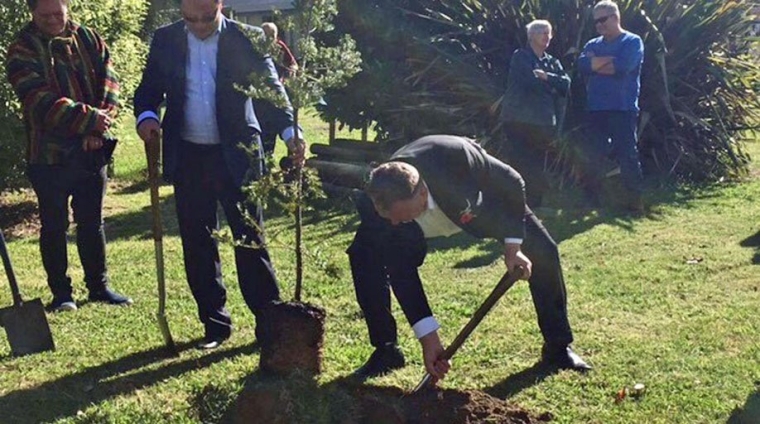
There’s an irony about the combination of the Provincial Growth Fund funded one billion trees programme, sheep and beef land being sold without needing Overseas Investment Office (OIO) approval for conversion to forestry, the sharp fall in Chinese log prices, and Shane Jones ranting about log traders being intoxicated by high prices.
According to Jones, these log traders should have supported the domestic timber processing industry, although it’s not immediately obvious how domestic sales would have compensated for log exports to China which exceeded $3 billion over 12 months.
The history of tree planting, well before it was seen as essential for meeting greenhouse gas reduction (GHG) targets, is no different from any other commodity. After an exciting start too much of anything inevitably provokes indigestion; think oil, dairy, sheep meat, wool, angora, alpacas, logs – you name it, there is always a cycle; the world may even turn away from New Zealand Sauvignon Blanc one day. China features strongly as a market which has a habit of dominating purchasing patterns, driving prices up before turning the tap off, although this was more of an issue when the state rigidly controlled all purchasing.
While Chinese demand for beef and sheep meat appears guaranteed because of the growth in the middle classes and a shortage of animal protein, meat exporters must be careful not to burn their bridges with the rest of the world. At least red meat exports to China are moving away from commodity supply towards meeting increasingly sophisticated consumer demand for added value product forms, although there is still the risk Chinese importers will switch to further processing at their end of the supply chain.
In contrast, logs are essentially a straight commodity with added value being limited to log type and specification. Lots of other countries have introduced tree planting programmes, so Jones’s scheme is not unique, nor is it clear where the markets for further processed timber will be developed. Without knocking the need for GHG reduction, it’s hard not to conclude it might have been a good idea to work out where the billion trees are going to find a home, admittedly in 30-40 years time. Estimates of the time for demand from China to recover fully range from weeks to six months to 10 years, so it’s clear nobody really knows.
It’s a bit rich for Jones to criticise those log traders for taking advantage of a ready market for trees which were planted a quarter of a century ago in the last great forestry boom, when Japan was the major market. As with other commodities New Zealand doesn’t have a large domestic consumption base, which means we must either export in raw form or find ways to add value before exporting. There are no commodity based businesses that can survive on the domestic market alone.
Jones is just another in a long line of politicians who invest large sums of taxpayer money into trying to get us to do something noble, otherwise known as altering behaviour or distorting normal market forces. In the case of GHG reduction, it is such an emotive topic politicians must be seen to take action, to appease both foreign governments and voters at home, as well as those who haven’t yet reached voting age, but are increasingly vocal. As an additional factor, the composition and modus operandi of our current government make it possible for a minority party to push its own agenda backed by taxpayer funds without proper oversight of the effectiveness of the investment.
Given a stable environment without sudden swings in incentive programmes the market usually gets things fairly right. Land and commodity prices respond to the relative demand between sectors reflecting, in New Zealand’s case, the international marketplace for what we produce and to a lesser extent changes in government policy. Since WW2 several key events have had a striking impact on the level of global demand for our exports and, as a consequence, land use. These events include among others: huge demand for wool during and after the Korean War, followed by an inexorable decline in wool prices, Britain joining the European Common Market, SMPs, removal of subsidies in 1985 causing collapse of sheep meat prices leading to growth of forestry in late 80s and dairy conversions since early 90s. The impact of free trade with a wealthy, modernising China and climate change are the two most important factors which currently present both opportunities and threats to which the sector must respond.
The most noteworthy change in land use during the last fifty years has been the conversion of sheep and beef farms to dairy, forestry, deer, grape and horticultural production, as well as urban sprawl. This has been driven by the returns obtainable from the conversions, all of which have been better than farming sheep and beef. Ironically, the effect of political pressure to encourage tree planting and a streamlined OIO approval process to attract overseas forestry investment coincides with the highest ever lamb prices in the international market.
While Shane Jones doesn’t give the impression he tolerates anything contrary to his world view, it would be helpful if he were to consider the unintended consequences of his headlong rush into forestry, as well as a careful look at where all these logs or added value timber will be sold. A look at past experience might be useful.
Current schedule and saleyard prices are available in the right-hand menu of the Rural section of this website. This article was first published at Farmers Weekly and is here with permission.
We welcome your comments below. If you are not already registered, please register to comment
Remember we welcome robust, respectful and insightful debate. We don't welcome abusive or defamatory comments and will de-register those repeatedly making such comments. Our current comment policy is here.